
Predicting Dementia in Veterans With a Brain Injury

Post by Anastasia Sares

The takeaway

In this study, the authors used health data from thousands of veterans to build a risk model for dementia and death after sustaining a traumatic brain injury (TBI). This is important for the care of veterans specifically, as well as our understanding of the long-term consequences of traumatic brain injury.

What's the science?

Longitudinal studies, where data is collected over many years, are critical to establishing the long-term health effects of different life experiences, such as brain injury. However, these kinds of studies are few and far between because running them is complex and expensive. Another way to assess long-term health outcomes is to search in medical archives or records and use that information to try and predict a person’s health over time. In other words, past and present medical data are used to create a model of health risks that can be used going forward. The model can tell us about how likely it is that a similar person will develop a health problem in the future.

Previously, models have been developed for the general population showing that traumatic brain injury (TBI) increases the risk of both death and dementia in the following years. However, there are certain populations where this risk may be higher or lower. For example, veterans may have combat-related experiences that could exacerbate the effects of TBI.

This week in Neurology, Barnes and colleagues developed a model to predict the risk of death and dementia after TBI, based on over 100,000 medical records. They focused on veterans and included an assessment about combat-related experience to understand how these factors influence the risk of death and dementia.

How did they do it?

The authors were granted access to a medical database containing information from medical visits of many veterans. For their sample, they specifically targeted older people (over 55), who had a TBI diagnosis between 2001 and 2019 (with no dementia at that time), and had at least one follow-up visit. They gathered demographic information as well as two key variables related to military service: whether the person had served in a theater of combat operations, and whether they had previously had an injury caused or worsened by their active service. As for outcomes, the authors divided the participants into 3 groups: people who died within 5 years of the incident, people who developed dementia in that same period, or people who survived that period without death or dementia.

What did they find?

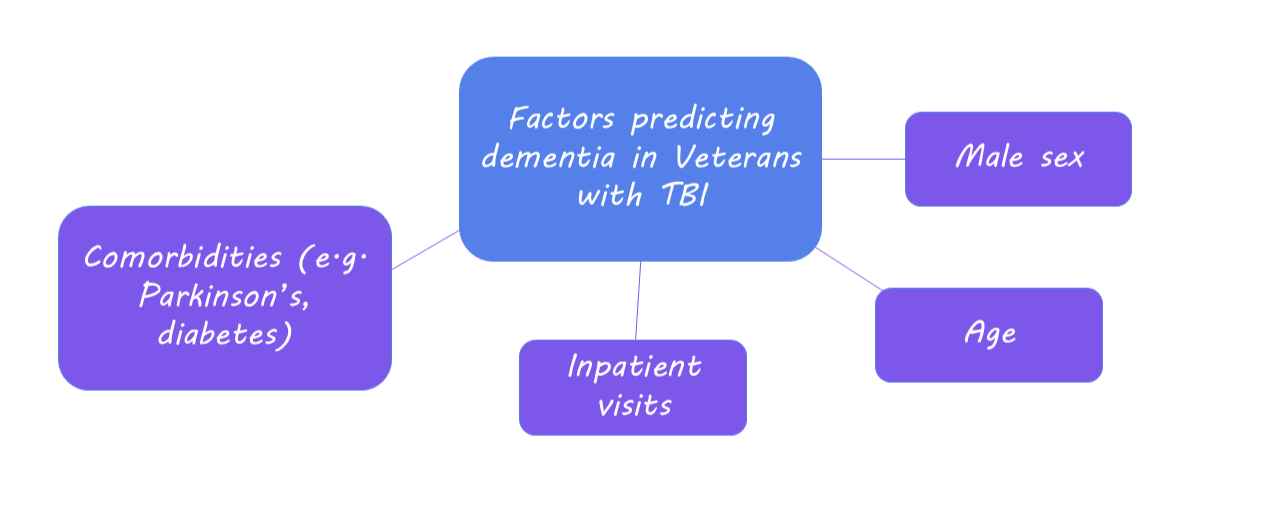
Of all the participants with TBI, 11% were later diagnosed with dementia, and 19% later died. The authors reported the hazard ratio to show how different factors influenced this statistic: how much more or less likely a person was to develop dementia or die. A hazard ratio of 1 means that there was no influence on the rate of dementia or death; a number above 1 indicates that these negative outcomes were more likely, and a number below 1 indicates they were less likely. As might be expected, age was a significant risk factor, with the hazard ratio increasing each decade of life, starting at 1.4 and climbing to 13.1. Having other conditions like Parkinson’s elevated the risk as well, with a hazard ratio of 3. Other physical and mental health conditions also increased the risk, with the hazard ratio between 1 and 2, depending on the condition. Older age and psychosis contributed more to the risk for dementia, while physical health issues and hospitalizations contributed more to the risk for death. The model performed fairly well in veterans with a service connection, veterans with combat service, and those with neither, indicating that these predictions generalize to a variety of TBI cases.
What's the impact?

The model developed in this study can be used to predict the risk of veterans developing dementia or other health complications in the future. This can help clinicians to be vigilant and suggest preventive care measures for those most at risk.
Access the original scientific publication here. 

Vascular and Immune Cell Disease Mechanisms in Neurological Disease

Post by Lila Metko

The takeaway

There is a link between cerebrovascular dysfunction (i.e., dysfunction in the blood vessels of the brain) and neurological diseases, yet how genetic variants in cerebrovascular cells influence the risk of disease is unknown. The authors developed a novel technology called MultiVINE-seq to understand how gene variants influence disease, and found distinct mechanisms associated with both cerebrovascular and neurological disease.

What's the science?

Over 90% of disease-associated genetic variants reside in non-coding regions of our genetic material. It is estimated that these disease-associated variants are active in a cell-specific manner. There is a clear relationship between cerebrovascular pathology and neurological diseases like Alzheimer’s disease; however, the genetic associations underlying these pathologies remain unclear. Currently, most of our knowledge on these genetic variants that influence disease risk is from investigating non-vascular cell types, due to the difficulty in recovering genetic material from vascular cell nuclei. This week in Neuron, Reid and colleagues developed a method for obtaining high-quality genomic data in vascular cells and integrated it with GWAS data to better understand how these genetic variants influence neurodegenerative disease mechanisms. 

How did they do it?

The authors processed prefrontal cortex samples from 30 post-mortem human brains. The samples were from individuals with conditions ranging from no cognitive impairment to dementia. The MultiVINE-seq processing required collagenase III, an enzyme that specifically digests collagen fibers, and loose-fit homogenization, a type of homogenization that reduces mechanical stress. From their output of genetic material, they determined which variants were in active regulatory elements by finding out which ones were in accessible chromatin regions, and overlapping snATAC-sequence data (which measures chromatin accessibility) with GWAS data. They correlated this information with pre-mRNA transcripts to determine which gene’s expression levels were most likely regulated by the variant-containing regulatory element. Finally, they grouped the genes for which variants likely affected each category of disease to see if there were any commonalities between genes in the same disease group. 

What did they find?

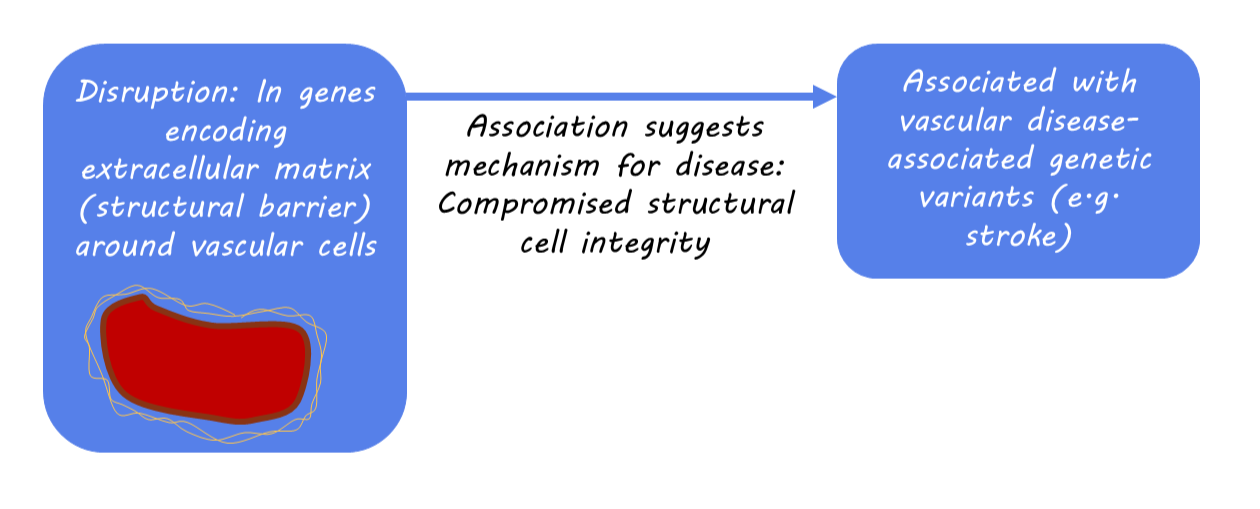
Variants associated with vascular diseases, such as stroke and aneurysm, were strongly associated with disruptions in extracellular matrix genes, which are responsible for the structural integrity of blood vessels in the brain. Thus, the vascular variants may contribute to a deterioration of the structural integrity of blood vessels, leading to leakage in the brain. Variants associated with Alzheimer’s disease were associated with proteins involved in the activation of immune cells and immune system signaling molecules. One Alzheimer’s Disease variant was specifically associated with regulating a protein, PDK2B, that is involved in the activation of T cells. T cells are a type of immune cell that destroys cells that contain pathogenic or foreign material. Further experiments showed that PDK2B and T cells were found near β-amyloid plaques. This suggests that this disease variant may weaken the brain’s immune response and ability to clear protein fragments, such as the material that builds up, forming amyloid plaques in the brain’s of people with Alzheimer’s disease.

What's the impact?

This study is the first to provide insight intot how disease-related non-coding variants in vascular and immune cells may contribute to neurodegenerative disease pathology. This is important because many neurological diseases are associated with deficits in neural vasculature or immune dysfunction. Having this information can equip scientists to better develop biomarkers or treatments for these disorders. 

Access the original scientific publication here.

Does Education Slow Cognitive Aging?

Post by Natalia Ladyka-Wojcik

The takeaway

Previous studies examining the link between education and cognitive decline in aging have yielded mixed results, often relying on small or single-country samples. In this large, multi-national cohort study, researchers found that higher education was associated with better memory performance and greater brain volume, but it did not protect against age-related neurodegeneration.

What's the science?

The relationship between higher education and cognitive function in aging remains a subject of debate. Although a substantial body of evidence has identified education as a major protective factor against age-related dementia in later life, the underlying mechanisms of this are unclear. Two prominent theories – the brain maintenance and cognitive reserve accounts – suggest that education can slow or postpone age-related cognitive decline. However, emerging longitudinal data challenge this view, showing that more educated individuals do not necessarily experience reduced cognitive decline over time. Instead, an alternative hypothesis posits that higher education provides an early-life cognitive advantage that persists into old age, without altering the trajectory of decline. This week in Nature Medicine, Fjell and colleagues examined a large, multi-national longitudinal dataset of memory performance and brain imaging to test whether education offers protection against cognitive aging.

How did they do it?

Addressing the relationship between education and cognitive aging requires large, diverse, and longitudinal datasets with sufficient statistical power. To test competing theories, the authors analyzed longitudinal memory scores in 170,795 participants over the age of 50, along with over 15,000 brain MRI scans from 6,472 participants across 33 Western countries. These data were drawn from large, population-based sources, including the Survey of Health, Ageing and Retirement in Europe (SHARE), which provided repeated measures of verbal episodic memory – a form of memory for specific events in time and space that is particularly sensitive to aging. The researchers also examined neuroimaging markers of cognitive decline, including intracranial brain volume and volume of memory-related brain regions such as the hippocampus and thalamus. To broaden the generalizability of their findings beyond WEIRD (Western, Educated, Industrialized, Rich, and Democratic) populations, they replicated their memory findings in an independent cohort from China, India, Mexico, and South Africa.

What did they find?

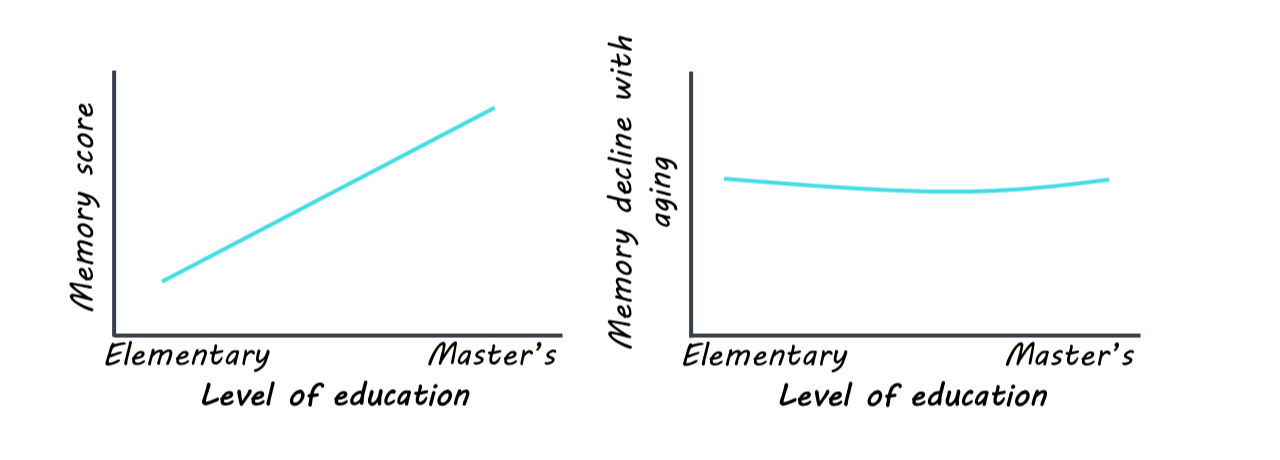
The researchers found that memory scores declined with age, consistent with expected age-related declines in episodic memory. Specifically, across the datasets analyzed, they observed a general pattern of higher memory scores among individuals with more education at all ages. Importantly, however, they found no evidence that higher education reduced memory decline or influenced repeated measures over time. To assess whether these results were specific to verbal memory, the authors extended their analysis to include tests of mathematical ability and temporospatial orientation within the SHARE cohort. For brain-based markers of aging, higher education was associated with greater intracranial volume and slightly larger volumes in memory-sensitive regions. However, the rate of decline in these brain regions was similar regardless of education level.

What's the impact?

This study is the first to show, using large-scale longitudinal data, that the commonly held view of education as a protective factor against cognitive aging lacks strong support. Instead, individuals with more years of formal education tend to begin adulthood with higher cognitive functioning, but they do not experience slower cognitive decline as they age.

Access the original scientific publication here.