
Predicting Dementia in Veterans With a Brain Injury
Post by Anastasia Sares
The takeaway
In this study, the authors used health data from thousands of veterans to build a risk model for dementia and death after sustaining a traumatic brain injury (TBI). This is important for the care of veterans specifically, as well as our understanding of the long-term consequences of traumatic brain injury.
What's the science?
Longitudinal studies, where data is collected over many years, are critical to establishing the long-term health effects of different life experiences, such as brain injury. However, these kinds of studies are few and far between because running them is complex and expensive. Another way to assess long-term health outcomes is to search in medical archives or records and use that information to try and predict a person’s health over time. In other words, past and present medical data are used to create a model of health risks that can be used going forward. The model can tell us about how likely it is that a similar person will develop a health problem in the future.
Previously, models have been developed for the general population showing that traumatic brain injury (TBI) increases the risk of both death and dementia in the following years. However, there are certain populations where this risk may be higher or lower. For example, veterans may have combat-related experiences that could exacerbate the effects of TBI.
This week in Neurology, Barnes and colleagues developed a model to predict the risk of death and dementia after TBI, based on over 100,000 medical records. They focused on veterans and included an assessment about combat-related experience to understand how these factors influence the risk of death and dementia.
How did they do it?
The authors were granted access to a medical database containing information from medical visits of many veterans. For their sample, they specifically targeted older people (over 55), who had a TBI diagnosis between 2001 and 2019 (with no dementia at that time), and had at least one follow-up visit. They gathered demographic information as well as two key variables related to military service: whether the person had served in a theater of combat operations, and whether they had previously had an injury caused or worsened by their active service. As for outcomes, the authors divided the participants into 3 groups: people who died within 5 years of the incident, people who developed dementia in that same period, or people who survived that period without death or dementia.
What did they find?
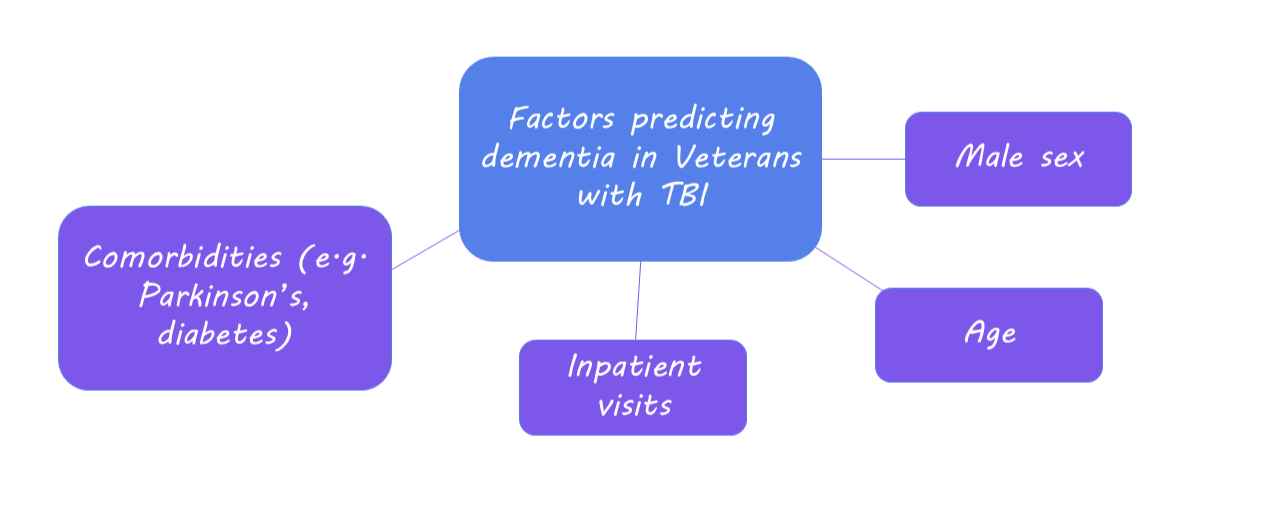
Of all the participants with TBI, 11% were later diagnosed with dementia, and 19% later died. The authors reported the hazard ratio to show how different factors influenced this statistic: how much more or less likely a person was to develop dementia or die. A hazard ratio of 1 means that there was no influence on the rate of dementia or death; a number above 1 indicates that these negative outcomes were more likely, and a number below 1 indicates they were less likely. As might be expected, age was a significant risk factor, with the hazard ratio increasing each decade of life, starting at 1.4 and climbing to 13.1. Having other conditions like Parkinson’s elevated the risk as well, with a hazard ratio of 3. Other physical and mental health conditions also increased the risk, with the hazard ratio between 1 and 2, depending on the condition. Older age and psychosis contributed more to the risk for dementia, while physical health issues and hospitalizations contributed more to the risk for death. The model performed fairly well in veterans with a service connection, veterans with combat service, and those with neither, indicating that these predictions generalize to a variety of TBI cases.
What's the impact?
The model developed in this study can be used to predict the risk of veterans developing dementia or other health complications in the future. This can help clinicians to be vigilant and suggest preventive care measures for those most at risk.