
Expression of Motor Neuron Embryonic Factors Increases Resilience to ALS Pathology
Post by Amanda Engstrom
The takeaway
As neurons mature, they become less resilient to insults, which impacts the progression of age-dependent neurodegenerative diseases. Re-expression of embryonic factors in postnatal neurons reactivates aspects of a younger gene expression profile and slows degeneration.
What's the science?
For many neurodegenerative diseases, aging is a major risk factor. This could be due to the loss of resilience in mature neurons compared to young neurons. Amyotrophic lateral sclerosis (ALS) is a progressive adult-onset degenerative disease specifically affecting motor neurons with no known cure. This week in Nature Neuroscience, Lowry, Patel and colleagues hypothesize that re-expression of embryonic motor neuron transcription factors, ISL1 and LHX3, in adult motor neurons could reactivate their “young” neuron state, increasing their resistance to the negative effects of ALS-causing mutations.
How did they do it?
To investigate the effect of postnatal expression of ISL1 and LHX3 (both transcription factors downregulated after birth), the authors performed post-natal Day 0 (P0) mouse injections of adeno-associated viruses (AAVs) expressing a transgene for either Isl1 or Lhx3 driven by ChatE (an enhancer for the Chat gene) so both proteins would be expressed in motor neurons continuously throughout adulthood. This resulted in 90% of CHAT expressing motor neurons in the adult lumbar spinal cord also expressing ISL1 and LHX3, though their expression did slowly decline over time. They performed single-nucleus multiome RNA and ATAC sequencing on motor neurons isolated from the mouse spinal cord, allowing them to compare the transcriptional changes and correlated changes in chromatin accessibility at the single-cell level. Lastly, the authors re-expressed ISL1 and LHX3 by P0 injection in the SOD1G93A ALS mouse model and assessed disease-relevant phenotypes.
What did they find?
Re-expression of ISL1 and LHX3 led to significant increases in expression of MNX1, a key embryonic target that is typically downregulated after birth. Using single-nucleus RNA analysis of the motor neurons, the authors identified three clusters corresponding to alpha motor neurons, gamma motor neurons, and type 3 motor neurons. Despite ISL and LHX3 expression in all three clusters, only alpha motor neurons and type 3 motor neurons had differential gene expression. Further, the differentially expressed genes identified in these two subtypes had little overlap. These data suggest that re-expression of ISL1 and LHX3 is not only specific to motor neurons, but also selective among motor neuron subtypes, and the effect is unique to each subtype. The changes in chromatin accessibility were also distinct between alpha motor neurons and type 3 motor neurons. However, in both cases, the top motifs enriched in upregulated peaks were Lhx3 motifs, similar to their accessibility during motor neuron development. To determine which genes were being altered, the authors compared the differentially expressed genes to the normal temporal expression profile of alpha and type 3 motor neurons. In both subtypes, there was an upregulation of genes normally expressed embryonically and early postnatally, while downregulated genes were most highly expressed in typical mature motor neurons. Taken together, these data suggest that despite the cell-type-specific differences in gene expression changes, the global effect of re-expression of ISL1 and LHX3 results in a less mature state in both alpha and type 3 motor neurons.
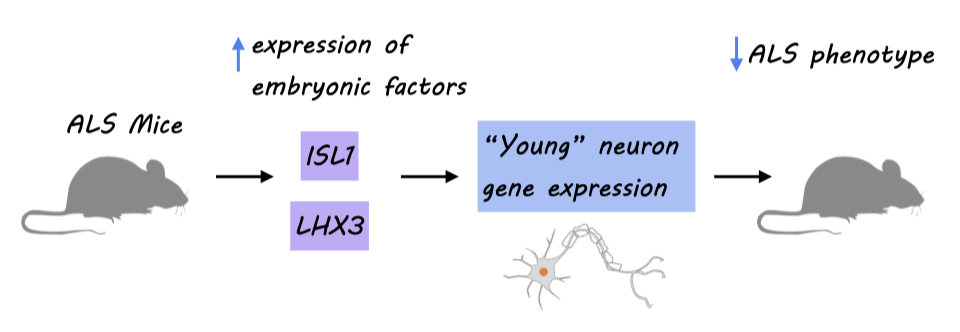
Two histological hallmarks of disease pathology in ALS mouse models are large, round aggregates of SQSTM1 round bodies and SOD1 vacuoles. The percentage of both SQSTM1 round bodies and SOD1 pathology was reduced in motor neurons with re-expression of ISL1 and LHX3 compared to those without. Treatment did not alter overall survival in ALS mice, but did delay the onset of tremors and increased the total number of CHAT+ motor neurons. The proportion of ISL1+ LHX3+ cells was increased at late stage timepoints, suggesting that sustained expression of ISL1 and LHX3 can preserve the health CHAT+ motor neurons.
What's the impact?
This study is the first to show that re-expression of ISL1 and LHX3 at an early postnatal stage can revert mature motor neurons to a younger state and reduce neuronal phenotypes in an ALS mouse model. This study provides a foundation for more targeted and biologically relevant reprogramming of mature cell types, increasing their resilience against age-dependent neurogenerative diseases.