
Brain Similarity Predicts Whether Strangers Become Friends
Post by Natalia Ladyka-Wojcik
The takeaway
Friendships are more likely to form and last between people who already share similar brain patterns in response to the world, even before they meet. These pre-existing brain similarities, beyond factors such as physical proximity or demographics, predict who grows closer over time, suggesting that deeper interpersonal compatibilities shape enduring social relationships.
What's the science?
Humans are thought to form social networks based on their resemblance to one another in demographics, behaviors, and preferences, a phenomenon known as homophily. Yet, past attempts to link social network closeness with inter-individual similarities in self-report measures of personality traits have yielded inconsistent findings. More recent research suggests that friends share similar feelings and thoughts about the world, which are mirrored by similarities in brain-based measures. However, because these studies are cross-sectional, they cannot determine whether brain similarity predicts a future friendship or instead emerges as people become friends and influence one another through shared experiences and environments. This week in Nature Human Behavior, Shen and colleagues aimed to test whether pre-existing similarities in neural responses to naturalistic movies among strangers could predict who would later become closer in a social network.
How did they do it?
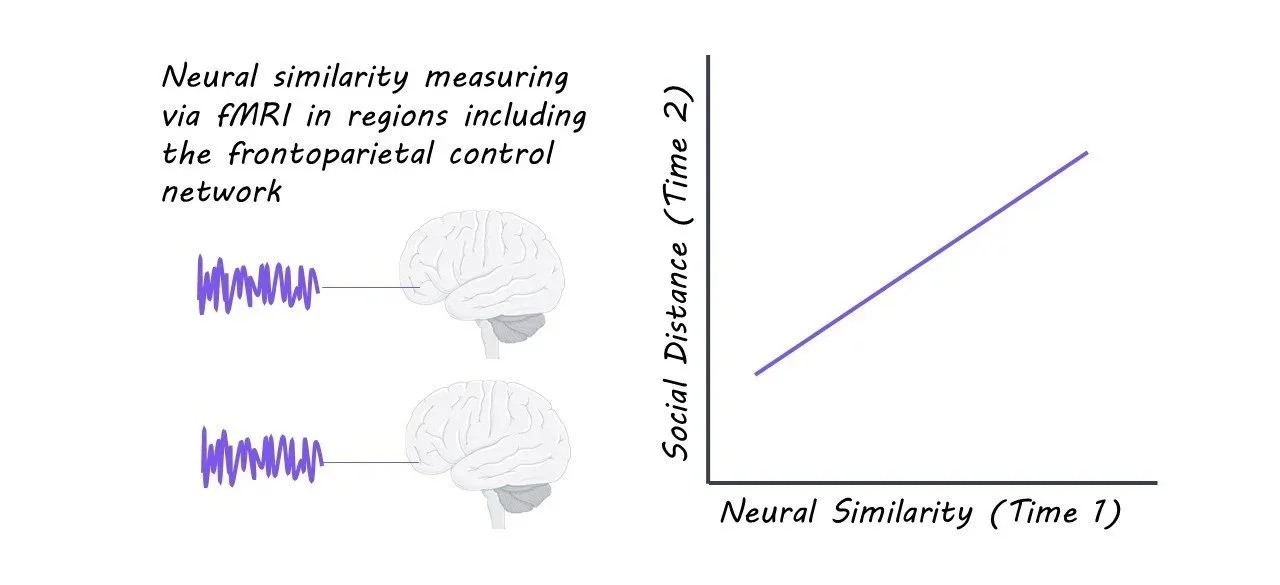
To determine whether similarities in brain activity predict who will later become friends, the authors recorded brain responses in a cohort of incoming graduate university students while they underwent fMRI scanning and watched 14 naturalistic movie clips. At later time points during the school year, the student cohort completed surveys reporting on their friendships, which allowed the authors to map out their social network. For each unique pair of participants, the authors calculated the correlation between their brain response time series at the start of the study in different brain regions, providing a measure of neural similarity, and the students’ social network positions two and eight months later, focusing on whether people who became friends had more similar brain activity than those who did not. The researchers also tested whether demographic factors like age, academic background, or shared interests predicted friendships more strongly, and whether enjoyment of the movies themselves could account for brain similarities.
What did they find?
The study found that people who later became friends, or who grew closer over time, tended to have more similar brain responses when watching the same movies before they had met. This effect was strongest in key brain regions of the frontoparietal control network, which has been linked to processing emotions, decision-making, and attention. Importantly, these similarities could not be fully explained by whether people simply enjoyed the movies or found them interesting. Whereas shared demographic factors like age accounted for some of the resemblance in brain responses between people, they did not explain the broader pattern observed in friendships that grew closer over time across the social network. Taken together, the findings suggest that friendship is shaped not only by shared backgrounds or interests, but also by deeper similarities in how people’s brains process the world around them.
What's the impact?
This study is the first to show that over time, strangers who exhibit similar brain responses for interpreting, attending to, and emotionally processing the external world are more likely to become friends and increase their social closeness.