
Does Education Slow Cognitive Aging?
Post by Natalia Ladyka-Wojcik
The takeaway
Previous studies examining the link between education and cognitive decline in aging have yielded mixed results, often relying on small or single-country samples. In this large, multi-national cohort study, researchers found that higher education was associated with better memory performance and greater brain volume, but it did not protect against age-related neurodegeneration.
What's the science?
The relationship between higher education and cognitive function in aging remains a subject of debate. Although a substantial body of evidence has identified education as a major protective factor against age-related dementia in later life, the underlying mechanisms of this are unclear. Two prominent theories – the brain maintenance and cognitive reserve accounts – suggest that education can slow or postpone age-related cognitive decline. However, emerging longitudinal data challenge this view, showing that more educated individuals do not necessarily experience reduced cognitive decline over time. Instead, an alternative hypothesis posits that higher education provides an early-life cognitive advantage that persists into old age, without altering the trajectory of decline. This week in Nature Medicine, Fjell and colleagues examined a large, multi-national longitudinal dataset of memory performance and brain imaging to test whether education offers protection against cognitive aging.
How did they do it?
Addressing the relationship between education and cognitive aging requires large, diverse, and longitudinal datasets with sufficient statistical power. To test competing theories, the authors analyzed longitudinal memory scores in 170,795 participants over the age of 50, along with over 15,000 brain MRI scans from 6,472 participants across 33 Western countries. These data were drawn from large, population-based sources, including the Survey of Health, Ageing and Retirement in Europe (SHARE), which provided repeated measures of verbal episodic memory – a form of memory for specific events in time and space that is particularly sensitive to aging. The researchers also examined neuroimaging markers of cognitive decline, including intracranial brain volume and volume of memory-related brain regions such as the hippocampus and thalamus. To broaden the generalizability of their findings beyond WEIRD (Western, Educated, Industrialized, Rich, and Democratic) populations, they replicated their memory findings in an independent cohort from China, India, Mexico, and South Africa.
What did they find?
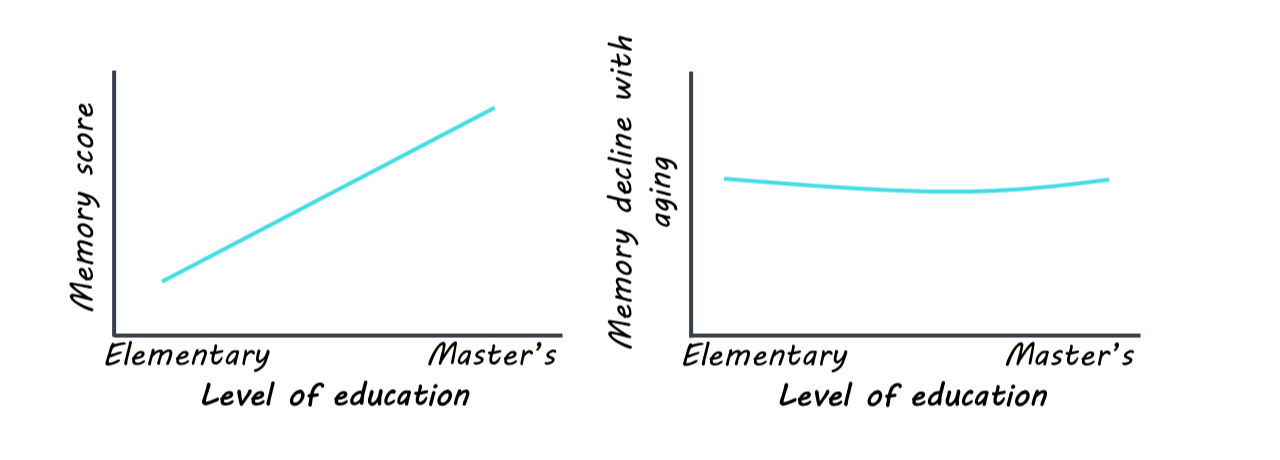
The researchers found that memory scores declined with age, consistent with expected age-related declines in episodic memory. Specifically, across the datasets analyzed, they observed a general pattern of higher memory scores among individuals with more education at all ages. Importantly, however, they found no evidence that higher education reduced memory decline or influenced repeated measures over time. To assess whether these results were specific to verbal memory, the authors extended their analysis to include tests of mathematical ability and temporospatial orientation within the SHARE cohort. For brain-based markers of aging, higher education was associated with greater intracranial volume and slightly larger volumes in memory-sensitive regions. However, the rate of decline in these brain regions was similar regardless of education level.
What's the impact?
This study is the first to show, using large-scale longitudinal data, that the commonly held view of education as a protective factor against cognitive aging lacks strong support. Instead, individuals with more years of formal education tend to begin adulthood with higher cognitive functioning, but they do not experience slower cognitive decline as they age.