
Can The Menstrual Cycle Impact Memory Processing?
Post by Rebecca Glisson
The takeaway
Hormones such as estradiol, the primary female reproductive hormone, can alter the number of inputs a brain cell receives from within the hippocampus, the memory center of the brain. When estradiol levels are highest during an estrous cycle (the mouse menstrual cycle), these brain cells have the most connections to other cells within the hippocampus, suggesting that higher estradiol is related to better learning and memory function.
What's the science?
Cells in the brain communicate with each other when a synapse (the end of one neuron) sends signals to a dendritic spine (the beginning of another neuron). The more dendritic spines there are on one neuron, the more inputs it receives and the more communication it has in turn with other neurons. This week in Neuron, Wolcott and colleagues explored whether the fluctuations of estradiol during the estrous cycle in female mice affect the density of dendritic spines within the hippocampus.
How did they do it?
To study the spine density of neurons in the hippocampus, the authors used a specialized microscope in combination with two-photon imaging, or used fluorescence to look specifically at the dendritic spines of cells. They first measured the concentration of estradiol in females in order to track each stage of the estrous cycle, which lasts 4-5 days in mice and has four different stages, similar to the human menstrual cycle. Estradiol is most concentrated just before ovulation in both humans and mice, which occurs during the proestrus stage in mice. In order to measure changes in the dendrites of neurons, the authors implanted a permanent glass microperiscope in the brain, since the hippocampus is found deep within the brain and is typically difficult to look at in live mice. They used mice that were genetically bred to have fluorescent cells in this area of the brain so that they could track changes in the dendrites of these cells. When new dendritic spines formed, the authors also tracked whether these spines were lost quickly afterwards or remained as a new, lasting part of the cell.
What did they find?
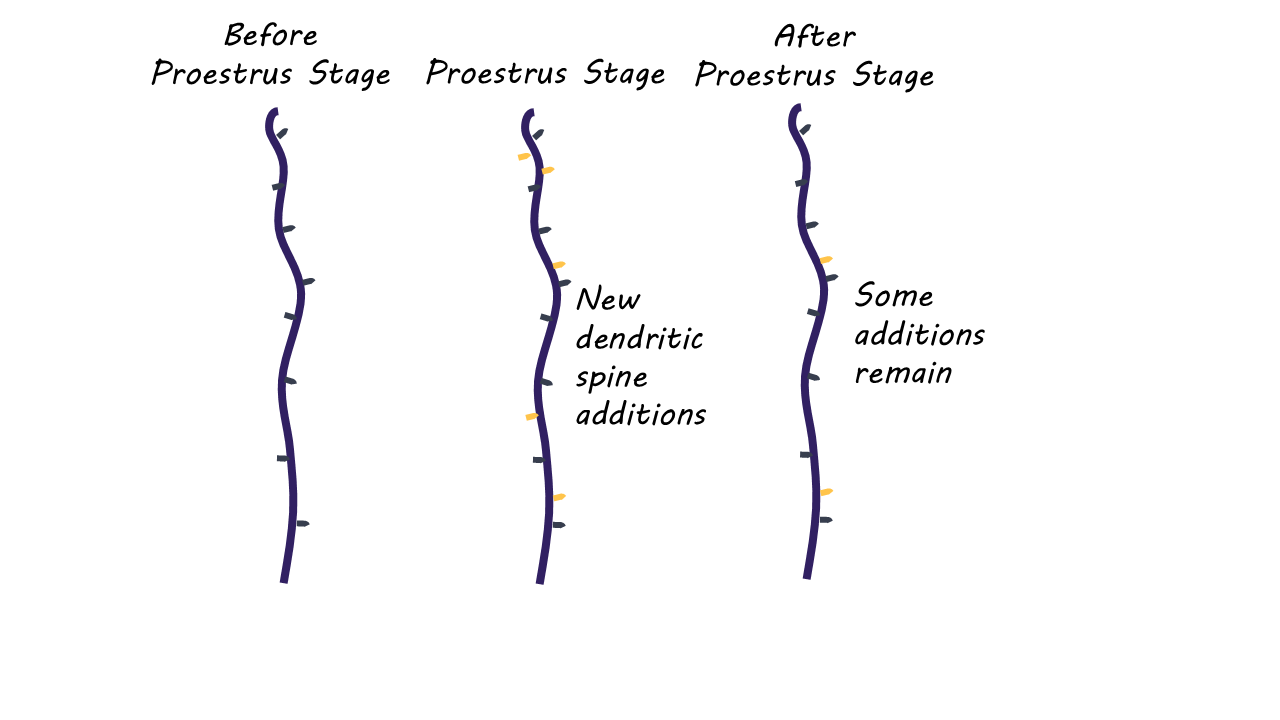
Female mice had the highest density of dendritic spines when they were in the proestrus cycle, when estradiol concentrations were highest. This suggests that estradiol affects the structure of neurons and that higher concentrations of estradiol lead to more connections between cells in the hippocampus. The authors also found that, while many of the new spines that were added in the proestrus stage were shortly lost afterwards, a portion of these new spines remained present on the cells as a permanent addition. This demonstrated that estradiol can permanently change the structure of and connectivity between cells in this part of the brain.
What's the impact?
This study is the first to show that the estrous cycle in mice is related to the structure and function of hippocampal neurons. It suggests that learning and memory processing within the brain are influenced by the changes in hormone levels during the estrous cycle. However, females are not necessarily more variable than males due to their estrous cycles. For example, hormones also change throughout the day based on the sleep/wake circadian cycle, which occurs in both males and females. Studies like this can help us better understand how our learning and memory functions can change based on our hormones.