
A Dietary Pattern That Could Prevent Dementia
Post by Amanda Engstrom
The takeaway
Despite the association between a healthy diet and reduced risk of dementia, precise dietary patterns for dementia prevention have not been well defined. Using machine learning, the authors identify a dietary pattern that is associated with reduced dementia risk.
What's the science?
Dementia, a class of disease characterized by cognitive decline, currently has no effective treatment, making prevention a major focus of research. Dietary factors have been suggested to impact disease, with healthy eating being positively associated with reduced risk of dementia. However, previous studies have lacked the timescale and scope to properly establish dietary patterns that prevent dementia. This week in Nature Human Behavior, Chen and colleagues utilize machine learning to identify patterns linked with reduced dementia risk and examine how this diet can support overall brain health.
How did they do it?
The authors analyzed UK Biobank data from 185,012 participants with 24-hour diet recall and after 10 years, 1,987 developed some sort of dementia (referred to as all-cause dementia, ACD). The authors conducted a food-wide association study and determined which foods were statistically associated with ACD incidence. Utilizing a machine learning approach (LightGBM), the food groups associated with dementia were ranked by importance in predicting dementia risk, and used to develop the MODERN (Machine learning-assisted Optimizing Dietary intERvention against demeNtia risk) diet score. The MODERN diet was compared against other current diets, validated in multiple study cohorts, and evaluated for its associations with other health-related outcomes. Finally, the authors investigated the underlying biological mechanism using multimodal neuroimaging, metabolomics, inflammation biomarkers, and proteomics.
What did they find?
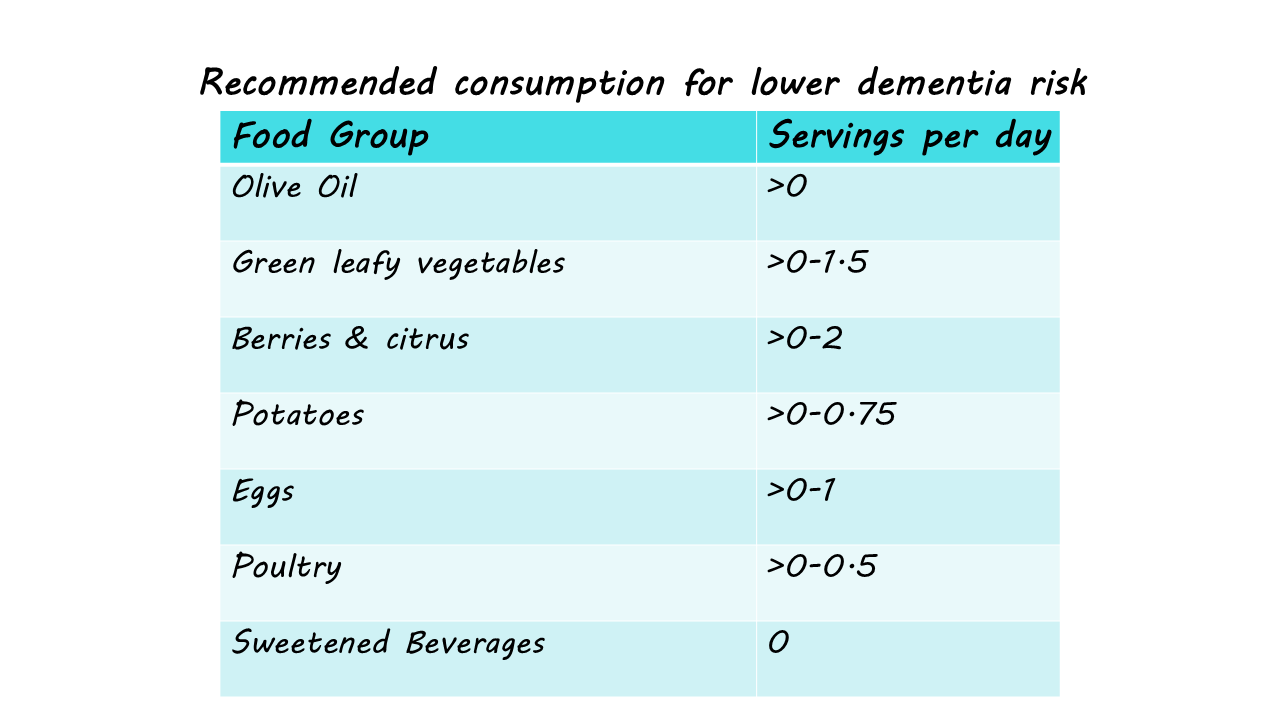
Of the 34 food groups analyzed, 25 were individually associated with ACD. Interestingly, many of them were not linearly associated, highlighting the importance of the amount consumed. The authors applied their machine learning approach to identify the optimal combination for dementia prevention. Termed the MODERN diet, it’s made up of eight key foods most strongly linked to lower risk (such as green leafy vegetables, citrus fruits, eggs, and poultry) and one linked to increased risk (sweetened beverages). The MODERN diet was validated in multiple independent cohorts, and each time performed better at predicting dementia outcome compared to previously established diets. Additionally, the MODERN diet was significantly associated with predicting other mental and behavioral disorders. Using brain magnetic resonance imaging, from a subset of participants, the MODERN diet score was associated with larger mean thickness of multiple brain structures, suggesting a protective role in maintaining brain health. Finally, the authors identified significant changes in metabolites based on the MODERN diet score, as well as decreased markers of inflammation and dementia related plasma proteins.
What's the impact?
This study is the first to combine a food-wide longitudinal analysis with machine learning to develop a new dietary pattern, the MODERN diet, to predict dementia risk. The MODERN diet is associated with better brain health via metabolism-inflammation pathways. This dietary pattern can inform primary dementia prevention and be tested in future randomized controlled trials.