Can The Menstrual Cycle Impact Memory Processing?

Post by Rebecca Glisson

The takeaway

Hormones such as estradiol, the primary female reproductive hormone, can alter the number of inputs a brain cell receives from within the hippocampus, the memory center of the brain. When estradiol levels are highest during an estrous cycle (the mouse menstrual cycle), these brain cells have the most connections to other cells within the hippocampus, suggesting that higher estradiol is related to better learning and memory function.

What's the science?

Cells in the brain communicate with each other when a synapse (the end of one neuron) sends signals to a dendritic spine (the beginning of another neuron). The more dendritic spines there are on one neuron, the more inputs it receives and the more communication it has in turn with other neurons. This week in Neuron, Wolcott and colleagues explored whether the fluctuations of estradiol during the estrous cycle in female mice affect the density of dendritic spines within the hippocampus.

How did they do it?

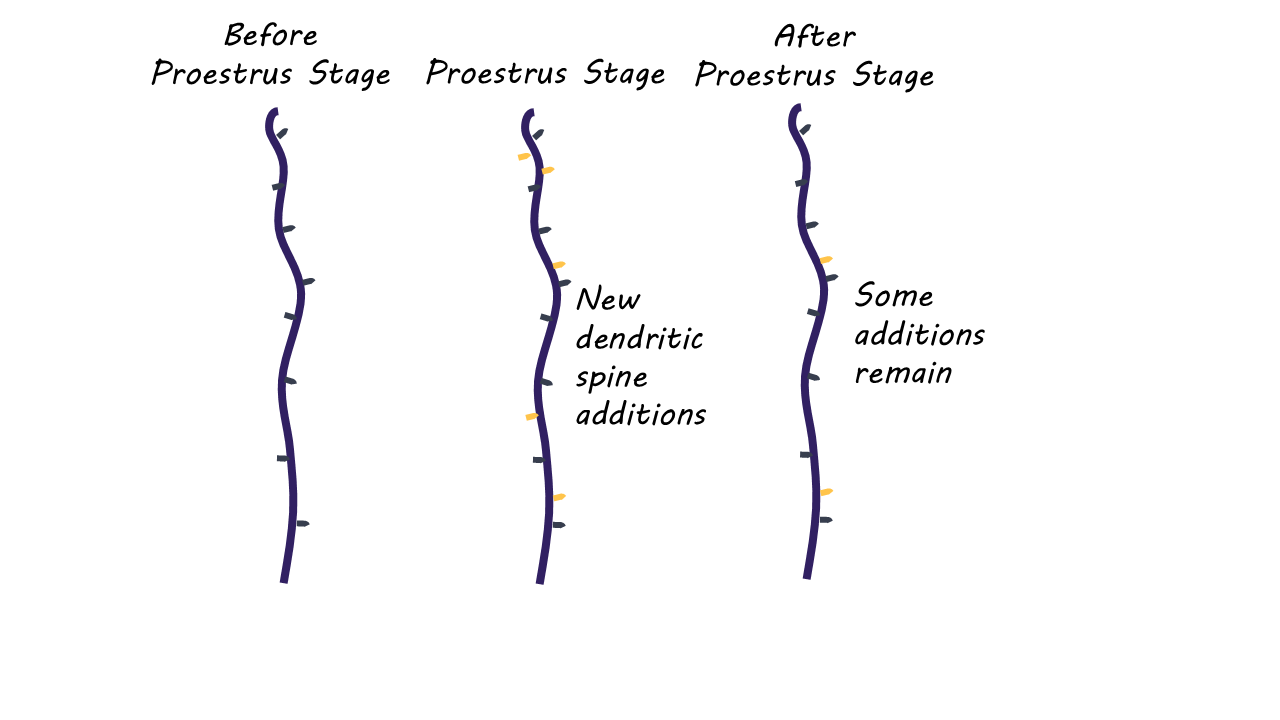
To study the spine density of neurons in the hippocampus, the authors used a specialized microscope in combination with two-photon imaging, or used fluorescence to look specifically at the dendritic spines of cells. They first measured the concentration of estradiol in females in order to track each stage of the estrous cycle, which lasts 4-5 days in mice and has four different stages, similar to the human menstrual cycle. Estradiol is most concentrated just before ovulation in both humans and mice, which occurs during the proestrus stage in mice. In order to measure changes in the dendrites of neurons, the authors implanted a permanent glass microperiscope in the brain, since the hippocampus is found deep within the brain and is typically difficult to look at in live mice. They used mice that were genetically bred to have fluorescent cells in this area of the brain so that they could track changes in the dendrites of these cells. When new dendritic spines formed, the authors also tracked whether these spines were lost quickly afterwards or remained as a new, lasting part of the cell.

What did they find?

Female mice had the highest density of dendritic spines when they were in the proestrus cycle, when estradiol concentrations were highest. This suggests that estradiol affects the structure of neurons and that higher concentrations of estradiol lead to more connections between cells in the hippocampus. The authors also found that, while many of the new spines that were added in the proestrus stage were shortly lost afterwards, a portion of these new spines remained present on the cells as a permanent addition. This demonstrated that estradiol can permanently change the structure of and connectivity between cells in this part of the brain.
What's the impact?

This study is the first to show that the estrous cycle in mice is related to the structure and function of hippocampal neurons. It suggests that learning and memory processing within the brain are influenced by the changes in hormone levels during the estrous cycle. However, females are not necessarily more variable than males due to their estrous cycles. For example, hormones also change throughout the day based on the sleep/wake circadian cycle, which occurs in both males and females. Studies like this can help us better understand how our learning and memory functions can change based on our hormones.
Access the original scientific publication here.

A Dietary Pattern That Could Prevent Dementia

Post by Amanda Engstrom

The takeaway

Despite the association between a healthy diet and reduced risk of dementia, precise dietary patterns for dementia prevention have not been well defined. Using machine learning, the authors identify a dietary pattern that is associated with reduced dementia risk. 

What's the science?

Dementia, a class of disease characterized by cognitive decline, currently has no effective treatment, making prevention a major focus of research. Dietary factors have been suggested to impact disease, with healthy eating being positively associated with reduced risk of dementia. However, previous studies have lacked the timescale and scope to properly establish dietary patterns that prevent dementia. This week in Nature Human Behavior, Chen and colleagues utilize machine learning to identify patterns linked with reduced dementia risk and examine how this diet can support overall brain health.

How did they do it?

The authors analyzed UK Biobank data from 185,012 participants with 24-hour diet recall and after 10 years, 1,987 developed some sort of dementia (referred to as all-cause dementia, ACD). The authors conducted a food-wide association study and determined which foods were statistically associated with ACD incidence. Utilizing a machine learning approach (LightGBM), the food groups associated with dementia were ranked by importance in predicting dementia risk, and used to develop the MODERN (Machine learning-assisted Optimizing Dietary intERvention against demeNtia risk) diet score. The MODERN diet was compared against other current diets, validated in multiple study cohorts, and evaluated for its associations with other health-related outcomes. Finally, the authors investigated the underlying biological mechanism using multimodal neuroimaging, metabolomics, inflammation biomarkers, and proteomics. 

What did they find?

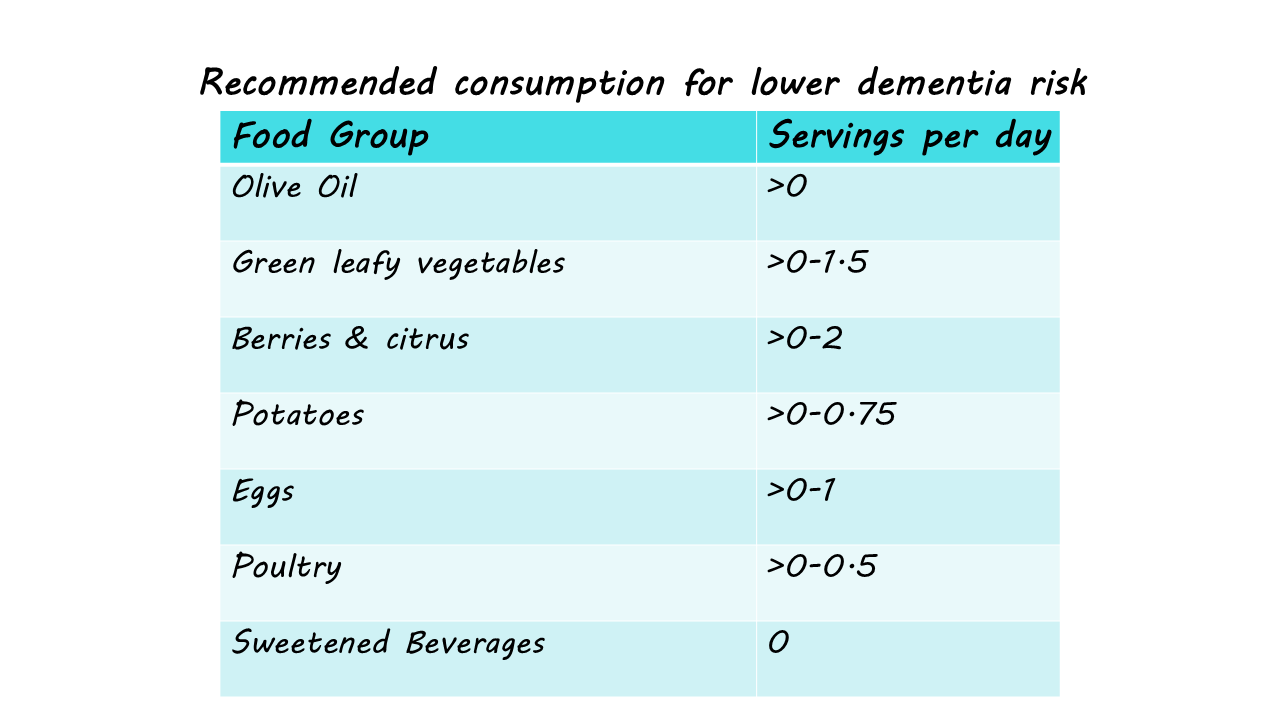
Of the 34 food groups analyzed, 25 were individually associated with ACD. Interestingly, many of them were not linearly associated, highlighting the importance of the amount consumed. The authors applied their machine learning approach to identify the optimal combination for dementia prevention. Termed the MODERN diet, it’s made up of eight key foods most strongly linked to lower risk (such as green leafy vegetables, citrus fruits, eggs, and poultry) and one linked to increased risk (sweetened beverages). The MODERN diet was validated in multiple independent cohorts, and each time performed better at predicting dementia outcome compared to previously established diets. Additionally, the MODERN diet was significantly associated with predicting other mental and behavioral disorders. Using brain magnetic resonance imaging, from a subset of participants, the MODERN diet score was associated with larger mean thickness of multiple brain structures, suggesting a protective role in maintaining brain health. Finally, the authors identified significant changes in metabolites based on the MODERN diet score, as well as decreased markers of inflammation and dementia related plasma proteins. 

What's the impact?

This study is the first to combine a food-wide longitudinal analysis with machine learning to develop a new dietary pattern, the MODERN diet, to predict dementia risk. The MODERN diet is associated with better brain health via metabolism-inflammation pathways. This dietary pattern can inform primary dementia prevention and be tested in future randomized controlled trials. 

Access the original scientific publication here.

Improving Brain Flexibility in Adults with Autism

Post by Soumilee Chaudhuri

The takeaway

Individuals with autism often exhibit rigid patterns of thinking and perception, which may stem from reduced flexibility in how their brain transitions between different activity states. Previous research has shown that the severity of core autistic traits is linked to this kind of neural rigidity. This study used brain stimulation to temporarily increase brain flexibility in adults with autism. 

What's the science?

Autism spectrum disorder (ASD) is widely characterized by differences in how the brain integrates and processes information across multiple systems. One emerging theory suggests that a core feature of autism may be reduced flexibility in the brain's global dynamics—that is, the ease with which the brain transitions between different activity states. These state transitions are essential for adapting to new tasks, shifting attention, interpreting sensory input, and understanding social signals. Previous studies have shown that individuals with autism often have more rigid brain dynamics and fewer state transitions and that this rigidity is associated with key traits of autism, such as repetitive behaviors, heightened sensory perception, and difficulties with nonverbal communication. However, it remains unclear whether this rigidity is simply a byproduct of autism or if it contributes to these traits. This study aimed to determine whether increasing the flexibility of global brain dynamics can causally reduce core traits associated with ASD.

How did they do it?

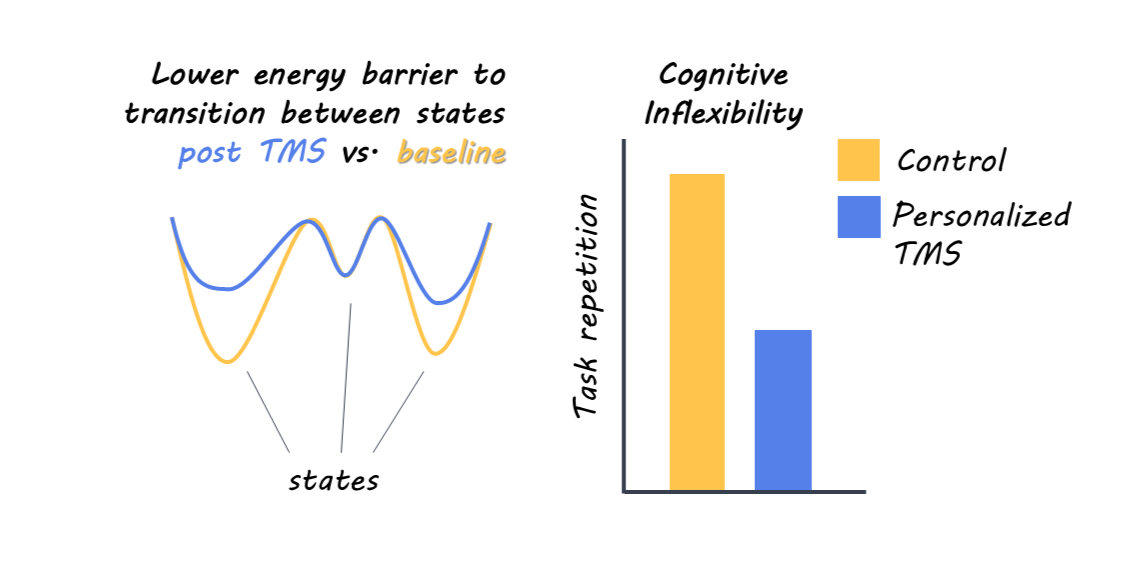
Using a new brain stimulation technique called brain-state-dependent transcranial magnetic stimulation (TMS), the researchers delivered brief pulses of energy to the brain only when it entered a rigid or inflexible state. To identify these states, the team first recorded resting brain activity from 50 autistic and 50 non-autistic adults using functional MRI (fMRI) and electroencephalography (EEG). They employed a method called energy landscape analysis to identify patterns that indicated brain rigidity. Based on this, they created a tailored stimulation protocol targeting the right superior parietal lobule (SPL)—an area involved in attention, flexibility, and sensory integration.. Forty autistic participants received this personalized TMS during multiple sessions. To evaluate changes, participants completed three tasks before and after the intervention: one measuring task-switching (cognitive flexibility), one assessing visual perception (sensory stability), and one evaluating social understanding (reading facial expressions and vocal tones).

What did they find?

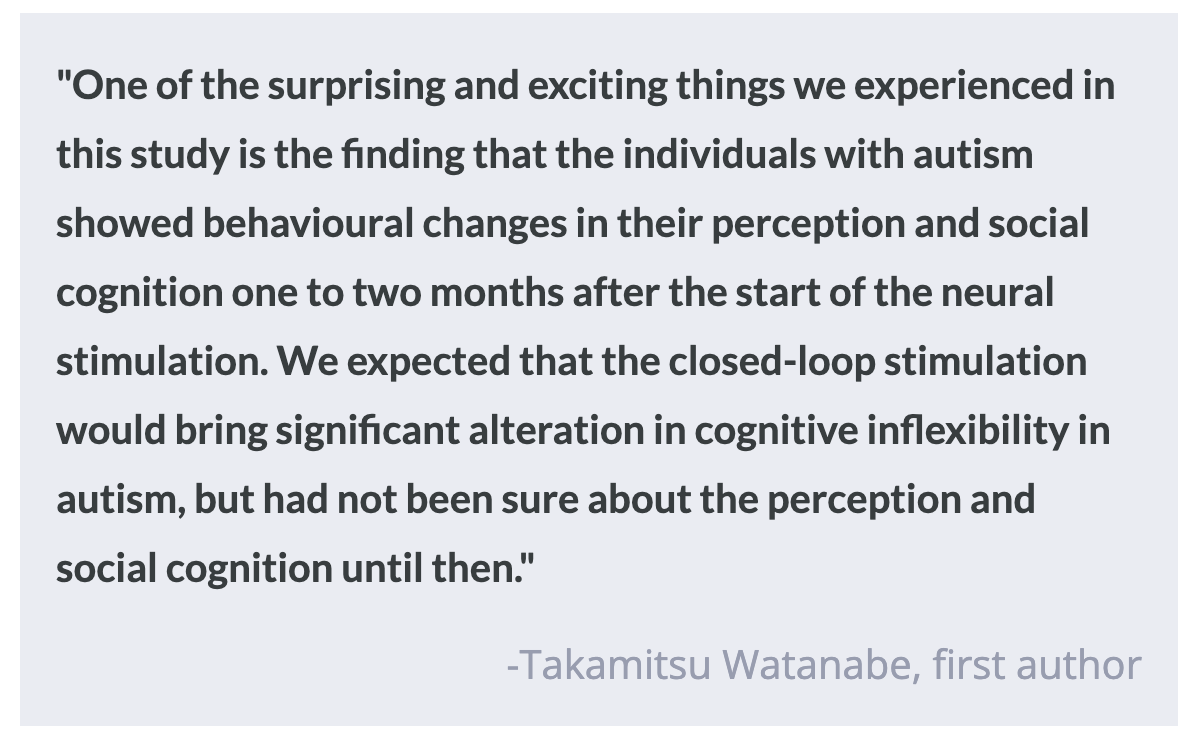
Following the brain-state-dependent stimulation sessions, participants receiving personalized TMS (versus a control group) demonstrated an apparent increase in the brain's ability to shift between different patterns of activity. Immediate improvements in cognitive flexibility accompanied this enhancement in neural flexibility and fluidity. Specifically, autistic participants were more capable of switching between tasks without needing external cues. Improvements in other areas—such as reduced sensory sensitivity and enhanced nonverbal communication—emerged more gradually, becoming noticeable only after multiple sessions. Brain imaging data supported these behavioral improvements. The researchers observed a) stronger communication between brain regions responsible for attention and visual processing (the frontoparietal and visual cortex) and b) improved nonverbal social understanding marked by enhanced connections among the frontoparietal network, the default mode network (involved in self-referential thinking), and the salience network (which helps prioritize social and emotional information). In addition to assessing pre- and post- stimulation sessions, the authors also identified progressive changes throughout the 12-week stimulation period, indicating that the effects last longer than a single session. Changes were noted earlier in cognitive and neural flexibility (at the one-week mark) and later in other areas.

What's the impact?

This study provides strong evidence that targeting brain rigidity in real time using brain-state-dependent stimulation can lead to meaningful changes in the core traits of autism. Findings suggest that there may be a direct connection between brain dynamics and behavior, as shown by increased cognitive flexibility post-stimulation, while the slower improvements in sensory and social functioning point to broader changes across brain networks over time. Taken together, these results are promising and could craft personalized intervention strategies for individuals with autism.