Why Does the Brain Sometimes Mistake Imagination for Reality?

Post by Soumilee Chaudhuri

The takeaway

The human brain employs common neural circuits for both external perception and internal imagination, which can lead to confusion between real and imagined experiences. The authors of this study designed an experiment that intentionally blurred the line between imagination and perception to show how a brain region called the fusiform gyrus distinguishes between internal (imagined) experiences and external (perceived) ones.

What's the science?

Decades of research have shown that visual imagination activates many of the same brain regions (visual cortices) involved in actual visual perception. While this shared use of neural resources is efficient, it also creates a challenge: the brain might confuse imagined experiences with real ones. Previous research has demonstrated that when imagination is very vivid, individuals are more likely to believe what they imagine is real. The exact neural mechanisms by which the brain differentiates between externally perceived and internally generated sensory information remain unclear. This week in Neuron, Dijkstra and colleagues used brain imaging while participants viewed and imagined specific visual patterns to try and answer this question.

How did they do it?

As part of this study, twenty-six healthy volunteers took part in a visual detection task while their brain activity was recorded using functional magnetic resonance imaging (fMRI). All of them completed a behavioral training session to practice detecting and imagining oriented faint patterns or gratings. For the main task, they were shown these gratings that tilted either left or right, sometimes hidden in noisy backgrounds. At the same time, participants were asked to imagine a grating that either matched (congruent) or didn't match (incongruent) the pattern they were trying to detect, with these conditions changing in blocks. After each trial, they reported whether they thought a real grating appeared and rated the vividness of their mental image. Participants judged whether a pattern was present and rated the vividness of their mental imagery. Their brain scans were then analyzed to understand how the brain combines signals from both seeing and imagining to tell apart reality from imagination.

What did they find?

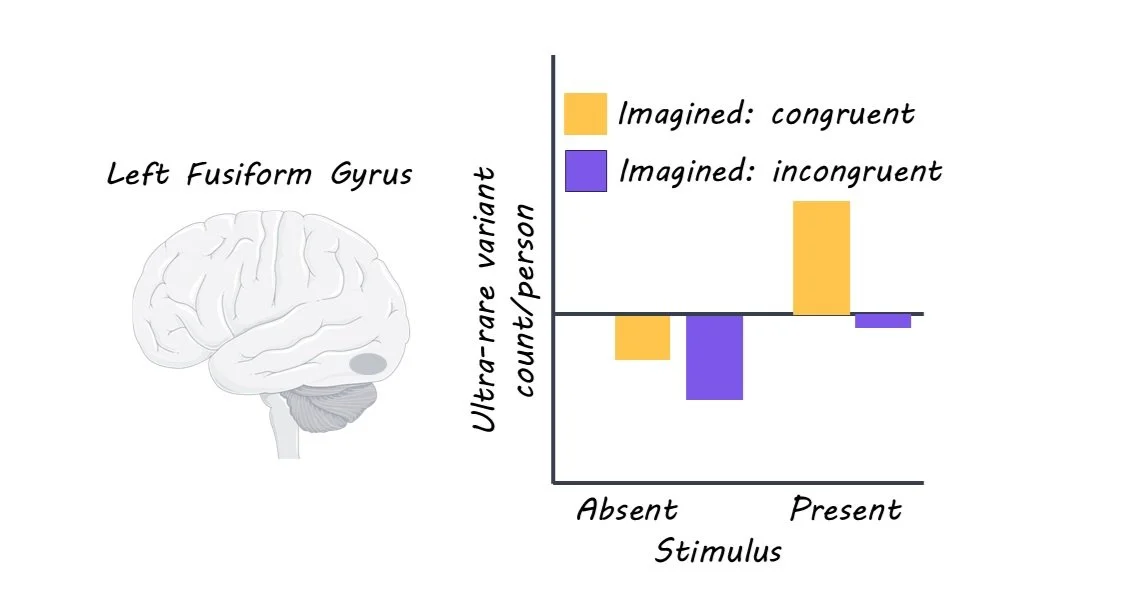
The study found that the bilateral fusiform gyrus (FG) plays a crucial role in determining whether what we see is real or imagined. Brain activity in the FG was more potent when what people imagined matched the real stimulus (called the congruent condition), especially in the left FG, where this effect was highly significant. Individuals who exhibited greater confusion between imagination and reality also showed more vigorous FG activity on the right side. Moreover, the vividness of people's mental images also influenced FG activity. In contrast, other brain areas showed some activity but lacked the specific pattern required to distinguish between reality and imagination. Significantly, activity in the left FG could predict when people mistakenly thought an imagined image was real, but only when the imagined image matched the one they were looking for (i.e., the congruent condition). This shows that the FG helps the brain distinguish between sensory signals and imagination, explaining why we sometimes confuse the two.
What's the impact?

This research reveals how the brain distinguishes real experiences from imagined ones by using the FG to combine signals from perception and mental imagery into a "reality signal” or RS. This signal helps decision-making regions of the brain determine whether something is truly happening or just imagined. Disruption in this biological process could contribute to serious dysregulation of sensory perceptions, such as hallucinations, especially associated with psychiatric illnesses such as schizophrenia. This work sets the stage for developing targeted and effective treatments for individuals who struggle to distinguish between imagination and reality in everyday life.
Ultra-Rare Variants in Mitochondrial DNA Identified in Bipolar Disorder

Post by Amanda Engstrom

The takeaway

Mitochondrial dysfunction has been thought to play a role in various neuropsychiatric disorders. In bipolar disorder, there is an enrichment of a small number of ultra-rare, potentially pathogenic mitochondrial DNA variants that could be directly targeted to improve mitochondrial function in the brain. 

What's the science?

Bipolar disorder (BD) is a major psychiatric disorder characterized by recurrent manic and depressive episodes. Despite being highly heritable, genomic studies have not been able to specify the mechanism underlying BD etiology. However, different variants, or changes to the DNA sequence, of mitochondrial DNA have been suggested to be a factor in BD. The mitochondria play a critical role in the function of all cells and have been theoretically linked to neuronal dysfunction due to their high requirement for energy processing. This week in Molecular Psychiatry, Ohtani and colleagues used advanced DNA sequencing technology to investigate the contribution of brain mitochondrial DNA variants to BD’s pathophysiology. 

How did they do it?

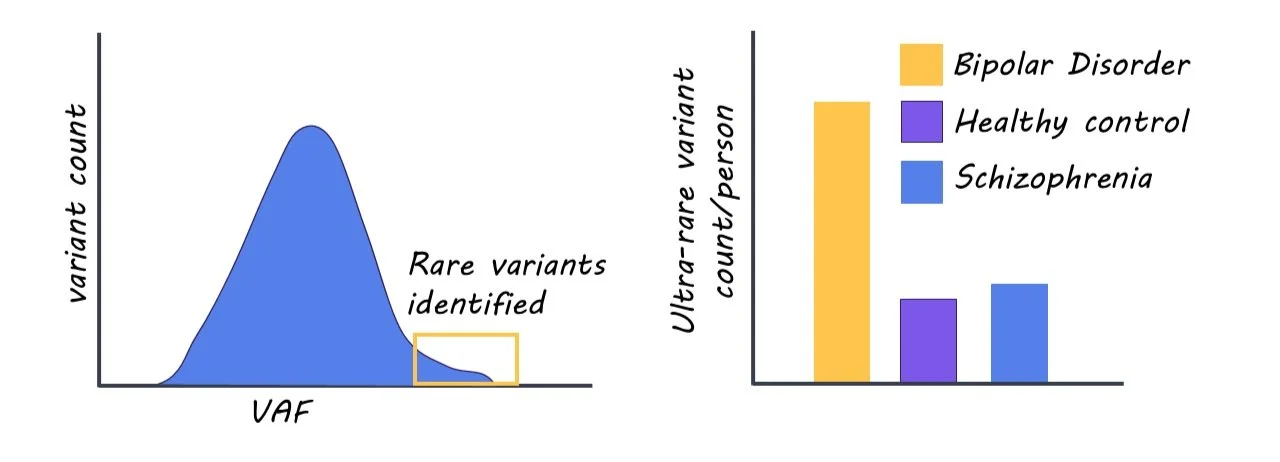
The authors analyzed brain DNA from 54 BD patients, 55 schizophrenia patients, and 54 healthy controls to investigate the association between BD and mitochondrial DNA variants. They used duplex molecular barcode sequencing, a high-precision technique that tags each DNA molecule to detect rare mitochondrial DNA variants with single-molecule resolution. This approach allowed for the identification of heteroplasmic variants, where both normal and mutated mitochondrial DNA are present within the same cell. They then calculated the Variant Allele Frequency (VAF), that is the percentage of DNA sequences in a sample that carry the specific genetic variant. Using both bulk analysis and single-molecule analysis pipelines, they could detect variants with either high and moderate-VAF or low VAF, respectively. The authors could then determine which variants are present and the frequency of each variant in healthy controls compared to BP or schizophrenia patients. 

The authors hypothesized two potential models for the mode of association between BD and mitochondrial variants in the brain:

1- A limited number of likely pathogenic variants with a high VAF would cause mitochondrial dysfunction and impair neuronal activity.

2- Accumulation of numerous non-specific variants with low VAF progressively degrades mitochondrial function and impairs neuronal activity. 

What did they find?

Using bulk sequencing analysis, the authors identified 116 heteroplasmic variants with high/moderate VAF. Thirty-six of them were ultra-rare variants (rarely seen in healthy controls). Both BD and schizophrenia brain mitochondrial DNA had more variants compared to controls, but when limiting the analysis to the ultra-rare variants, only BD had an increase in variants. Through further investigation of these ultra-rare variants, the authors identified potentially pathogenic mutations such as 1) the m.3243A>G mutation, which is causative of the mitochondrial disorder MELAS, 2) four loss-of-function mutations, and 3) six rRNA variants with scores for high pathogenicity. To detect low-VAF variants, the authors used single-molecule analysis. They identified a total of 52,312 low-VAF heteroplasmic variants, however, there was no difference in the frequency of these variants between BD, schizophrenia, and controls. There was an association with age across all groups, with the frequencies increasing with age, reinforcing prior evidence of age-associated systematic mutation rate increase. Additionally, when analyzing the mutation patterns at the single nucleotide level, there was no difference in the mutation pattern among the three groups. Together, these data suggest the mitochondrial variants in BD are due to a consistent specific mutagenic mechanism and not due to a general increase in DNA variability, supporting model 1 from the authors' original hypothesis. Thus, a subset of BD patients could harbor ultra-rare, potentially pathogenic, mitochondrial DNA mutations in their brain tissue, which could be impacting the pathophysiology of their disease. 

What's the impact?

This study was the first to examine mitochondrial variant accumulation at single-molecule resolution in mood disorders. Ultra-rare loss-of-function and rRNA variants are novel candidates for further investigation into the role of mitochondrial dysfunction in BD. There are already several compounds targeting mitochondrial function that could be useful therapies for the treatment of patients with BD.

Access the original scientific publication here

Neural Responses to Internal and External Signals Predict Coma Recovery

Post by Shireen Parimoo

The takeaway

During wakefulness, the brain simultaneously processes both internally generated signals, such as the heartbeat, and external sensory stimuli, like sounds. Patients in a comatose state who later recover from the coma show preserved regularity of neural responses to cardiac and auditory signals. 

What's the science?

Interoception is the ability to sense signals generated by the body, such as the heartbeat or the sensation of goosebumps. The heartbeat evoked potential (HEP) is a specific neural response to heartbeats and is indicative of the brain’s processing of cardiac signals. The brain also tracks sensory input from the external world, like sounds, showing altered patterns of activity when there is deviation from an expected pattern or regularity. This change in response to the deviation is called a prediction error. Interestingly, during both wakefulness and sleep, neural responses to internally generated signals like the heartbeat track neural responses to externally generated signals like sounds in the environment. However, it is unclear whether neural responses to cardiac signals influence sensory processing during a deeply unconscious state. This week in PNAS, Pelentritou and colleagues used electrophysiological techniques to investigate whether the brain uses cardiac signals to track auditory input in a comatose state, and its relationship to patient outcomes. 

How did they do it?

The authors recorded brain and cardiac activity from 48 patients who had suffered cardiac arrest and entered a comatose state. In an auditory paradigm, patients were exposed to sounds and silences with varying levels of regularity relative to the heartbeat. There were four conditions: (1) baseline or control condition with no sound; (2) synchronous condition in which a sound occurred at a fixed interval after a heartbeat was detected; (3) isosynchronous condition in which a sound occurred at a fixed interval relative to the previous sound, but was not synchronized to the heartbeat; and (4) asynchronous condition in which sounds were presented irregularly relative to other sounds and to the heartbeat. Importantly, sounds were omitted on 20% of the trials, which allowed the authors to determine if the patients’ neural and cardiac responses showed evidence of prediction error (i.e., deviation from regularity) in any of the conditions

Electroencephalography was used to record neural responses, which included auditory evoked potentials (AEPs) in response to sound onset and omission-evoked potentials (OEPs) on omission trials, recorded relative to when the sound would have occurred. Cardiac activity was recorded using electrocardiography, including HEPs and omission HEPs during sound-on and omission trials, respectively. Here, OEPs and OHEPs were used as indicators of a prediction error response. The authors compared the regularity of neural and cardiac responses across conditions and for patients with a favorable outcome (i.e., recovery from coma) and an unfavorable outcome. Next, they used a support vector machine classifier (a machine learning technique) on neural data from each trial to predict which condition the brain activity belonged to and whether it could be used to predict patient outcome. Finally, they measured cardiac deceleration – or the amount of slowing between heartbeats – in response to sound omissions in the synchronous condition to predict whether a patient would recover from the coma

What did they find?

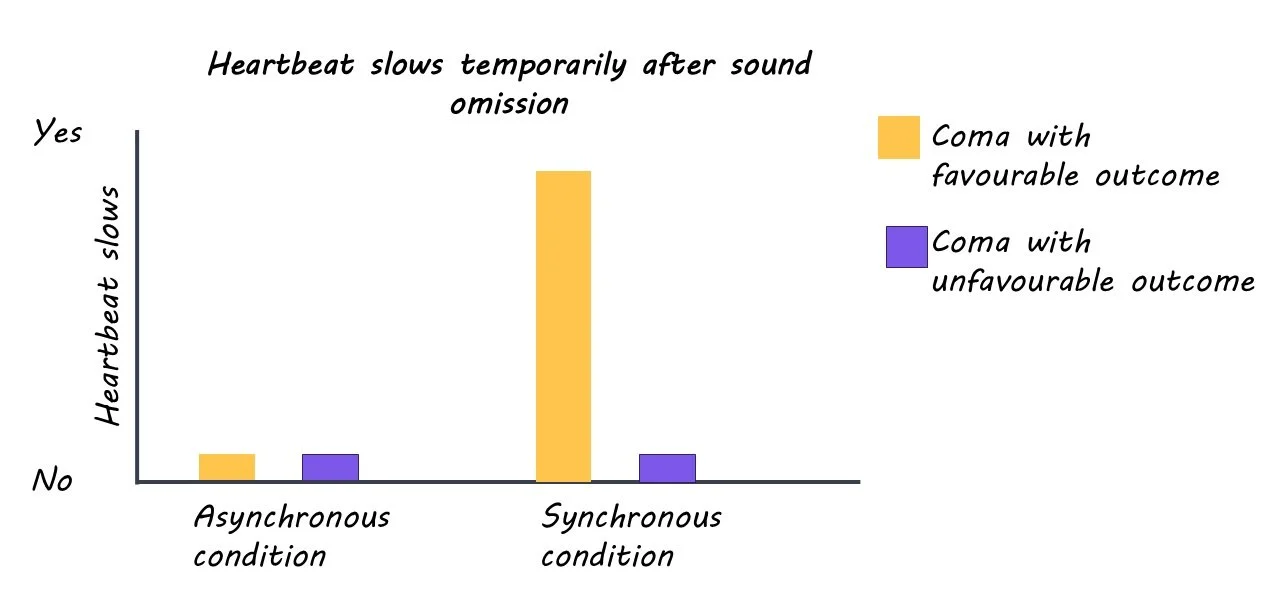
Patients with favorable outcomes showed a significant difference in OEPs during omissions in the synchronous condition, as compared to the asynchronous and baseline conditions. In patients with unfavorable outcomes, however, there was no difference in OEPs across the four conditions. Moreover, there was no difference in OEPs between the isosynchronous and baseline conditions in either patient group. This means that deviation from the regularity of external sounds relative to the heartbeat, but not to sounds, disrupts cardiac-auditory regularity of neural responses, but only in patients who later recover from the coma. 

Single-trial neural activity was predictive of patient outcomes. Specifically, patients with a favorable outcome showed greater cardiac-auditory regularity in the synchronous condition compared to the baseline condition. Relatedly, sound omissions in the synchronous condition influenced cardiac deceleration, but this effect was only observed in patients with a favorable outcome. The same effect was observed in the isosynchronous condition as well, but to a smaller extent. Thus, deviation from the regularity of auditory input – both in relation to the heartbeat and to previous sensory input – led to temporary slowing in between heartbeats of patients who went on to recover from the coma

What's the impact?

These results demonstrate that the brain uses internally generated signals to monitor sensory processing, even in deep unconsciousness, like a coma. Notably, the degree of neural synchronization in response to these signals predicts patient outcomes, offering a promising prognostic marker for coma recovery.