
Why Is Our Memory Gist-Like?

Post by Lila Metko

The takeaway

Engram cells are neurons that activate when a memory is formed and reactivate when a memory is recalled. Recollection is not always perfect, and sometimes these cells are activated under similar, but not identical, contexts to those in which the memory was formed. Formation of new cells in the hippocampus is necessary for this gist-like type of memory processing.  

What's the science?

The hippocampus (HC) is a brain region that consolidates and retrieves memories. For our survival, our memories must be more gist-like rather than very precise, so we can flexibly adapt to changing circumstances. Previous theory suggests that interactions between the prefrontal cortex and HC drive gist memory formation. This week in Nature, Ko and colleagues used optogenetic silencing, eGRASP visualization, and other methods to eliminate and accelerate neurogenesis to understand how gist memory formation can occur within the HC

How did they do it?

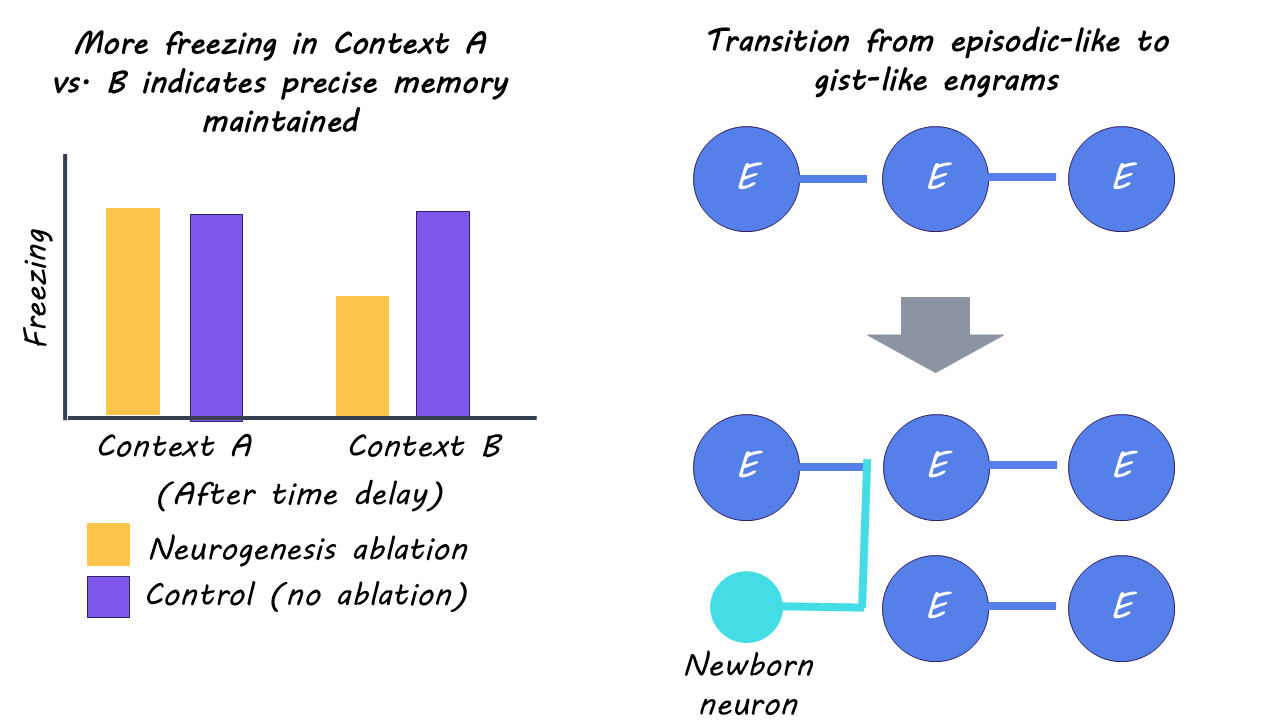
Experiment 1: The authors used a contextual fear conditioning paradigm to test memory in mice at 1 day (recent), 14 days (intermediate), and 28 days (remote). After mice are placed in a new environment (‘context A’), they will typically freeze if placed in an environment they associate with the stimulus again. One benefit of this paradigm is the ability to make a second environment (‘context B’) similar to context A so that they could test for gist memory. During the fear learning session, they labeled active neurons (engram neurons) with a fluorescent protein, and then quantified them for activity at each time point. Engram neurons were also silenced at the timepoints to determine effects on memory.

Experiment 2: The authors visualized engram cell synapses using the eGRASP technique to gain a better understanding of which subparts of the HC were involved in the engram reactivation and which neuron types played a role.  

Experiment 3: The authors then did a tracing experiment to label newborn neurons in the dentate gyrus region of the HC, to examine if they synapsed on a nearby engram cell. Finally, they used gamma irradiation and voluntary wheel running, respectively, to eliminate and boost neurogenesis in different cohorts of mice and examined memory in the contextual fear conditioning paradigm in each group. 

What did they find?

Experiment 1: The authors found that initially, the mice froze mostly in response to context A (the context in which they received the aversive stimulus), but by the 28th day, froze equally to the two similar contexts, indicating a decrease in precise memory. In some areas of the HC, engram cell activity mirrored the freezing patterns, showing high activity for A at timepoint one and equal activity for A and B at timepoint three. Silencing engram cells that project from one specific area of the HC to another suppresses freezing behavior in both context A and B at the 28-day timepoint, which indicates that these specific cells are responsible for gist memory. 

Experiment 2: In the experiment that labeled the engram cells, they found that over time, outputs from the dentate gyrus region of the HC to inhibitory neurons in the CA3 region decreased, and inputs to the CA1 region of the hippocampus from the CA3 increased. This indicates that there may be complementary feed-forward inhibition and excitation processes at play to facilitate gist memory

Experiment 3: The tracing experiment showed that newborn neurons from the dentate gyrus do synapse onto CA3 engrams. Importantly, CA3 engram cells that received inputs from newborn neurons were around three times more likely to be activated in context B (a similar but not identical context). When newborn neurons were eliminated, precise memory (more freezing to context A) increased at later timepoints, and the hippocampal connectivity patterns associated with later timepoints in experiment 2 were not seen at 28 days. Conversely, when neurogenesis was promoted with voluntary wheel running, precise memory went away at earlier timepoints (14 days), and the gist memory hippocampal connectivity changes that typically need 28 days to develop were seen as early as 14 days. This demonstrates that hippocampal neurogenesis likely facilitates gist memory. 
What's the impact?

This research shows that hippocampal neurogenesis can actively reshape memory circuits, shifting detailed event memories into flexible gist representations. It suggests that forgetting may not always be a bad thing, but more of an adaptive generalization of past experiences to new situations. This insight could influence strategies for education, mental health therapies, and age-related memory care by targeting neurogenesis or circuit remodeling to fine-tune the balance between precision and generalization in memory.
Access the original scientific publication here.

The Global fMRI Signal Tracks Changes in Arousal

Post by Natalia Ladyka-Wojcik

The takeaway

A global brain signal closely correlates with changes in arousal across the brain and body, suggesting this signal may be shaped by the autonomic nervous system that modulates arousal. 

What's the science?

In functional magnetic resonance imaging (fMRI), the global signal is the average signal intensity across the whole brain. The global signal is one of the strongest and most consistent signals that neuroscientists detect, but it is often regressed out of neuroimaging analyses of functional connectivity because it is believed to represent physiological noise (such as heart rate or breathing) that could confound experimental results. Recently, however, some scientists have started to consider whether the global fMRI signal might reflect valuable information — it could also be tied to changes in arousal, like how awake or restful a person is. These slow brain signals (within a low-frequency, 0.01–0.1 Hz range) seem to line up with changes in both brain electrical activity captured with electroencephalography (EEG) and bodily responses related to arousal, such as pupil size. This week in Nature Neuroscience, Bolt and colleagues explored how closely the global fMRI signal is linked to activity in the autonomic nervous system, a part of the peripheral nervous system that regulates arousal-related processes in the body, including blood pressure and breathing. 

How did they do it?

The authors used several datasets, including fMRI, EEG, and recordings of physiological signals, to study what happens during rest and sleep with the global signal. They focused on things like heart rate changes, breathing patterns, sweating (measured through skin conductance), blood vessel pulsation, and changes in pupil size (with pupillometry) to see if these body signals fluctuated with the global fMRI signal. Importantly, they also examined whether moments when arousal levels spontaneously changed, like during brief events in sleep called “K-complexes” in EEG, were linked with coordinated changes in both the brain and body. Furthermore, their analysis included a dataset that measured how much carbon dioxide (CO₂) people exhaled (using a method called PETCO₂), which changes with arousal. By looking at how PETCO₂ was related to the global fMRI signal specifically, they could test whether breathing itself might simply be driving some of these global fluctuations between fMRI signal and physiological signals during rest, something that neuroimaging analyses typically aim to remove. 

What did they find?

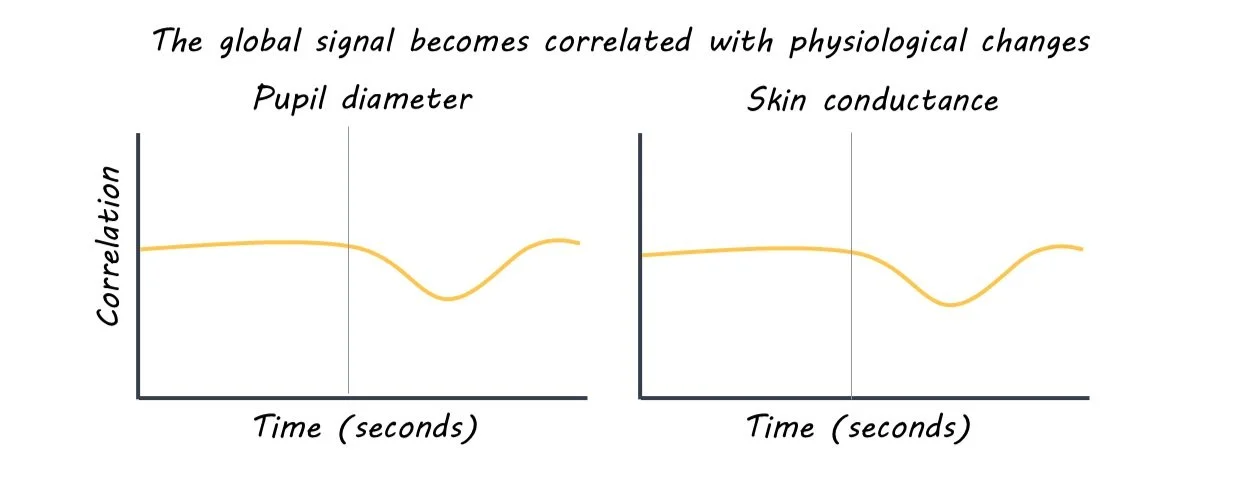
The authors found that a single, global pattern could explain a lot of the shared activity between the brain’s global signal and various arousal systems. They observed this same brain–body pattern not only during spontaneous arousal changes in sleep (like K-complexes), but also when arousal was intentionally changed, for example, during deep breathing or sensory stimulation. Critically, they found that CO₂ levels alone could not explain the global brain fluctuations during rest. Instead, the authors suggest that their results demonstrate that the autonomic nervous system and brain signals that regulate arousal are likely driving these widespread patterns seen in fMRI. 

What's the impact?

This study is the first to show comprehensive evidence across many datasets to challenge the prevailing idea that global signals should be removed from fMRI simply because they are dominated by physiological noise. This research also highlights the potential importance of the global signal in understanding how the brain and body coordinate during rest and sleep.  

Access the original scientific publication here.

Striving for a Happier Brain

Post by Rebecca Glisson 

The takeaway

Recent studies have examined how happiness originates in the brain. The more we understand how we feel happy, the better we can work toward improving happiness at a societal level.

Searching for happiness in a stressful time

If you’ve been feeling stressed lately by recent events – climate change, political events, economic hardships – and you’re wondering how to find happiness and stay resilient, rest assured that scientists are wondering alongside you. Recent studies are exploring the link between stress and how our brains create the feeling of happiness. The World Health Organization, for example, reports that mental health issues are on the rise globally and that mental health impacts our ability to function in our daily lives. Another study has found that the more income inequality a nation experiences, the greater the inequality in national happiness. By understanding the neurobiology of happiness and how stress interferes, we can work to shape our society to increase overall happiness levels.

Dopamine and social media

Dopamine is a neurotransmitter that is widely associated with rewarding behavior. For example, when you eat something enjoyable, dopamine is released in the brain, you feel pleasure, and are more likely to repeat that behavior. However, stress can negatively impact how dopamine functions in response to pleasurable behaviors. Studies in rats have found that chronic stress is associated with less dopamine production in response to rewarding stimuli. In people, chronic stress could lead to a smaller and smaller dopamine response over time, which can result in more and more reward-seeking behavior to achieve the same dopamine response. You may have experienced this if you’ve ever gotten caught in a loop of endlessly browsing social media: looking at a new video or seeing a notification only releases a small amount of dopamine that disappears quickly, which starts a loop of further scrolling that releases even more dopamine. Limiting this kind of social media use is recommended, as it prevents you from developing a higher and higher tolerance to the dopamine response.

Oxytocin and social bonding

Another molecule associated with happiness in the brain is oxytocin, a hormone released in response to social bonding. One study found that if given an extra dose of oxytocin, a person will be more friendly to a stranger who gives them help. Another study showed that oxytocin given to depressed patients helps to maintain attention to a happy face. It is no wonder, then, that forced separation from regular social interaction due to pandemic shutdowns would lead to less oxytocin in our systems and less happiness from social lives.

What can we do to increase our happiness?

One science-backed way to increase happiness is by developing and maintaining strong social bonds, which are crucial for our well-being. We can work towards creating spaces for social bonding by designing our cities and living areas to foster meaningful social connections. Libraries and parks are great examples of places such as these where local events can lead to positive social interactions that can decrease our stress levels and increase our happiness over time.

References +

Alexander, R., Aragón, O. R., Bookwala, J., Cherbuin, N., Gatt, J. M., Kahrilas, I. J., ... & Styliadis, C. (2021). The neuroscience of positive emotions and affect: Implications for cultivating happiness and wellbeing. Neuroscience & Biobehavioral Reviews, 121, 220-249.

Bates, C. R., Bohnert, A. M., & Gerstein, D. E. (2018). Green schoolyards in low-income urban neighborhoods: natural spaces for positive youth development outcomes. Frontiers in psychology, 9, 805.

Berridge, K. C., & Kringelbach, M. L. (2011). Building a neuroscience of pleasure and well-being. Psychology of Well-Being: Theory, Research and Practice, 1, 1-26.

Di Chiara, G., Loddo, P., & Tanda, G. (1999). Reciprocal changes in prefrontal and limbic dopamine responsiveness to aversive and rewarding stimuli after chronic mild stress: implications for the psychobiology of depression. Biological psychiatry, 46(12), 1624-1633.

Domes, G., Normann, C., & Heinrichs, M. (2016). The effect of oxytocin on attention to angry and happy faces in chronic depression. BMC psychiatry, 16, 1-8.

Human, L. J., Woolley, J. D., & Mendes, W. B. (2018). Effects of oxytocin administration on receiving help. Emotion, 18(7), 980.

Macit, H. B., Macit, G., & Güngör, O. (2018). A research on social media addiction and dopamine driven feedback. Journal of Mehmet Akif Ersoy University Economics and Administrative Sciences Faculty, 5(3), 882-897.

Pressman, S. D., Jenkins, B. N., & Moskowitz, J. T. (2019). Positive affect and health: What do we know and where next should we go?. Annual review of psychology, 70(1), 627-650.