
Why Is Our Memory Gist-Like?
Post by Lila Metko
The takeaway
Engram cells are neurons that activate when a memory is formed and reactivate when a memory is recalled. Recollection is not always perfect, and sometimes these cells are activated under similar, but not identical, contexts to those in which the memory was formed. Formation of new cells in the hippocampus is necessary for this gist-like type of memory processing.
What's the science?
The hippocampus (HC) is a brain region that consolidates and retrieves memories. For our survival, our memories must be more gist-like rather than very precise, so we can flexibly adapt to changing circumstances. Previous theory suggests that interactions between the prefrontal cortex and HC drive gist memory formation. This week in Nature, Ko and colleagues used optogenetic silencing, eGRASP visualization, and other methods to eliminate and accelerate neurogenesis to understand how gist memory formation can occur within the HC.
How did they do it?
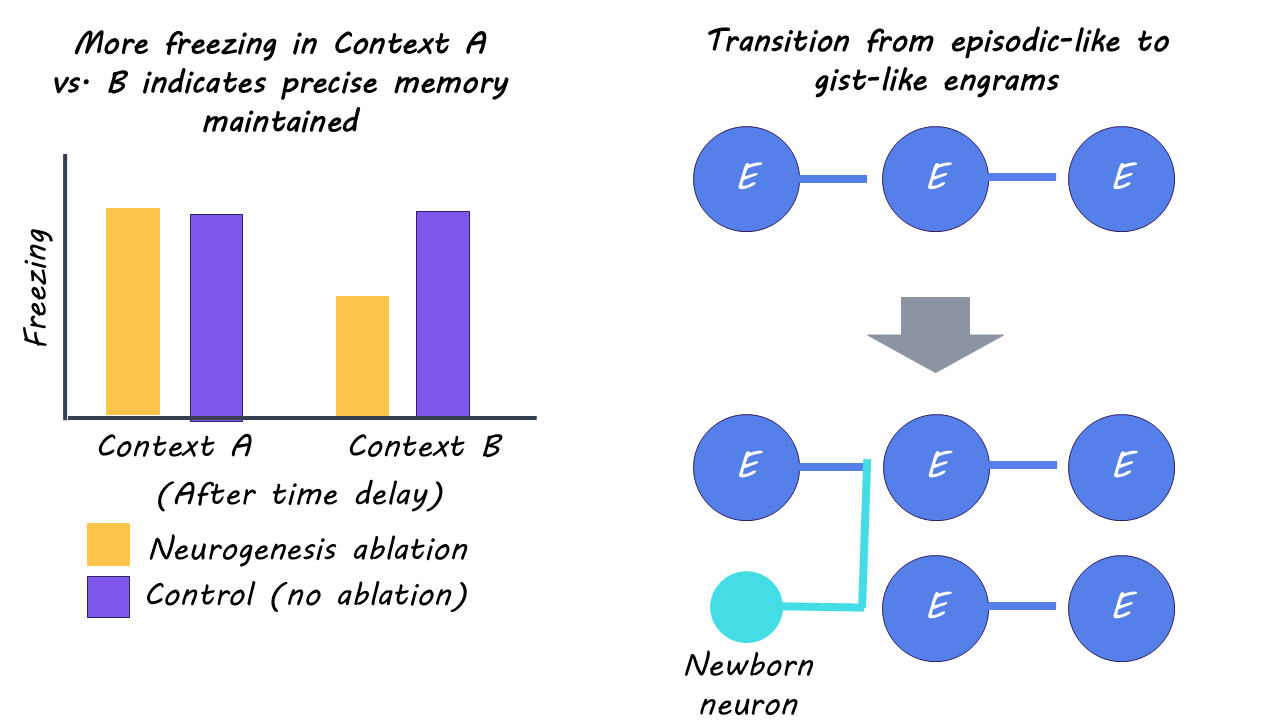
Experiment 1: The authors used a contextual fear conditioning paradigm to test memory in mice at 1 day (recent), 14 days (intermediate), and 28 days (remote). After mice are placed in a new environment (‘context A’), they will typically freeze if placed in an environment they associate with the stimulus again. One benefit of this paradigm is the ability to make a second environment (‘context B’) similar to context A so that they could test for gist memory. During the fear learning session, they labeled active neurons (engram neurons) with a fluorescent protein, and then quantified them for activity at each time point. Engram neurons were also silenced at the timepoints to determine effects on memory.
Experiment 2: The authors visualized engram cell synapses using the eGRASP technique to gain a better understanding of which subparts of the HC were involved in the engram reactivation and which neuron types played a role.
Experiment 3: The authors then did a tracing experiment to label newborn neurons in the dentate gyrus region of the HC, to examine if they synapsed on a nearby engram cell. Finally, they used gamma irradiation and voluntary wheel running, respectively, to eliminate and boost neurogenesis in different cohorts of mice and examined memory in the contextual fear conditioning paradigm in each group.
What did they find?
Experiment 1: The authors found that initially, the mice froze mostly in response to context A (the context in which they received the aversive stimulus), but by the 28th day, froze equally to the two similar contexts, indicating a decrease in precise memory. In some areas of the HC, engram cell activity mirrored the freezing patterns, showing high activity for A at timepoint one and equal activity for A and B at timepoint three. Silencing engram cells that project from one specific area of the HC to another suppresses freezing behavior in both context A and B at the 28-day timepoint, which indicates that these specific cells are responsible for gist memory.
Experiment 2: In the experiment that labeled the engram cells, they found that over time, outputs from the dentate gyrus region of the HC to inhibitory neurons in the CA3 region decreased, and inputs to the CA1 region of the hippocampus from the CA3 increased. This indicates that there may be complementary feed-forward inhibition and excitation processes at play to facilitate gist memory.
Experiment 3: The tracing experiment showed that newborn neurons from the dentate gyrus do synapse onto CA3 engrams. Importantly, CA3 engram cells that received inputs from newborn neurons were around three times more likely to be activated in context B (a similar but not identical context). When newborn neurons were eliminated, precise memory (more freezing to context A) increased at later timepoints, and the hippocampal connectivity patterns associated with later timepoints in experiment 2 were not seen at 28 days. Conversely, when neurogenesis was promoted with voluntary wheel running, precise memory went away at earlier timepoints (14 days), and the gist memory hippocampal connectivity changes that typically need 28 days to develop were seen as early as 14 days. This demonstrates that hippocampal neurogenesis likely facilitates gist memory.
What's the impact?
This research shows that hippocampal neurogenesis can actively reshape memory circuits, shifting detailed event memories into flexible gist representations. It suggests that forgetting may not always be a bad thing, but more of an adaptive generalization of past experiences to new situations. This insight could influence strategies for education, mental health therapies, and age-related memory care by targeting neurogenesis or circuit remodeling to fine-tune the balance between precision and generalization in memory.