
The Global fMRI Signal Tracks Changes in Arousal
Post by Natalia Ladyka-Wojcik
The takeaway
A global brain signal closely correlates with changes in arousal across the brain and body, suggesting this signal may be shaped by the autonomic nervous system that modulates arousal.
What's the science?
In functional magnetic resonance imaging (fMRI), the global signal is the average signal intensity across the whole brain. The global signal is one of the strongest and most consistent signals that neuroscientists detect, but it is often regressed out of neuroimaging analyses of functional connectivity because it is believed to represent physiological noise (such as heart rate or breathing) that could confound experimental results. Recently, however, some scientists have started to consider whether the global fMRI signal might reflect valuable information — it could also be tied to changes in arousal, like how awake or restful a person is. These slow brain signals (within a low-frequency, 0.01–0.1 Hz range) seem to line up with changes in both brain electrical activity captured with electroencephalography (EEG) and bodily responses related to arousal, such as pupil size. This week in Nature Neuroscience, Bolt and colleagues explored how closely the global fMRI signal is linked to activity in the autonomic nervous system, a part of the peripheral nervous system that regulates arousal-related processes in the body, including blood pressure and breathing.
How did they do it?
The authors used several datasets, including fMRI, EEG, and recordings of physiological signals, to study what happens during rest and sleep with the global signal. They focused on things like heart rate changes, breathing patterns, sweating (measured through skin conductance), blood vessel pulsation, and changes in pupil size (with pupillometry) to see if these body signals fluctuated with the global fMRI signal. Importantly, they also examined whether moments when arousal levels spontaneously changed, like during brief events in sleep called “K-complexes” in EEG, were linked with coordinated changes in both the brain and body. Furthermore, their analysis included a dataset that measured how much carbon dioxide (CO₂) people exhaled (using a method called PETCO₂), which changes with arousal. By looking at how PETCO₂ was related to the global fMRI signal specifically, they could test whether breathing itself might simply be driving some of these global fluctuations between fMRI signal and physiological signals during rest, something that neuroimaging analyses typically aim to remove.
What did they find?
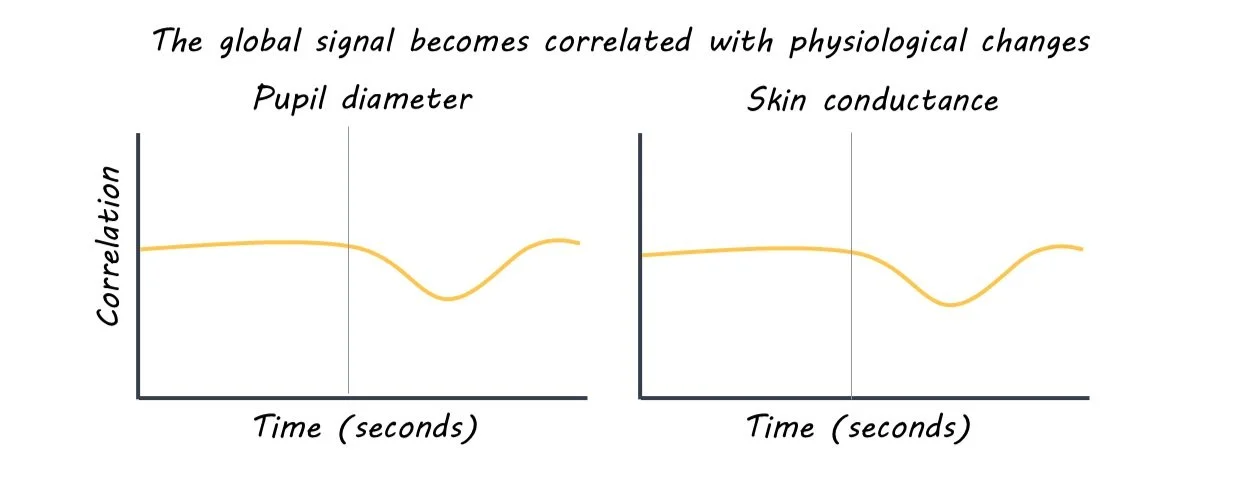
The authors found that a single, global pattern could explain a lot of the shared activity between the brain’s global signal and various arousal systems. They observed this same brain–body pattern not only during spontaneous arousal changes in sleep (like K-complexes), but also when arousal was intentionally changed, for example, during deep breathing or sensory stimulation. Critically, they found that CO₂ levels alone could not explain the global brain fluctuations during rest. Instead, the authors suggest that their results demonstrate that the autonomic nervous system and brain signals that regulate arousal are likely driving these widespread patterns seen in fMRI.
What's the impact?
This study is the first to show comprehensive evidence across many datasets to challenge the prevailing idea that global signals should be removed from fMRI simply because they are dominated by physiological noise. This research also highlights the potential importance of the global signal in understanding how the brain and body coordinate during rest and sleep.