Neural Responses to Internal and External Signals Predict Coma Recovery
Post by Shireen Parimoo
The takeaway
During wakefulness, the brain simultaneously processes both internally generated signals, such as the heartbeat, and external sensory stimuli, like sounds. Patients in a comatose state who later recover from the coma show preserved regularity of neural responses to cardiac and auditory signals.
What's the science?
Interoception is the ability to sense signals generated by the body, such as the heartbeat or the sensation of goosebumps. The heartbeat evoked potential (HEP) is a specific neural response to heartbeats and is indicative of the brain’s processing of cardiac signals. The brain also tracks sensory input from the external world, like sounds, showing altered patterns of activity when there is deviation from an expected pattern or regularity. This change in response to the deviation is called a prediction error. Interestingly, during both wakefulness and sleep, neural responses to internally generated signals like the heartbeat track neural responses to externally generated signals like sounds in the environment. However, it is unclear whether neural responses to cardiac signals influence sensory processing during a deeply unconscious state. This week in PNAS, Pelentritou and colleagues used electrophysiological techniques to investigate whether the brain uses cardiac signals to track auditory input in a comatose state, and its relationship to patient outcomes.
How did they do it?
The authors recorded brain and cardiac activity from 48 patients who had suffered cardiac arrest and entered a comatose state. In an auditory paradigm, patients were exposed to sounds and silences with varying levels of regularity relative to the heartbeat. There were four conditions: (1) baseline or control condition with no sound; (2) synchronous condition in which a sound occurred at a fixed interval after a heartbeat was detected; (3) isosynchronous condition in which a sound occurred at a fixed interval relative to the previous sound, but was not synchronized to the heartbeat; and (4) asynchronous condition in which sounds were presented irregularly relative to other sounds and to the heartbeat. Importantly, sounds were omitted on 20% of the trials, which allowed the authors to determine if the patients’ neural and cardiac responses showed evidence of prediction error (i.e., deviation from regularity) in any of the conditions.
Electroencephalography was used to record neural responses, which included auditory evoked potentials (AEPs) in response to sound onset and omission-evoked potentials (OEPs) on omission trials, recorded relative to when the sound would have occurred. Cardiac activity was recorded using electrocardiography, including HEPs and omission HEPs during sound-on and omission trials, respectively. Here, OEPs and OHEPs were used as indicators of a prediction error response. The authors compared the regularity of neural and cardiac responses across conditions and for patients with a favorable outcome (i.e., recovery from coma) and an unfavorable outcome. Next, they used a support vector machine classifier (a machine learning technique) on neural data from each trial to predict which condition the brain activity belonged to and whether it could be used to predict patient outcome. Finally, they measured cardiac deceleration – or the amount of slowing between heartbeats – in response to sound omissions in the synchronous condition to predict whether a patient would recover from the coma.
What did they find?
Patients with favorable outcomes showed a significant difference in OEPs during omissions in the synchronous condition, as compared to the asynchronous and baseline conditions. In patients with unfavorable outcomes, however, there was no difference in OEPs across the four conditions. Moreover, there was no difference in OEPs between the isosynchronous and baseline conditions in either patient group. This means that deviation from the regularity of external sounds relative to the heartbeat, but not to sounds, disrupts cardiac-auditory regularity of neural responses, but only in patients who later recover from the coma.
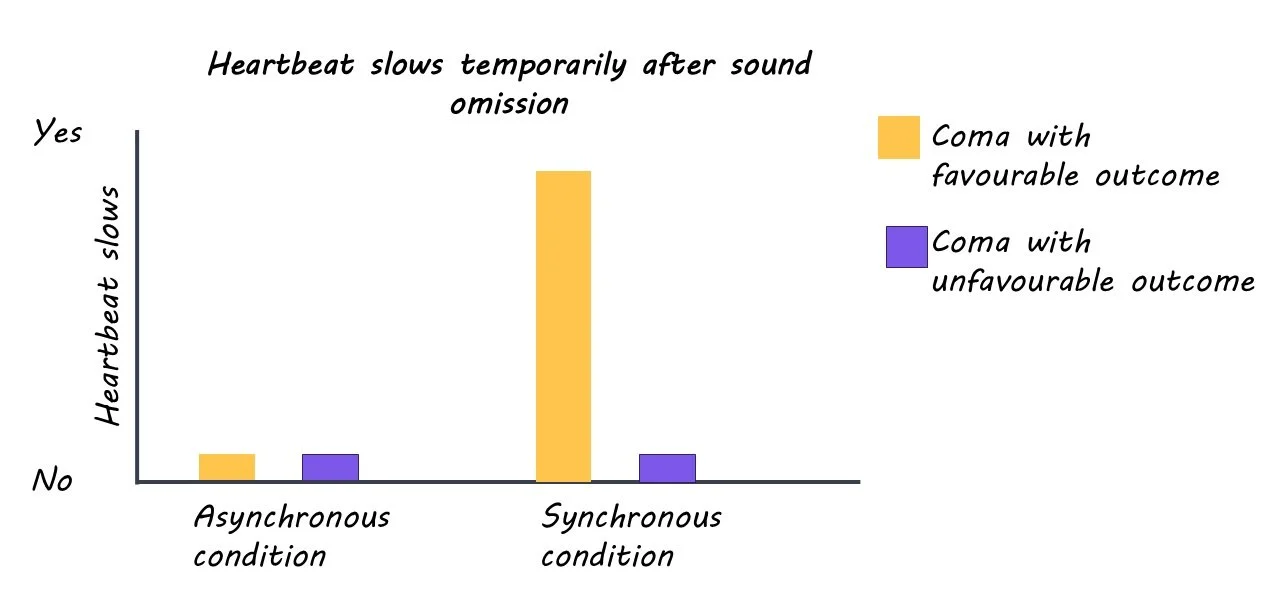
Single-trial neural activity was predictive of patient outcomes. Specifically, patients with a favorable outcome showed greater cardiac-auditory regularity in the synchronous condition compared to the baseline condition. Relatedly, sound omissions in the synchronous condition influenced cardiac deceleration, but this effect was only observed in patients with a favorable outcome. The same effect was observed in the isosynchronous condition as well, but to a smaller extent. Thus, deviation from the regularity of auditory input – both in relation to the heartbeat and to previous sensory input – led to temporary slowing in between heartbeats of patients who went on to recover from the coma.
What's the impact?
These results demonstrate that the brain uses internally generated signals to monitor sensory processing, even in deep unconsciousness, like a coma. Notably, the degree of neural synchronization in response to these signals predicts patient outcomes, offering a promising prognostic marker for coma recovery.