
Ultra-Rare Variants in Mitochondrial DNA Identified in Bipolar Disorder
Post by Amanda Engstrom
The takeaway
Mitochondrial dysfunction has been thought to play a role in various neuropsychiatric disorders. In bipolar disorder, there is an enrichment of a small number of ultra-rare, potentially pathogenic mitochondrial DNA variants that could be directly targeted to improve mitochondrial function in the brain.
What's the science?
Bipolar disorder (BD) is a major psychiatric disorder characterized by recurrent manic and depressive episodes. Despite being highly heritable, genomic studies have not been able to specify the mechanism underlying BD etiology. However, different variants, or changes to the DNA sequence, of mitochondrial DNA have been suggested to be a factor in BD. The mitochondria play a critical role in the function of all cells and have been theoretically linked to neuronal dysfunction due to their high requirement for energy processing. This week in Molecular Psychiatry, Ohtani and colleagues used advanced DNA sequencing technology to investigate the contribution of brain mitochondrial DNA variants to BD’s pathophysiology.
How did they do it?
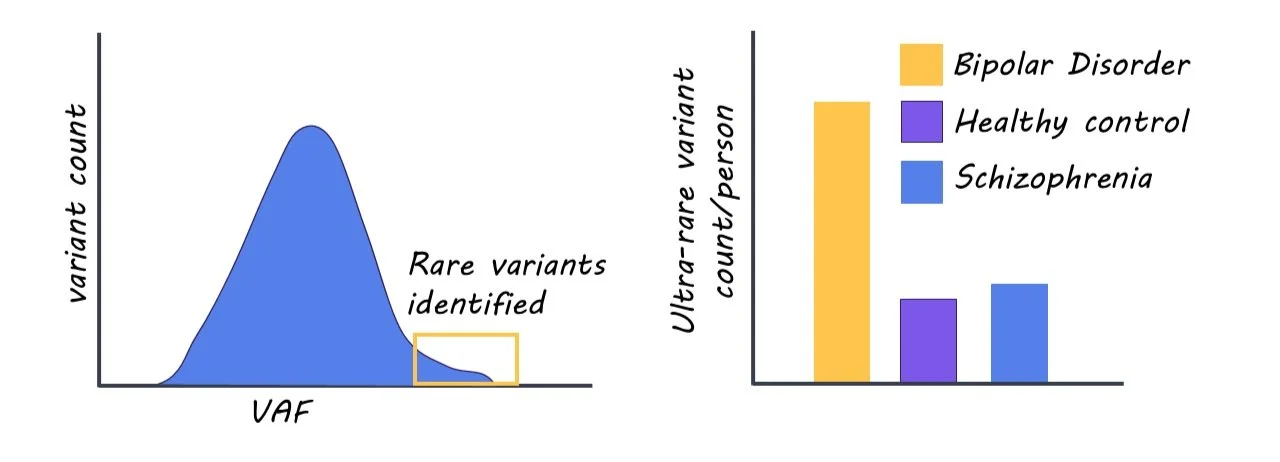
The authors analyzed brain DNA from 54 BD patients, 55 schizophrenia patients, and 54 healthy controls to investigate the association between BD and mitochondrial DNA variants. They used duplex molecular barcode sequencing, a high-precision technique that tags each DNA molecule to detect rare mitochondrial DNA variants with single-molecule resolution. This approach allowed for the identification of heteroplasmic variants, where both normal and mutated mitochondrial DNA are present within the same cell. They then calculated the Variant Allele Frequency (VAF), that is the percentage of DNA sequences in a sample that carry the specific genetic variant. Using both bulk analysis and single-molecule analysis pipelines, they could detect variants with either high and moderate-VAF or low VAF, respectively. The authors could then determine which variants are present and the frequency of each variant in healthy controls compared to BP or schizophrenia patients.
The authors hypothesized two potential models for the mode of association between BD and mitochondrial variants in the brain:
1- A limited number of likely pathogenic variants with a high VAF would cause mitochondrial dysfunction and impair neuronal activity.
2- Accumulation of numerous non-specific variants with low VAF progressively degrades mitochondrial function and impairs neuronal activity.
What did they find?
Using bulk sequencing analysis, the authors identified 116 heteroplasmic variants with high/moderate VAF. Thirty-six of them were ultra-rare variants (rarely seen in healthy controls). Both BD and schizophrenia brain mitochondrial DNA had more variants compared to controls, but when limiting the analysis to the ultra-rare variants, only BD had an increase in variants. Through further investigation of these ultra-rare variants, the authors identified potentially pathogenic mutations such as 1) the m.3243A>G mutation, which is causative of the mitochondrial disorder MELAS, 2) four loss-of-function mutations, and 3) six rRNA variants with scores for high pathogenicity. To detect low-VAF variants, the authors used single-molecule analysis. They identified a total of 52,312 low-VAF heteroplasmic variants, however, there was no difference in the frequency of these variants between BD, schizophrenia, and controls. There was an association with age across all groups, with the frequencies increasing with age, reinforcing prior evidence of age-associated systematic mutation rate increase. Additionally, when analyzing the mutation patterns at the single nucleotide level, there was no difference in the mutation pattern among the three groups. Together, these data suggest the mitochondrial variants in BD are due to a consistent specific mutagenic mechanism and not due to a general increase in DNA variability, supporting model 1 from the authors' original hypothesis. Thus, a subset of BD patients could harbor ultra-rare, potentially pathogenic, mitochondrial DNA mutations in their brain tissue, which could be impacting the pathophysiology of their disease.
What's the impact?
This study was the first to examine mitochondrial variant accumulation at single-molecule resolution in mood disorders. Ultra-rare loss-of-function and rRNA variants are novel candidates for further investigation into the role of mitochondrial dysfunction in BD. There are already several compounds targeting mitochondrial function that could be useful therapies for the treatment of patients with BD.