Why Does the Brain Sometimes Mistake Imagination for Reality?
Post by Soumilee Chaudhuri
The takeaway
The human brain employs common neural circuits for both external perception and internal imagination, which can lead to confusion between real and imagined experiences. The authors of this study designed an experiment that intentionally blurred the line between imagination and perception to show how a brain region called the fusiform gyrus distinguishes between internal (imagined) experiences and external (perceived) ones.
What's the science?
Decades of research have shown that visual imagination activates many of the same brain regions (visual cortices) involved in actual visual perception. While this shared use of neural resources is efficient, it also creates a challenge: the brain might confuse imagined experiences with real ones. Previous research has demonstrated that when imagination is very vivid, individuals are more likely to believe what they imagine is real. The exact neural mechanisms by which the brain differentiates between externally perceived and internally generated sensory information remain unclear. This week in Neuron, Dijkstra and colleagues used brain imaging while participants viewed and imagined specific visual patterns to try and answer this question.
How did they do it?
As part of this study, twenty-six healthy volunteers took part in a visual detection task while their brain activity was recorded using functional magnetic resonance imaging (fMRI). All of them completed a behavioral training session to practice detecting and imagining oriented faint patterns or gratings. For the main task, they were shown these gratings that tilted either left or right, sometimes hidden in noisy backgrounds. At the same time, participants were asked to imagine a grating that either matched (congruent) or didn't match (incongruent) the pattern they were trying to detect, with these conditions changing in blocks. After each trial, they reported whether they thought a real grating appeared and rated the vividness of their mental image. Participants judged whether a pattern was present and rated the vividness of their mental imagery. Their brain scans were then analyzed to understand how the brain combines signals from both seeing and imagining to tell apart reality from imagination.
What did they find?
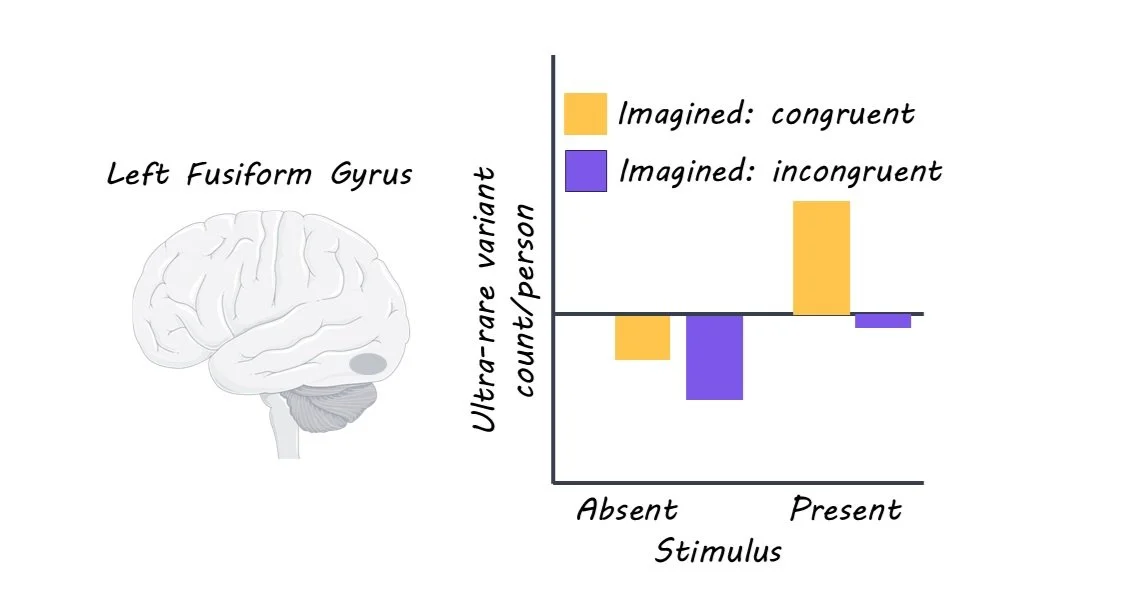
The study found that the bilateral fusiform gyrus (FG) plays a crucial role in determining whether what we see is real or imagined. Brain activity in the FG was more potent when what people imagined matched the real stimulus (called the congruent condition), especially in the left FG, where this effect was highly significant. Individuals who exhibited greater confusion between imagination and reality also showed more vigorous FG activity on the right side. Moreover, the vividness of people's mental images also influenced FG activity. In contrast, other brain areas showed some activity but lacked the specific pattern required to distinguish between reality and imagination. Significantly, activity in the left FG could predict when people mistakenly thought an imagined image was real, but only when the imagined image matched the one they were looking for (i.e., the congruent condition). This shows that the FG helps the brain distinguish between sensory signals and imagination, explaining why we sometimes confuse the two.
What's the impact?
This research reveals how the brain distinguishes real experiences from imagined ones by using the FG to combine signals from perception and mental imagery into a "reality signal” or RS. This signal helps decision-making regions of the brain determine whether something is truly happening or just imagined. Disruption in this biological process could contribute to serious dysregulation of sensory perceptions, such as hallucinations, especially associated with psychiatric illnesses such as schizophrenia. This work sets the stage for developing targeted and effective treatments for individuals who struggle to distinguish between imagination and reality in everyday life.