
How Cognitive Fatigue Affects Effort-Based Choices
Post by Meagan Marks
The takeaway
Cognitive fatigue—that well-known feeling after a long day of work—typically reduces our motivation to take on additional tasks. During this decline in motivation, the dorsolateral prefrontal cortex and right insula exhibit strengthened connectivity, providing insight into the neurobiology of fatigue and suggesting a potential target for amotivation.
What's the science?
Cognitive fatigue is a familiar feeling that follows sustained mental effort, building up throughout the workday and reducing our willingness to engage in further exertion. Despite its relevance, the mechanism by which cognitive fatigue is generated in the brain and its influence on decision-making circuitry remain unclear. Understanding the neurobiology behind cognitive fatigue and its impact on exertion-related choices will not only offer insight into everyday brain function but may also help identify neural networks involved in amotivation—a lack of motivation and energy that often accompanies many psychiatric and neurological conditions. This week in the Journal of Neuroscience, Steward and colleagues identify brain regions involved in cognitive fatigue and examine how they interact with effort-based decision-making areas to uncover how fatigue shapes effort-based choices.
How did they do it?
The study involved 28 participants (18 females, 10 males), who first practiced the experimental task—a version of the “n-back” memory task—outside of the magnetic resonance imaging (MRI) scanner. In this task, participants were shown a sequence of letters, one at a time, and were periodically asked whether a letter matched one presented “n” letters earlier, with “n” ranging from 1 to 6. Higher values of “n” represented greater cognitive effort, and each effort level was paired with a specific color (e.g., n=1 in green to represent minimal effort, n=6 in blue to represent maximum effort), allowing participants to associate each color with a corresponding level of mental exertion.
After this association phase, participants entered the scanner. To establish a baseline, they completed 80 trials in which they repeatedly chose between a simple n=1 task for $1 or a more cognitively demanding n-back task (displayed by color) for a higher monetary reward. Participants then entered the experimental or ‘fatigue phase’, which followed the same structure but included intermittent bouts of mentally demanding tasks designed to induce fatigue. This phase also consisted of 80 trials.
A control group followed the same protocol, except rest periods replaced the exertion bouts during the second phase. This controlled for potential confounding factors such as time, task exposure, or trial order, ensuring that any observed effects were specifically attributed to cognitive fatigue.
What did they find?
As expected, participants were less likely to choose high-effort options when fatigued—preferring low-effort, low-reward choices—especially as the experiment progressed, compared to baseline. This effect was not seen in the control group, indicating that the behavioral changes were due to cognitive fatigue.
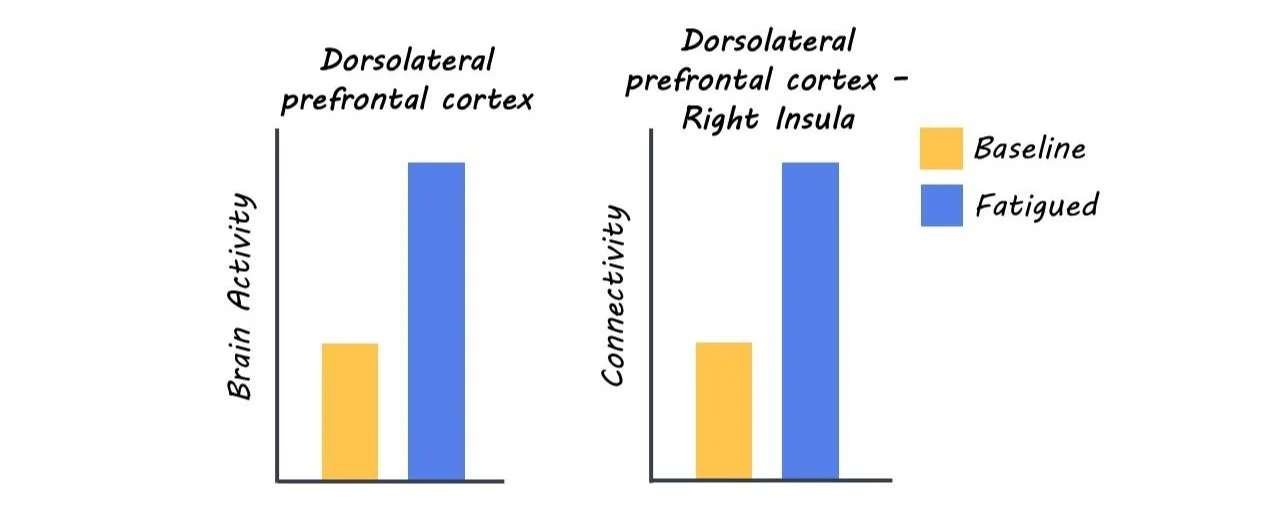
Neuroimaging data revealed that regions within the brain’s effort-valuation network showed altered activity based on the monetary value and perceived effort level of choices. This pattern held across both the fatigue and baseline phases. However, one effort-valuation region—the right insula—showed greater fluctuations in activity in response to the effort-based decisions during the fatigue phase. This suggests it is particularly sensitive to cognitive fatigue and may play a role in evaluating effort when mental resources are drained. During fatigue, this region also showed increased connectivity with the dorsolateral prefrontal cortex, a region associated with cognitive control and demand. Activity in the dorsolateral prefrontal cortex rose with increasing fatigue, suggesting it may help detect when the brain is fatigued. The strengthened connectivity between the right insula and dorsolateral prefrontal cortex during fatigue implies that these regions may work together to integrate information about an individual’s cognitive state and guide decisions about future mental effort.
What's the impact?
This study is the first to identify a potential circuit that modulates our effort-based choices and evaluations when mentally fatigued. Two brain regions— the dorsolateral prefrontal cortex (a ‘fatigue’ region) and the right insula (an effort-valuation region)— show strengthened communication when making effort-based decisions during a fatigued state, indicating that they may work together to influence our choice to perform additional mental exertion when in a state of cognitive fatigue. Understanding this connection not only uncovers the neurobiology behind a common human experience but also points to a possible target for addressing amotivation, a debilitating symptom in many neurological and psychiatric conditions.