
How The Brain Recovers From Sleep Debt
Post by Natalia Ladyka-Wojcik
The takeaway
After a period of sleep deprivation, our bodies settle the (sleep) score by entering into a period of persistent and deep recovery sleep. For the first time, scientists have discovered the neural circuit that promotes recovery sleep, providing key insights into how the brain maintains sleep homeostasis.
What's the science?
Sleep is governed by homeostatic control, the body’s mechanism for maintaining a stable internal environment despite changes in the external environment. When we experience sleep deprivation, the resulting accumulation of “sleep debt” prompts the body to restore sleep balance by initiating a period of persistent and deep recovery sleep. Although many molecular and cellular mechanisms have been proposed to regulate sleep, we still don’t know what specific neural circuits may detect or transmit homeostatic signals to sleep-promoting brain regions. This week in Science, Lee and colleagues set out to identify a neural circuit responsible for triggering this essential recovery sleep, using tools that allow neuroscientists to control the signaling of brain cells in mice.
How did they do it?
In mammals, sleep can be categorized into two types: rapid eye movement (REM) sleep and non-REM sleep, the latter of which is considered a deeper, recovery-type sleep. Here, the authors mapped a group of excitatory neurons in the thalamus of mice that project to brain regions which are thought to promote non-REM sleep. Specifically, they investigated non-REM, homeostatic recovery sleep after activating and inhibiting neurons in the nucleus reuniens of the thalamus – a major relay station for sensory and motor information in the brain. The authors used a technique called chemogenetics to inhibit neurons of the nucleus reuniens during sleep deprivation in order to determine if subsequent non-REM recovery sleep would be affected. A similar approach using optogenetics, a tool that uses targeted pulses of light to control the activation of neurons, was also used to determine if the stimulation of excitatory neurons in the nucleus reuniens would promote sleep behaviors. Finally, the authors assessed the downstream impact of activation in these neurons by tracing their projections to other non-REM sleep-promoting brain regions.
What did they find?
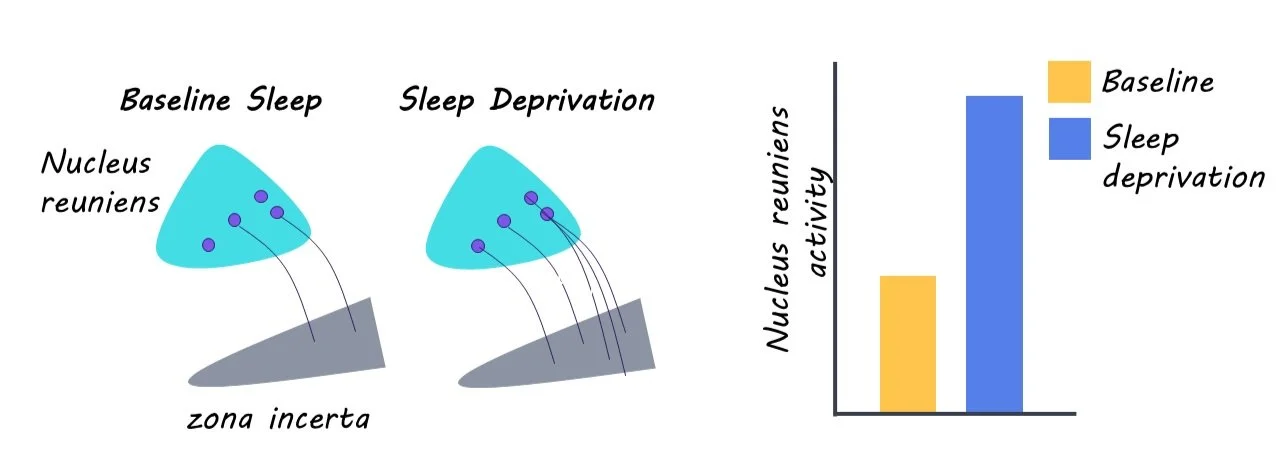
The authors found that inhibiting neurons in the thalamic nucleus reuniens decreased the quality of homeostatic, non-REM recovery sleep that the mice subsequently experienced. In contrast, stimulated neurons in the nucleus reuniens led to mice exhibiting longer, deeper, non-REM sleep after a delay, suggesting that these neurons regulate sleep homeostasis. The authors also found that mice engaged in more behaviors associated with preparation for sleep, such as self-grooming, after optogenetic activation of these neurons. Importantly, after longer periods of sleep deprivation, neurons in the nucleus reuniens fired more frequently while the mice were awake – an effect that diminished with subsequent recovery sleep. Finally, the authors found that these neurons projected to a small subthalamic region called the zona incerta, to generate non-REM recovery sleep. Curiously, sleep deprivation enhanced interactions between the nucleus reuniens and zona incerta, whereas disrupting synaptic plasticity in the nucleus reuniens impaired this interaction and reduced non-REM sleep.
What's the impact?
This study is the first to identify a neural circuit responsible for homeostatic control over non-REM recovery sleep, separate from regular sleep-wake cycles. Specifically, these findings suggest that during sleep deprivation, brain regions that promote non-REM sleep increase their communication to drive deeper, more restorative sleep. By uncovering the brain mechanisms that support recovery sleep in mice, this research provides insight into what may happen in the human brain after sleep loss, particularly in conditions like idiopathic hypersomnia, where patients experience an overwhelming and persistent need for sleep.