
Reducing Loneliness: Comparing an AI Chatbot to a Human

Post by Lila Metko

The takeaway

Given the global loneliness epidemic, many scientists are looking to technology to find scalable solutions. A recent study shows that artificial intelligence (AI) may be a good solution when an immediate boost in affect is needed, but that over the long term, real human relationships can better foster a reduction in loneliness.

What’s the science?

Generative AI is used by a large number of people not just for information, but for a meaningful source of connection. In recent years, a growing number of scientific studies have examined the effects of chatbots on social connection and positive mood. While many studies have shown positive immediate effects of chatbots, few have assessed the benefits over time. Interestingly, one long-term study found that chatbots may negatively impact emotional state, with seeking chatbot social support predicting increased loneliness. This week in Journal of Experimental Social Psychology, Li and colleagues assessed the cumulative impact of interacting with a custom AI chatbot on emotional outcomes in a population vulnerable to loneliness.

How did they do it?

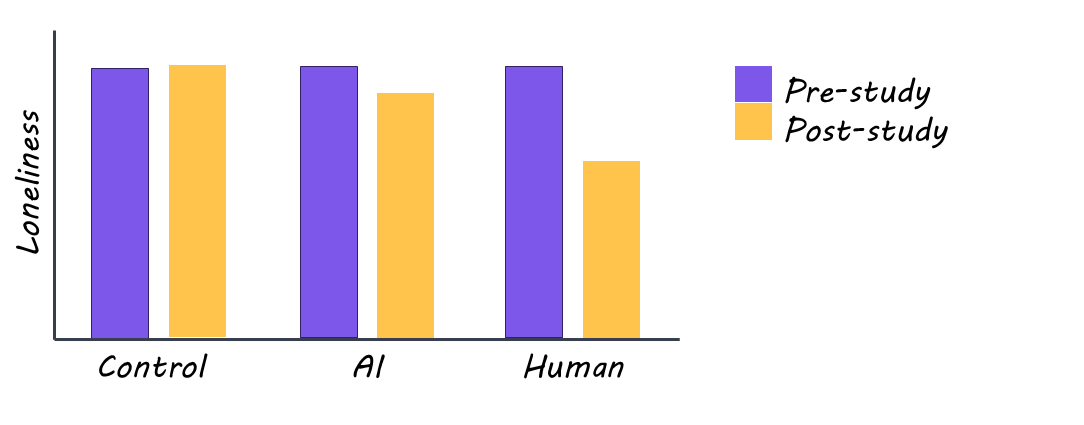
The authors conducted this study using two experimental groups (chatbot and human) and one control group (daily journaling) to compare the impact of a supportive chatbot on loneliness with that of conversing with a random peer. They conducted this two-week study using a custom chatbot named Sam, designed to have the qualities of an ideal supportive friend, and a subject pool of first-semester college students at a Canadian university. Conversations for each group, including the journaling group, were held on the social media platform Discord, a popular platform among students. The human peer group met with their human conversation partners in person at the beginning of the study. The chatbot and peer group participants were asked to send one meaningful message each day. Each participant was asked to perform their assigned task and take a short survey for 14 consecutive days. The participants were also assessed via a survey pre and post-study.

What did they find?

The authors found that only the human peer group showed a decrease in loneliness post-study. A similar pattern was found for positive mood and perceived isolation. Interestingly, both the human peer group and the chatbot group displayed decreased negative mood post-study compared to the control group. Participants were allowed to use their Discord room for one week following the study. The percentage of the human peer group that continued to engage with their human conversation partner in the Discord room was more than double the percentage in the group that continued communication with their chatbot during this one-week time period. These findings overall suggest that interactions with a human peer may be more beneficial than interactions with an AI chatbot to reduce loneliness.
What’s the impact?

This study’s results suggest a “middle ground” role of AI chatbots on emotional outcomes in individuals vulnerable to loneliness, demonstrating that a chatbot can reduce negative affect, while a human’s support may have a more positive impact in the longer term. This study sheds light on when to use AI or human-based support in vulnerable populations to reduce loneliness. The authors suggest that it is better to view AI as a tool to ameliorate rather than mimic human connection.
Access the original scientific publication here.

Can Cell Therapy Restore Hearing Loss?

Post by Anastasia Sares

The takeaway

In an experimental cell therapy treatment, researchers transplanted young, immature auditory cells from the ears of newborn mice into older mice whose hearing had been damaged. These cells, surrounded by a new environment, matured and repaired the hearing of the older mice. 

What's the science?

Deep in the inner ear are cells called hair cells that are responsible for taking sound from the environment and turning it into electrical signals to be sent to the brain. These cells are attached to a membrane in the ear that vibrates with incoming sounds, and the movement of this membrane causes the cells to fire. However, as we age, hair cells experience significant wear and tear, and they are sensitive to insults like loud noise exposure, infections, and head trauma. There are even certain classes of drugs that can cause hair cells to die off as a side effect. Hair cells generally do not regenerate in adults, so when they die, it causes an irreversible loss in hearing. While there are some solutions for hair cell loss, such as cochlear implants, these all come with their own drawbacks.

Cell therapy is a kind of medical treatment that involves taking cells from one organism and transplanting them into another (or from one organ/tissue to another within the same organism). It includes treatments like bone marrow transplants and stem cell therapy. When trying to apply this kind of therapy to hearing loss, there are several challenges: will the transplanted cells develop into functioning hair cells? Will the procedure be too invasive and cause additional damage to the inner ear? Will the procedure result in significantly better hearing in the end?

This week in Neuroscience, Liu and colleagues showed that cells can be successfully transplanted into the inner ear and restore hearing function in mice that have drug-induced hearing loss.

How did they do it?

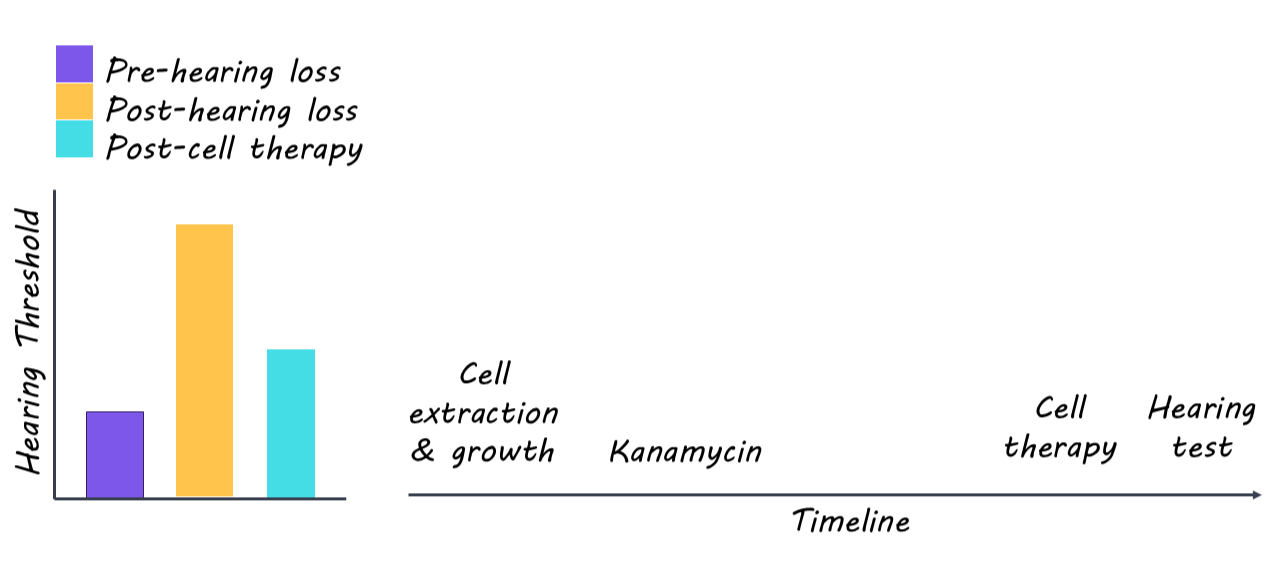
The authors first induced hearing loss in a group of adult mice by administering an antibiotic known to cause hair cell death (kanamycin). Then, relying on previous research, they extracted a very specific type of cell from the inner ears of newborn mice and grew these cells in a gel matrix, where the cells clumped together to form small “organoids” that were ready to become hair cells. They then injected these cells into the left inner ear of each adult mouse (with the right ear serving as a control).

To measure the mice’s hearing, the authors used the auditory brainstem response, which records electrical activity from the brainstem to measure how well the early auditory system responds to sound. They made these measurements before hearing loss, after hearing loss, and after cell therapy.

What did they find?

The authors confirmed that hair cells had died and that the adult mice’s hearing was severely impaired after being exposed to kanamycin. After cell therapy, hair cells survived the transplant and did not cause any additional hearing loss in the mice. The new cells were able to repopulate the inner ear, and hearing thresholds recovered substantially (though not completely) following the cell therapy.

What's the impact?

This study shows that it is possible to restore the function of hair cells and significantly improve hearing using cell therapy. Cell therapy may be a viable way to address the previously irreversible problem of hearing loss that affects millions of people worldwide.

Access the original scientific publication here.

Brain Rhythms Translate Empathy Into Prosocial Behavior

Post by Amanda Engstrom 

The takeaway

Orexin neurons in the anterior cingulate cortex generate theta oscillations that transform empathic perception into prosocial behavior, revealing a precise circuit linking emotional understanding to helpful behavior.

What's the science?

Empathy allows animals to perceive and share others’ emotional states and drives prosocial behaviors, which are essential for societal cohesion and well-being. In mice, empathy has been associated with changes in theta oscillations (slow, repeating electrical patterns that coordinate communication between brain regions) in the anterior cingulate cortex (ACC). The ACC has been suggested to be a “central hub” for empathy and prosocial behaviors, projecting into multiple brain regions involved in these complex behaviors. 

The neuropeptide orexin regulates arousal, stress, and emotional processing and promotes theta oscillations. However, it remains unclear what upstream circuits modulate these oscillations and how they influence empathy and prosocial behaviors. This week in Science, Kim and colleagues examine how orexin modulates ACC theta oscillations and their relationship to prosocial behaviors. 

How did they do it?

The authors evaluated empathy’s effects on prosocial behavior using an observational fear-conditioning paradigm (one mouse watches another receive a foot shock) combined with a consolation assay measuring allogrooming (the observer mouse grooming the foot-shocked mouse). They tested two paradigms: an experience-dependent observer (EXP), which had previously received a foot shock, and a naïve observer with no prior fear experience. They measured vicarious freezing (the observer mouse freezes at the tone when the experimental mouse receives the foot shock) and allogrooming in both groups and evaluated the impact of consolation on the shocked mouse using an open-field test. To dissect the neuronal mechanisms involved in these behaviors, the authors recorded ACC theta oscillations (5–7 Hz) during behavior. They conducted fiber photometry recordings using a genetically encoded orexin sensor (OxLight1), and using optogenetics, they inhibited ACC-projecting orexigenic circuits in observing mice only during the observation period when the experimental mouse received a foot shock

What did they find?

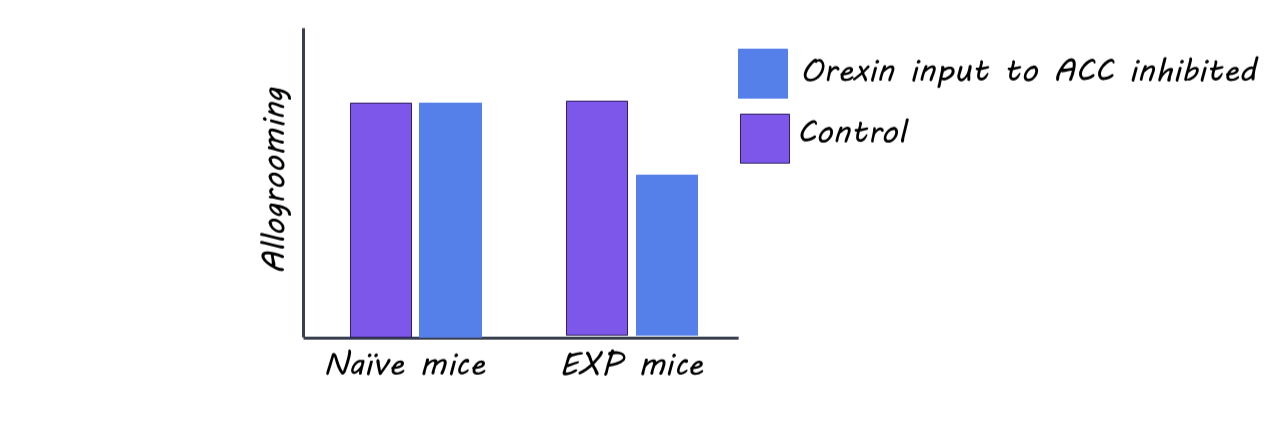
Both naïve and EXP observers exhibited vicarious freezing during observation and increased allogrooming after foot shock reunion. However, EXP mice displayed stronger vicarious freezing and more allogrooming compared to naïve mice. Self-grooming increased after observing the foot shock, but did not differ between groups. Notably, emphatic-like behaviors required visual attention - an observer mouse looking away during the foot shock showed no effects. Additionally, the authors found that the increased allogrooming by EXP observers resulted in less anxiety-like behavior in the mice that received the foot shock. Together, these data suggest that shared experiences enhance prosocial behaviors but don’t alter self-directed care.

To dissect the mechanism behind these behaviors, the authors show that both naïve and EXP observers have increased 5- to 7- Hz theta oscillations in the ACC while mice are observing the foot shock and during allogrooming (i.e. empathy and prosocial behavior), but not self-grooming. Concordantly, there was a selective increase in orexin activity at the same time, but only in EXP mice, suggesting that orexin-dependent increases require shared experience rather than observation alone. Inhibiting orexin input to the ACC specifically during the observation period reduced theta power and allogrooming in EXP mice and had no effect in naïve mice. These findings suggest that orexinergic inputs drive ACC theta oscillations to modulate affective empathy and prosocial action when there is shared experience.

What's the impact?

This study found that orexin-dependent increases in ACC theta oscillations link affective empathy to prosocial comforting behaviors. It demonstrates that social behavior relies on specific neuromodulatory rhythms to translate emotional experience into action. Elucidation of this upstream mechanism can provide potential targets for treating disorders that lead to empathy deficits. 

Access the original scientific publication here.