
Reducing Loneliness: Comparing an AI Chatbot to a Human
Post by Lila Metko
The takeaway
Given the global loneliness epidemic, many scientists are looking to technology to find scalable solutions. A recent study shows that artificial intelligence (AI) may be a good solution when an immediate boost in affect is needed, but that over the long term, real human relationships can better foster a reduction in loneliness.
What’s the science?
Generative AI is used by a large number of people not just for information, but for a meaningful source of connection. In recent years, a growing number of scientific studies have examined the effects of chatbots on social connection and positive mood. While many studies have shown positive immediate effects of chatbots, few have assessed the benefits over time. Interestingly, one long-term study found that chatbots may negatively impact emotional state, with seeking chatbot social support predicting increased loneliness. This week in Journal of Experimental Social Psychology, Li and colleagues assessed the cumulative impact of interacting with a custom AI chatbot on emotional outcomes in a population vulnerable to loneliness.
How did they do it?
The authors conducted this study using two experimental groups (chatbot and human) and one control group (daily journaling) to compare the impact of a supportive chatbot on loneliness with that of conversing with a random peer. They conducted this two-week study using a custom chatbot named Sam, designed to have the qualities of an ideal supportive friend, and a subject pool of first-semester college students at a Canadian university. Conversations for each group, including the journaling group, were held on the social media platform Discord, a popular platform among students. The human peer group met with their human conversation partners in person at the beginning of the study. The chatbot and peer group participants were asked to send one meaningful message each day. Each participant was asked to perform their assigned task and take a short survey for 14 consecutive days. The participants were also assessed via a survey pre and post-study.
What did they find?
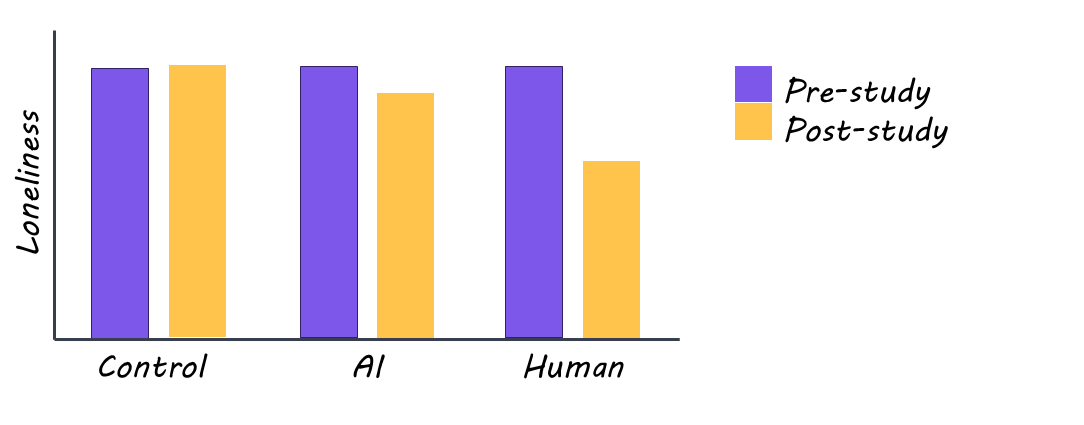
The authors found that only the human peer group showed a decrease in loneliness post-study. A similar pattern was found for positive mood and perceived isolation. Interestingly, both the human peer group and the chatbot group displayed decreased negative mood post-study compared to the control group. Participants were allowed to use their Discord room for one week following the study. The percentage of the human peer group that continued to engage with their human conversation partner in the Discord room was more than double the percentage in the group that continued communication with their chatbot during this one-week time period. These findings overall suggest that interactions with a human peer may be more beneficial than interactions with an AI chatbot to reduce loneliness.
What’s the impact?
This study’s results suggest a “middle ground” role of AI chatbots on emotional outcomes in individuals vulnerable to loneliness, demonstrating that a chatbot can reduce negative affect, while a human’s support may have a more positive impact in the longer term. This study sheds light on when to use AI or human-based support in vulnerable populations to reduce loneliness. The authors suggest that it is better to view AI as a tool to ameliorate rather than mimic human connection.