
Playing Rhythm Games May Improve Stuttering

Post by Anastasia Sares

The takeaway

This proof-of-concept study tested a computer game intervention with children who stutter. Those who played a rhythm-based game had improved rhythm and speech motor skills at the end of the study, but more work is needed to establish the efficacy of this gamified intervention.

What's the science?

Developmental stuttering is a disorder of speech that is characterized by involuntary pauses, repetitions, or extensions of speech sounds. Sometimes a stutter disappears naturally as children get older, but for about 1% of the population, stuttering continues into adulthood. There is a growing body of research showing that rhythmic abilities, like tapping to a beat or hearing differences in rhythmic patterns, are linked to language abilities, like reading and speaking. Scientists are beginning to test whether rhythm training might lead to improvements in language-related disorders like dyslexia and stuttering.

This week in Annals of the New York Academy of Sciences, Jamey and colleagues tested whether playing a rhythm game would improve speech fluency in people who stutter.

How did they do it?

About 20 children who stutter (ages 9-12) were recruited to participate in the study. These participants were divided into two groups: the rhythm-based intervention group and the non-rhythm-based intervention group. Both groups were tested on attention/cognition, rhythm ability, speech motor ability, and stuttering frequency before the intervention began and after it was over.

The rhythm-based intervention was a game called Rhythm Workers, in which the player must tap on the screen in synchrony with the music to help construction workers build a building, with levels being added to the building based on accurate synchronization. The non-rhythm-based game was based on an open-source version of the game Frozen Bubbles, where players must shoot bubbles out of a cannon to make clusters of colored bubbles on the screen and eliminate them. The same music was played in the background of both games, and they required similar amounts of tapping on the screen. Each group played their respective games for three weeks, and were told to aim for 30 minutes to one hour each day. The use of an “active control” condition is important in this kind of work to make sure that it is the rhythmic aspect of the game, not just the gamification itself or the time and attention required, that is responsible for any gains.

What did they find?

On average, both groups completed over 90% of the target amount of play time and reported enjoying the games, though there was variation between individuals in terms of their dedication and enjoyment. Both groups started out with similar scores on rhythmic behavior, attention/cognition, and speech, but the Rhythm Workers group showed some improvements in each category by the end of the intervention, while the Frozen Bubbles group did not. The more time participants spent in the Rhythm Workers game, the better their rhythm and stuttering scores were at the end of the intervention, while time spent in the Frozen Bubbles game was not related to rhythm or stuttering scores. Improvement in rhythm scores was also related to reduced stuttering.
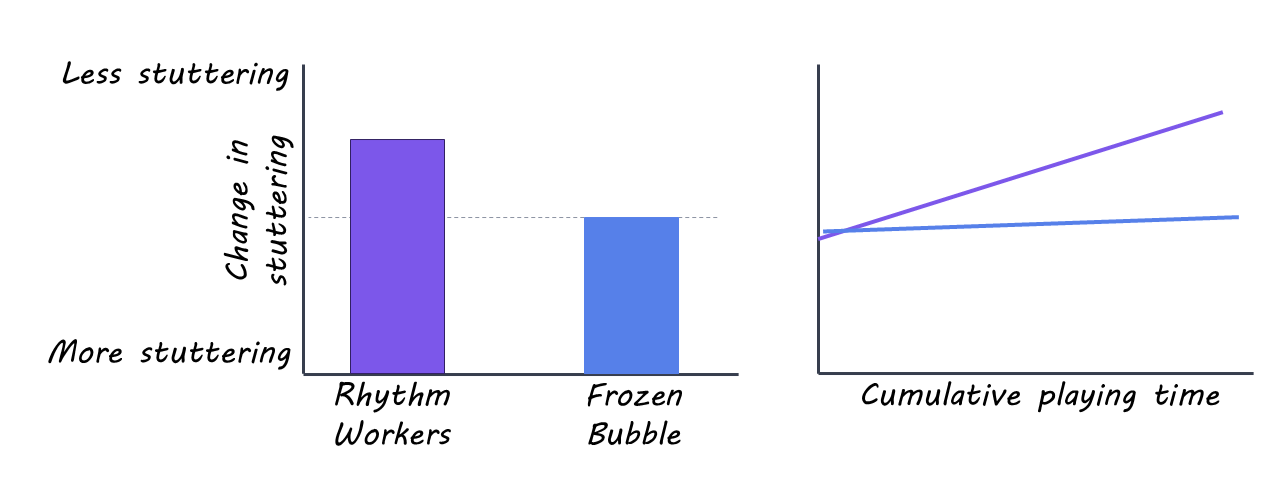
However, the main group difference of interest—whether stuttering scores improved more with the Rhythm Workers game than the Frozen Bubbles game—did not reach significance.

What's the impact?

This study, though the sample size is small, shows promise for rhythm-based interventions in speech disorders such as stuttering. The next step will be to replicate these findings and to test whether the Rhythm Workers game (or a similar intervention) could actually lead to significant reductions in stuttering in a larger sample.
Access the original scientific publication here.

Are Type 2 Diabetes and Dementia Linked?

Post by Rebecca Glisson

The takeaway

Type 2 diabetes can lead to worse cognitive health and even dementia. This study found that in a large sample of over 350,000 individuals, type 2 diabetes leads to a higher risk of Alzheimer’s disease.

What's the science?

The relationship between type 2 diabetes and brain health is not yet understood; however, some evidence suggests that diabetes symptoms are related to dementia symptoms. One common symptom of diabetes is the level of glucose (sugar) in the bloodstream 2 hours after eating, which should typically return to baseline levels in healthy individuals but stays high in diabetic individuals because they lack insulin to process glucose out of the bloodstream. This week in Diabetes, Obesity and Metabolism, Mason and colleagues studied the possible mechanisms of how diabetes is linked to dementia.

How did they do it?

The authors used a large database of survey questions and health measurements to test for correlations between diabetes and cognitive function. They used data from 357,883 participants who were between 40 and 69 years old (54.1% female). They tested cognitive functioning using MRI scans to measure volume in the hippocampus, a brain region involved in memory processing, along with total brain volume. To measure diabetes symptoms, the authors obtained blood samples from participants.

What did they find?

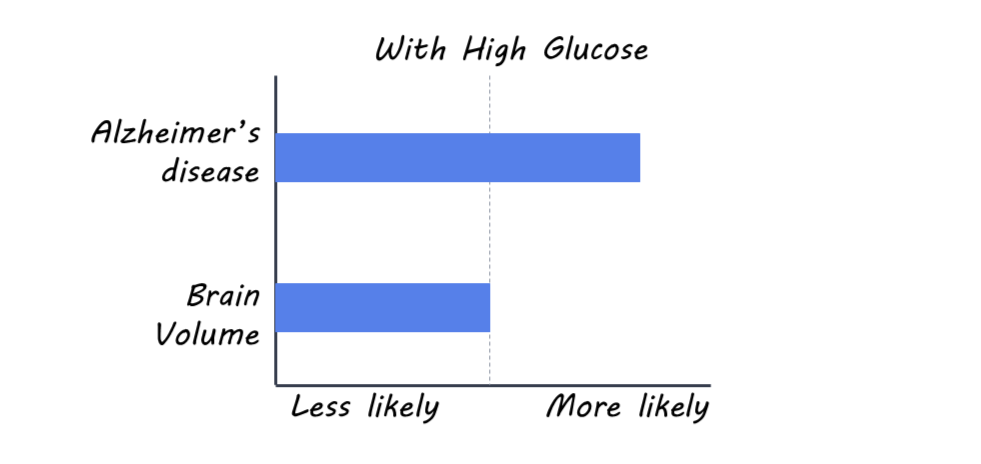
The authors found that individuals who had elevated levels of glucose had a 23% increased risk of dementia, and a 69% increased risk of Alzheimer’s disease. This supports the idea that individuals with type 2 diabetes are more at risk for developing cognitive disorders. However, the authors did not find any link between diabetes symptoms or brain measurements. This suggests that the increased risk for dementia from diabetes likely acts through other mechanisms. The authors suggest that future research should look into tau and amyloid plaques, which are other markers of Alzheimer’s disease and could be one cause for the link between diabetes and risk of developing dementia.

What's the impact?

This study is the first to show a clear link between diabetes symptoms and symptoms of cognitive dysfunction. However, the mechanism for this link is still unclear and needs further study. An important caveat is that only white, British participants were included in the study due to a lack of data availability for other groups, and further study should be conducted on diverse populations.

Access the original scientific publication here.

How Neurons Store Memory Content and Context

Post by Amanda Engstrom 

The takeaway

Recalling memories often requires linking what happened with the context in which it happened. In humans, information about content and context is largely encoded by separate neuronal populations that are coordinated over time, allowing the brain to form context-dependent memories while preserving stable independent representations. 

What's the science?

The medial temporal lobe (MTL) plays a crucial role in forming and retrieving memories. In particular, the hippocampus has been implicated in encoding items-in-context memory, which involves combining what happened (the item) with the context in which it occurred (a task or environment). Rodents rely on conjunctive encoding where hippocampal representations are context dependent, however in humans, concept cells often fire independently of context. Therefore, it remains unclear how item and context memories are formed and combined at the single neuron level. This week, in Nature, Bausch and colleagues recorded activity from thousands of individual neurons during a memory and decision-making task to investigate how human MTL neurons combine information about item and context.

How did they do it?

The authors recorded activity from over 3,000 neurons in 16 neurosurgical patients implanted with depth electrodes for clinical monitoring. Individual neurons were recorded while participants performed a task-dependent picture comparison test. Each trial began with a question that defined the context (Bigger?”, “Older?”, “Last seen in real life?”, “Like better?”, or “More expensive?”). Participants were then shown pairs of pictures for which to apply the question. This task required participants to remember items (each picture) within a specific context (answering the question), while keeping the item and context information independent of each other. The electrodes recorded neuronal spiking activity across multiple regions of the MTL, including the hippocampus, entorhinal cortex, parahippocampal cortex, and amygdala. Spike timing was precisely aligned to stimulus and/or task events. Using these recordings, the authors applied statistical modeling to determine whether firing was linked to the item (picture) alone, the context (task question) alone, or specific item – context interactions. 

What did they find?

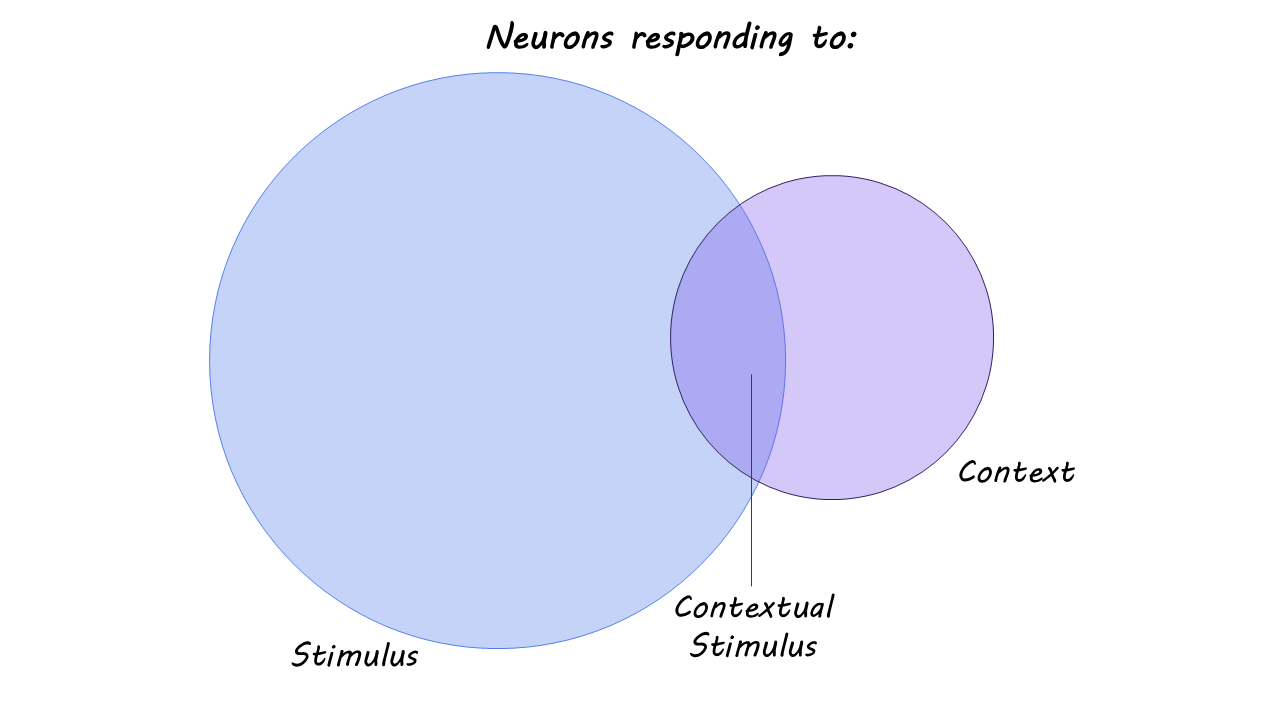
Only a small fraction of neurons fired selectively for specific item-context combinations. Instead, the majority of neurons across the MTL regions were primarily selective to stimulus (item/ picture) or context (task question). Item and context coding were largely independent, supporting a flexible and generalized memory formation pattern. 

After experimental pairing and statistical modeling, the authors observed coordinated activity across MTL regions. Firing of stimulus-selective neurons in the entorhinal cortex predicted later firing of context-specific neurons in the hippocampus, suggesting that although item and context are encoded independently, they interact dynamically during memory processing. These findings support a model in which humans rely on distinct but coordinated neuronal streams to form flexible, context-dependent memories.

What's the impact?

This study found that rather than combining item and context information within single neurons, the human brain encodes them separately and then integrates them through coordinated activity between distinct neuronal groups, enabling both generalized and contextually specific recall. These findings bridge the gap between rodent models of hippocampal-dependent memory formation and human concept-cell research and provide a mechanistic explanation for how the human brain balances memory specificity with generalization, a fundamental feature of adaptive cognition. 

Access the original scientific publication here.