Improving Brain Flexibility in Adults with Autism

Post by Soumilee Chaudhuri

The takeaway

Individuals with autism often exhibit rigid patterns of thinking and perception, which may stem from reduced flexibility in how their brain transitions between different activity states. Previous research has shown that the severity of core autistic traits is linked to this kind of neural rigidity. This study used brain stimulation to temporarily increase brain flexibility in adults with autism. 

What's the science?

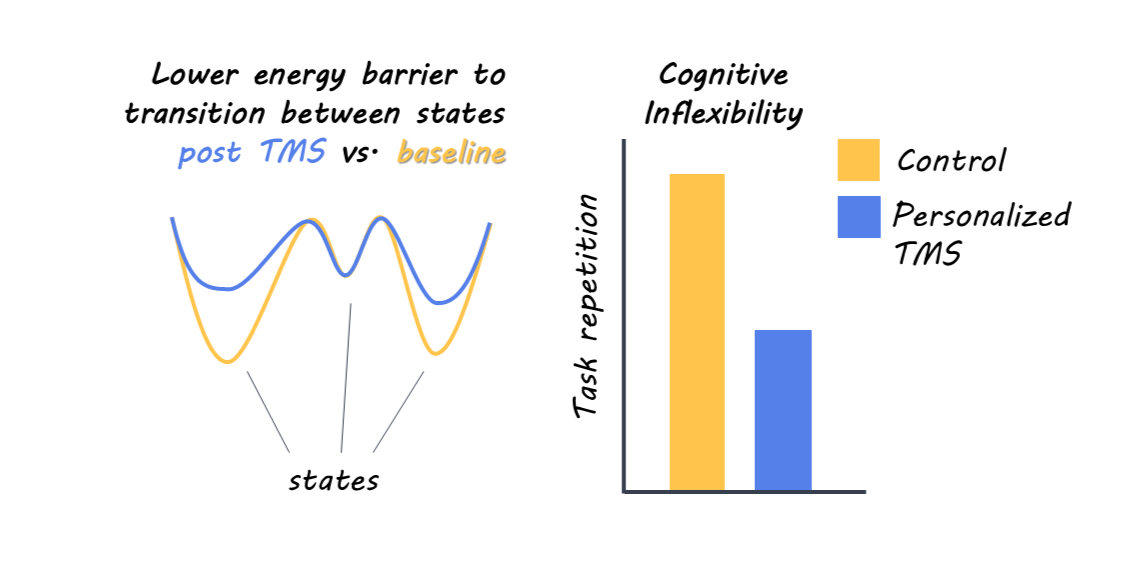
Autism spectrum disorder (ASD) is widely characterized by differences in how the brain integrates and processes information across multiple systems. One emerging theory suggests that a core feature of autism may be reduced flexibility in the brain's global dynamics—that is, the ease with which the brain transitions between different activity states. These state transitions are essential for adapting to new tasks, shifting attention, interpreting sensory input, and understanding social signals. Previous studies have shown that individuals with autism often have more rigid brain dynamics and fewer state transitions and that this rigidity is associated with key traits of autism, such as repetitive behaviors, heightened sensory perception, and difficulties with nonverbal communication. However, it remains unclear whether this rigidity is simply a byproduct of autism or if it contributes to these traits. This study aimed to determine whether increasing the flexibility of global brain dynamics can causally reduce core traits associated with ASD.

How did they do it?

Using a new brain stimulation technique called brain-state-dependent transcranial magnetic stimulation (TMS), the researchers delivered brief pulses of energy to the brain only when it entered a rigid or inflexible state. To identify these states, the team first recorded resting brain activity from 50 autistic and 50 non-autistic adults using functional MRI (fMRI) and electroencephalography (EEG). They employed a method called energy landscape analysis to identify patterns that indicated brain rigidity. Based on this, they created a tailored stimulation protocol targeting the right superior parietal lobule (SPL)—an area involved in attention, flexibility, and sensory integration.. Forty autistic participants received this personalized TMS during multiple sessions. To evaluate changes, participants completed three tasks before and after the intervention: one measuring task-switching (cognitive flexibility), one assessing visual perception (sensory stability), and one evaluating social understanding (reading facial expressions and vocal tones).

What did they find?

Following the brain-state-dependent stimulation sessions, participants receiving personalized TMS (versus a control group) demonstrated an apparent increase in the brain's ability to shift between different patterns of activity. Immediate improvements in cognitive flexibility accompanied this enhancement in neural flexibility and fluidity. Specifically, autistic participants were more capable of switching between tasks without needing external cues. Improvements in other areas—such as reduced sensory sensitivity and enhanced nonverbal communication—emerged more gradually, becoming noticeable only after multiple sessions. Brain imaging data supported these behavioral improvements. The researchers observed a) stronger communication between brain regions responsible for attention and visual processing (the frontoparietal and visual cortex) and b) improved nonverbal social understanding marked by enhanced connections among the frontoparietal network, the default mode network (involved in self-referential thinking), and the salience network (which helps prioritize social and emotional information). In addition to assessing pre- and post- stimulation sessions, the authors also identified progressive changes throughout the 12-week stimulation period, indicating that the effects last longer than a single session. Changes were noted earlier in cognitive and neural flexibility (at the one-week mark) and later in other areas.
What's the impact?

This study provides strong evidence that targeting brain rigidity in real time using brain-state-dependent stimulation can lead to meaningful changes in the core traits of autism. Findings suggest that there may be a direct connection between brain dynamics and behavior, as shown by increased cognitive flexibility post-stimulation, while the slower improvements in sensory and social functioning point to broader changes across brain networks over time. Taken together, these results are promising and could craft personalized intervention strategies for individuals with autism.
Genetic Factors Influence Brain Criticality and Cognition

Post by Lila Metko

The takeaway

Brain criticality, a homeostatic endpoint indicative of the excitatory-inhibitory balance, is associated with neural information flow, information capacity, and consciousness. Genetic factors influence brain criticality and its relationship with cognitive function.

What's the science?

A critical brain state is defined as a state where the brain is in optimal balance between excitatory and inhibitory activity. Brain criticality provides a framework for modeling and understanding large-scale brain activity that underlies processes like cognition and consciousness. There are a few measures that are used to quantify a brain’s proximity to a critical state, such as inter-avalanche interval (IAI), branching ratio, and Hurst exponents. An avalanche is defined as a cascade of spontaneous neuronal firing, and the IAI is the interval between them. Avalanches follow a power law distribution, meaning that there are many small and some large avalanches. In other words, there is no typical size to the avalanche - the size is random. The branching ratio describes how many neurons can be activated by a single neuron. Hurst exponents are a measure of how much past neuronal activity influences future neuronal activity. Both the genetic heritability of criticality and the genetic relationship between brain criticality and cognition are unknown. Recently, in PNAS, Xin and colleagues determined the heritability of criticality throughout the brain, as well as determined genetic correlations between brain criticality and cognition. 

How did they do it?

The authors obtained resting state fMRI data from 250 monozygotic twins, 142 dizygotic twins, and 437 unrelated individuals. The previously mentioned criticality measures, IAI, branching ratio and Hurst exponents were determined from the fMRI data. They used the ACE (Additive Genetic Effects, Common environment, Environment which is unique to the individual) twin model to determine the heritability of the criticality measures. This is one of the most commonly used models for determining heritability in a twin study, and it takes into account the correlation of features between monozygotic twins, between dizygotic twins, and between unrelated individuals. They used a partial least squares regression model to determine which genes were responsible for variation between participants in Hurst exponents. They then did a gene-ontology enrichment assessment to see if there were any functions or cellular locations that were highly represented in these genes, and a disease gene overlap analysis to see if a high proportion of these genes were associated with a particular disease. They then used twin modeling approaches to determine genetic correlations between cognition (as assessed by the NIH toolbox total cognition score) and criticality. 

What did they find?

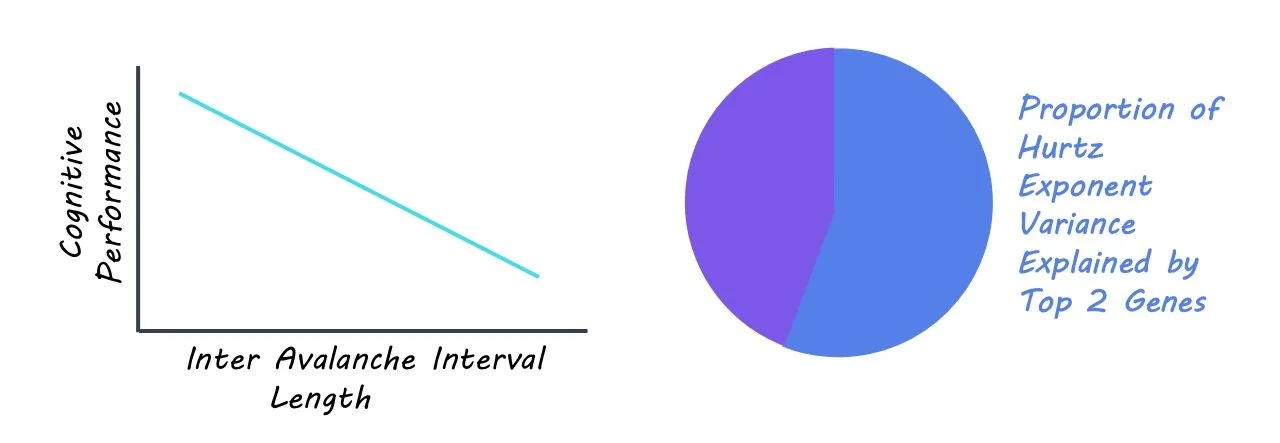
The authors found significant heritability of criticality at the whole-brain level and in over half of the individual brain regions analyzed. They found that criticality was more heritable in sensory brain regions as compared to regions that make associations. The top two groups of genes in the partial least squares regression analysis explained 56% of the variance in regional Hurst exponents. The gene ontology enrichment analysis showed that many of the genes were involved in controlling the excitability of the cell, and the disease gene overlap analysis found that major depressive disorder was the disease that had the largest proportion of contributing genes. The authors found a significant genetic correlation between IAI and cognition; genes associated with shorter IAIs are associated with higher cognitive performance. 

What's the impact?

This study is the first to show a genetic relationship between brain criticality and cognitive performance. In recent years, scientists have increasingly been working to develop genetically based treatments for disorders like depression. Thus, it is important for researchers to understand the genetic contribution to criticality, which plays an important role in information processing and cognition.

Access the original scientific publication here. 

Using New Technology to Classify Migraines

Post by Anastasia Sares

The takeaway

This study shows two exciting new technologies (functional near-infrared spectroscopy and machine learning) being put to use for the eventual better diagnosis of migraines.

What's the science?

Migraines are debilitating health episodes that include symptoms like nausea, painful headaches, fatigue, and light or sound sensitivity. It is relatively common, affecting over 1 in 10 people, with women three times more likely to suffer migraines than men. For some people, migraines also come along with an aura—a neurological abnormality like distorted vision.

Having migraines with auras is a risk factor for other conditions like stroke and heart attack, so it is important to identify them early. However, migraine diagnosis is not based on an objective test, but by a questionnaire filled out by the patient. This has two problems: first, people are not great at remembering all of their symptoms while sitting in the doctor’s office filling out a form, and second, doctors have limited time to tease out these symptoms during an appointment. 

This week in Biophotonics, Gulay and colleagues used a relatively new neuro-imaging technology, functional Near-Infrared Spectroscopy (fNIRS), combined with machine learning to classify migraine patients with and without aura, as well as no-migraine control participants.

How did they do it?

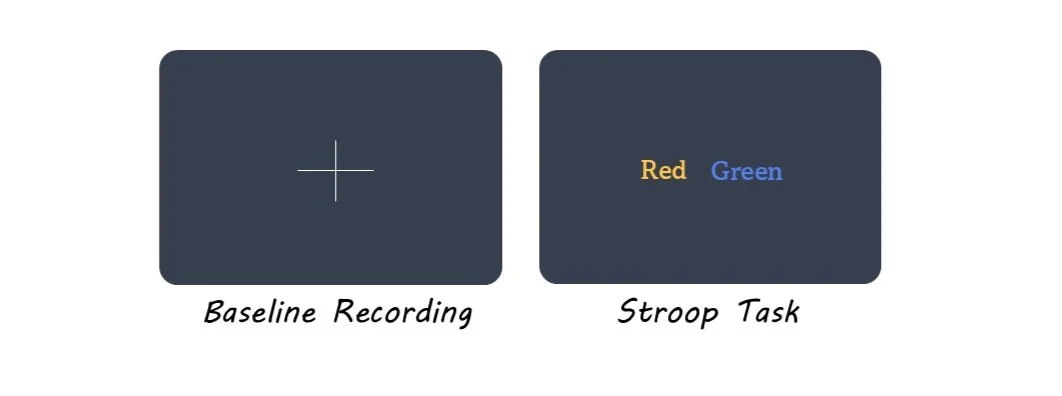
The authors performed fNIRS scanning on 32 participants, eight of whom had migraines with aura, twelve of whom had migraines without aura, and twelve of whom had no migraines at all. The participants sat for a 20-second rest period followed by a 3-minute Stroop task while an fNIRS machine recorded data. The Stroop task is an executive function task where participants are required to use inhibition when presented with a word (e.g., "red") printed in a different color (e.g., blue) and asked to name the color of the ink while ignoring the written word. fNIRS data is collected with a headband-like device containing tiny bulbs that shine light towards the scalp, where it scatters, some light penetrating deeper and some shallower. The headband is also equipped with sensors, which pick up the scattered light and analyze it. The light was limited to two very specific wavelengths that can be absorbed by molecules in the blood that carry oxygen (hemoglobin). In this way, fNIRS can track oxygen-rich and oxygen-poor blood as it flows in the brain just below the skull.

Once the data were gathered, the authors performed many mathematical operations on the signal to determine its characteristics: variance, entropy, and power over time, among many others. They then fed these values into a machine learning algorithm, training it to classify between the three groups of participants.

What did they find?

The model’s classification accuracy was evaluated by the leave-one-out method, in which the model is trained on all participants but one, and then asked to classify the final participant as a test. This is repeated many times with a random participant left out each time to obtain an accuracy score. The author’s model had an overall balanced accuracy of 84% to detect migraines with aura, 98% accuracy to detect migraines without aura, and 95% accuracy to detect people without migraines at all. Classification was best when using data from the left prefrontal cortex.

What's the impact?

This work shows the potential of a 5-minute neuroimaging protocol to detect migraines with aura, allowing for clinical follow-up. fNIRS is also more practical because, unlike MRI and EEG, it is less disrupted by a person’s movements; it is also less expensive than MRI and can be less time-consuming than EEG to set up.

Access the original scientific publication here.