
Genetic Factors Influence Brain Criticality and Cognition
Post by Lila Metko
The takeaway
Brain criticality, a homeostatic endpoint indicative of the excitatory-inhibitory balance, is associated with neural information flow, information capacity, and consciousness. Genetic factors influence brain criticality and its relationship with cognitive function.
What's the science?
A critical brain state is defined as a state where the brain is in optimal balance between excitatory and inhibitory activity. Brain criticality provides a framework for modeling and understanding large-scale brain activity that underlies processes like cognition and consciousness. There are a few measures that are used to quantify a brain’s proximity to a critical state, such as inter-avalanche interval (IAI), branching ratio, and Hurst exponents. An avalanche is defined as a cascade of spontaneous neuronal firing, and the IAI is the interval between them. Avalanches follow a power law distribution, meaning that there are many small and some large avalanches. In other words, there is no typical size to the avalanche - the size is random. The branching ratio describes how many neurons can be activated by a single neuron. Hurst exponents are a measure of how much past neuronal activity influences future neuronal activity. Both the genetic heritability of criticality and the genetic relationship between brain criticality and cognition are unknown. Recently, in PNAS, Xin and colleagues determined the heritability of criticality throughout the brain, as well as determined genetic correlations between brain criticality and cognition.
How did they do it?
The authors obtained resting state fMRI data from 250 monozygotic twins, 142 dizygotic twins, and 437 unrelated individuals. The previously mentioned criticality measures, IAI, branching ratio and Hurst exponents were determined from the fMRI data. They used the ACE (Additive Genetic Effects, Common environment, Environment which is unique to the individual) twin model to determine the heritability of the criticality measures. This is one of the most commonly used models for determining heritability in a twin study, and it takes into account the correlation of features between monozygotic twins, between dizygotic twins, and between unrelated individuals. They used a partial least squares regression model to determine which genes were responsible for variation between participants in Hurst exponents. They then did a gene-ontology enrichment assessment to see if there were any functions or cellular locations that were highly represented in these genes, and a disease gene overlap analysis to see if a high proportion of these genes were associated with a particular disease. They then used twin modeling approaches to determine genetic correlations between cognition (as assessed by the NIH toolbox total cognition score) and criticality.
What did they find?
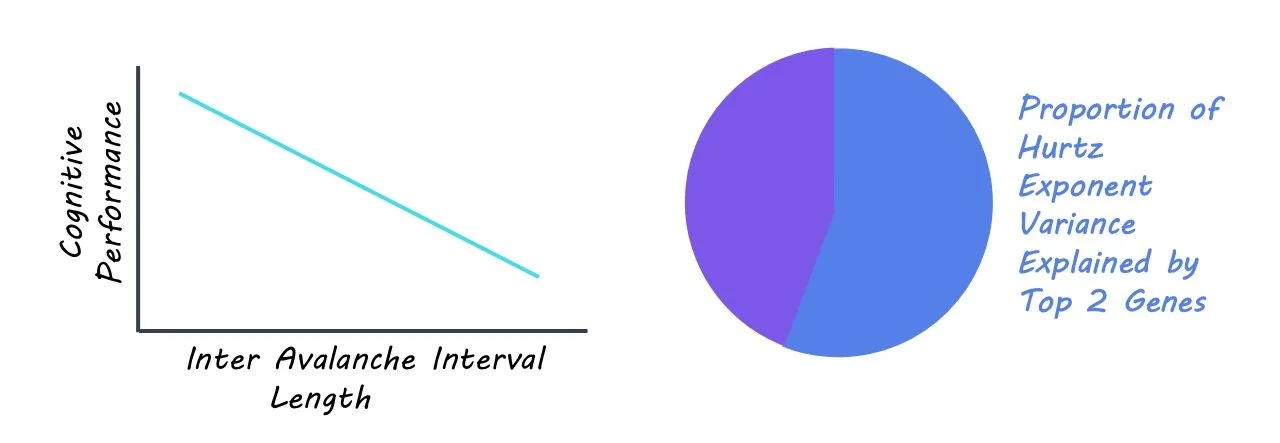
The authors found significant heritability of criticality at the whole-brain level and in over half of the individual brain regions analyzed. They found that criticality was more heritable in sensory brain regions as compared to regions that make associations. The top two groups of genes in the partial least squares regression analysis explained 56% of the variance in regional Hurst exponents. The gene ontology enrichment analysis showed that many of the genes were involved in controlling the excitability of the cell, and the disease gene overlap analysis found that major depressive disorder was the disease that had the largest proportion of contributing genes. The authors found a significant genetic correlation between IAI and cognition; genes associated with shorter IAIs are associated with higher cognitive performance.
What's the impact?
This study is the first to show a genetic relationship between brain criticality and cognitive performance. In recent years, scientists have increasingly been working to develop genetically based treatments for disorders like depression. Thus, it is important for researchers to understand the genetic contribution to criticality, which plays an important role in information processing and cognition.