How The Brain Recovers From Sleep Debt

Post by Natalia Ladyka-Wojcik 

The takeaway

After a period of sleep deprivation, our bodies settle the (sleep) score by entering into a period of persistent and deep recovery sleep. For the first time, scientists have discovered the neural circuit that promotes recovery sleep, providing key insights into how the brain maintains sleep homeostasis. 

What's the science?

Sleep is governed by homeostatic control, the body’s mechanism for maintaining a stable internal environment despite changes in the external environment. When we experience sleep deprivation, the resulting accumulation of “sleep debt” prompts the body to restore sleep balance by initiating a period of persistent and deep recovery sleep. Although many molecular and cellular mechanisms have been proposed to regulate sleep, we still don’t know what specific neural circuits may detect or transmit homeostatic signals to sleep-promoting brain regions. This week in Science, Lee and colleagues set out to identify a neural circuit responsible for triggering this essential recovery sleep, using tools that allow neuroscientists to control the signaling of brain cells in mice.  

How did they do it?

In mammals, sleep can be categorized into two types: rapid eye movement (REM) sleep and non-REM sleep, the latter of which is considered a deeper, recovery-type sleep. Here, the authors mapped a group of excitatory neurons in the thalamus of mice that project to brain regions which are thought to promote non-REM sleep. Specifically, they investigated non-REM, homeostatic recovery sleep after activating and inhibiting neurons in the nucleus reuniens of the thalamus – a major relay station for sensory and motor information in the brain. The authors used a technique called chemogenetics to inhibit neurons of the nucleus reuniens during sleep deprivation in order to determine if subsequent non-REM recovery sleep would be affected. A similar approach using optogenetics, a tool that uses targeted pulses of light to control the activation of neurons, was also used to determine if the stimulation of excitatory neurons in the nucleus reuniens would promote sleep behaviors. Finally, the authors assessed the downstream impact of activation in these neurons by tracing their projections to other non-REM sleep-promoting brain regions.

What did they find?

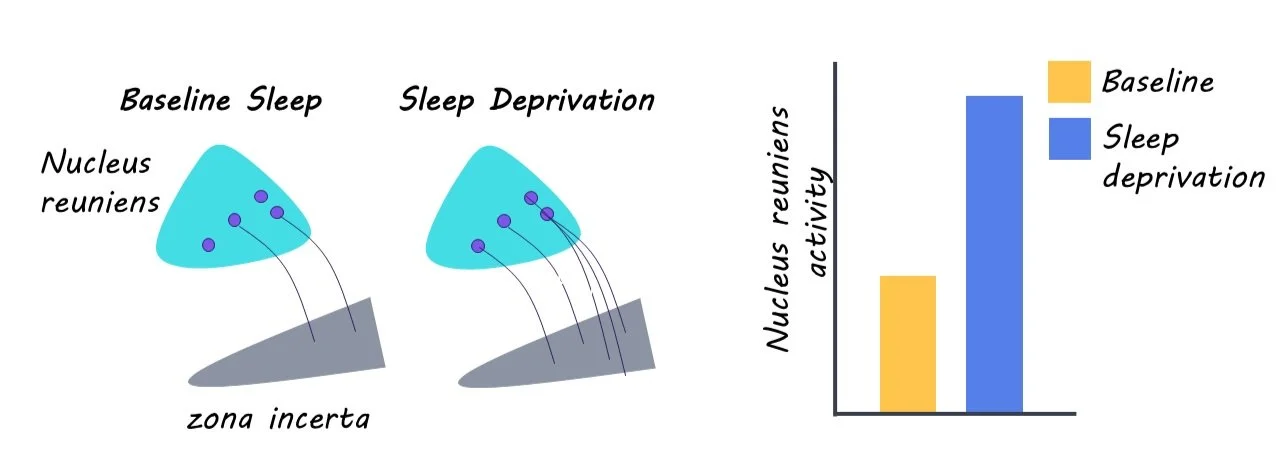
The authors found that inhibiting neurons in the thalamic nucleus reuniens decreased the quality of homeostatic, non-REM recovery sleep that the mice subsequently experienced. In contrast, stimulated neurons in the nucleus reuniens led to mice exhibiting longer, deeper, non-REM sleep after a delay, suggesting that these neurons regulate sleep homeostasis. The authors also found that mice engaged in more behaviors associated with preparation for sleep, such as self-grooming, after optogenetic activation of these neurons. Importantly, after longer periods of sleep deprivation, neurons in the nucleus reuniens fired more frequently while the mice were awake – an effect that diminished with subsequent recovery sleep. Finally, the authors found that these neurons projected to a small subthalamic region called the zona incerta, to generate non-REM recovery sleep. Curiously, sleep deprivation enhanced interactions between the nucleus reuniens and zona incerta, whereas disrupting synaptic plasticity in the nucleus reuniens impaired this interaction and reduced non-REM sleep.
What's the impact?

This study is the first to identify a neural circuit responsible for homeostatic control over non-REM recovery sleep, separate from regular sleep-wake cycles. Specifically, these findings suggest that during sleep deprivation, brain regions that promote non-REM sleep increase their communication to drive deeper, more restorative sleep. By uncovering the brain mechanisms that support recovery sleep in mice, this research provides insight into what may happen in the human brain after sleep loss, particularly in conditions like idiopathic hypersomnia, where patients experience an overwhelming and persistent need for sleep.
Access the original scientific publication here.

How Cognitive Fatigue Affects Effort-Based Choices

Post by Meagan Marks

The takeaway

Cognitive fatigue—that well-known feeling after a long day of work—typically reduces our motivation to take on additional tasks. During this decline in motivation, the dorsolateral prefrontal cortex and right insula exhibit strengthened connectivity, providing insight into the neurobiology of fatigue and suggesting a potential target for amotivation.

What's the science?

Cognitive fatigue is a familiar feeling that follows sustained mental effort, building up throughout the workday and reducing our willingness to engage in further exertion. Despite its relevance, the mechanism by which cognitive fatigue is generated in the brain and its influence on decision-making circuitry remain unclear. Understanding the neurobiology behind cognitive fatigue and its impact on exertion-related choices will not only offer insight into everyday brain function but may also help identify neural networks involved in amotivation—a lack of motivation and energy that often accompanies many psychiatric and neurological conditions. This week in the Journal of Neuroscience, Steward and colleagues identify brain regions involved in cognitive fatigue and examine how they interact with effort-based decision-making areas to uncover how fatigue shapes effort-based choices.

How did they do it?

The study involved 28 participants (18 females, 10 males), who first practiced the experimental task—a version of the “n-back” memory task—outside of the magnetic resonance imaging (MRI) scanner. In this task, participants were shown a sequence of letters, one at a time, and were periodically asked whether a letter matched one presented “n” letters earlier, with “n” ranging from 1 to 6. Higher values of “n” represented greater cognitive effort, and each effort level was paired with a specific color (e.g., n=1 in green to represent minimal effort, n=6 in blue to represent maximum effort), allowing participants to associate each color with a corresponding level of mental exertion.

After this association phase, participants entered the scanner. To establish a baseline, they completed 80 trials in which they repeatedly chose between a simple n=1 task for $1 or a more cognitively demanding n-back task (displayed by color) for a higher monetary reward. Participants then entered the experimental or ‘fatigue phase’, which followed the same structure but included intermittent bouts of mentally demanding tasks designed to induce fatigue. This phase also consisted of 80 trials.

A control group followed the same protocol, except rest periods replaced the exertion bouts during the second phase. This controlled for potential confounding factors such as time, task exposure, or trial order, ensuring that any observed effects were specifically attributed to cognitive fatigue.

What did they find?

As expected, participants were less likely to choose high-effort options when fatigued—preferring low-effort, low-reward choices—especially as the experiment progressed, compared to baseline. This effect was not seen in the control group, indicating that the behavioral changes were due to cognitive fatigue.

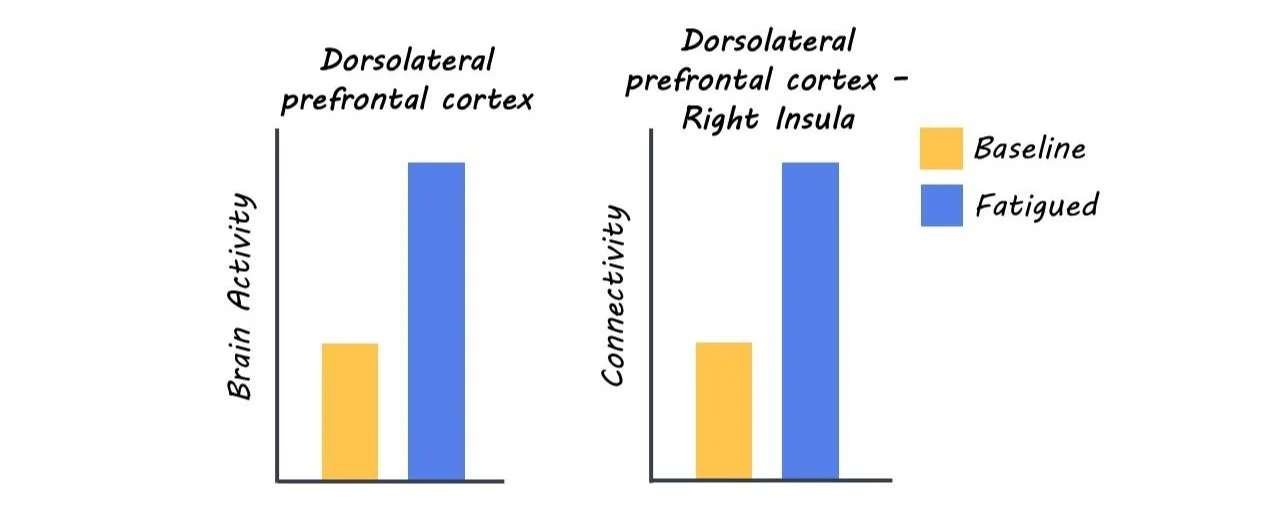
Neuroimaging data revealed that regions within the brain’s effort-valuation network showed altered activity based on the monetary value and perceived effort level of choices. This pattern held across both the fatigue and baseline phases. However, one effort-valuation region—the right insula—showed greater fluctuations in activity in response to the effort-based decisions during the fatigue phase. This suggests it is particularly sensitive to cognitive fatigue and may play a role in evaluating effort when mental resources are drained. During fatigue, this region also showed increased connectivity with the dorsolateral prefrontal cortex, a region associated with cognitive control and demand. Activity in the dorsolateral prefrontal cortex rose with increasing fatigue, suggesting it may help detect when the brain is fatigued. The strengthened connectivity between the right insula and dorsolateral prefrontal cortex during fatigue implies that these regions may work together to integrate information about an individual’s cognitive state and guide decisions about future mental effort.

What's the impact?

This study is the first to identify a potential circuit that modulates our effort-based choices and evaluations when mentally fatigued. Two brain regions— the dorsolateral prefrontal cortex (a ‘fatigue’ region) and the right insula (an effort-valuation region)— show strengthened communication when making effort-based decisions during a fatigued state, indicating that they may work together to influence our choice to perform additional mental exertion when in a state of cognitive fatigue. Understanding this connection not only uncovers the neurobiology behind a common human experience but also points to a possible target for addressing amotivation, a debilitating symptom in many neurological and psychiatric conditions.

Access the original scientific publication here.

Why Does the Brain Sometimes Mistake Imagination for Reality?

Post by Soumilee Chaudhuri

The takeaway

The human brain employs common neural circuits for both external perception and internal imagination, which can lead to confusion between real and imagined experiences. The authors of this study designed an experiment that intentionally blurred the line between imagination and perception to show how a brain region called the fusiform gyrus distinguishes between internal (imagined) experiences and external (perceived) ones.

What's the science?

Decades of research have shown that visual imagination activates many of the same brain regions (visual cortices) involved in actual visual perception. While this shared use of neural resources is efficient, it also creates a challenge: the brain might confuse imagined experiences with real ones. Previous research has demonstrated that when imagination is very vivid, individuals are more likely to believe what they imagine is real. The exact neural mechanisms by which the brain differentiates between externally perceived and internally generated sensory information remain unclear. This week in Neuron, Dijkstra and colleagues used brain imaging while participants viewed and imagined specific visual patterns to try and answer this question.

How did they do it?

As part of this study, twenty-six healthy volunteers took part in a visual detection task while their brain activity was recorded using functional magnetic resonance imaging (fMRI). All of them completed a behavioral training session to practice detecting and imagining oriented faint patterns or gratings. For the main task, they were shown these gratings that tilted either left or right, sometimes hidden in noisy backgrounds. At the same time, participants were asked to imagine a grating that either matched (congruent) or didn't match (incongruent) the pattern they were trying to detect, with these conditions changing in blocks. After each trial, they reported whether they thought a real grating appeared and rated the vividness of their mental image. Participants judged whether a pattern was present and rated the vividness of their mental imagery. Their brain scans were then analyzed to understand how the brain combines signals from both seeing and imagining to tell apart reality from imagination.

What did they find?

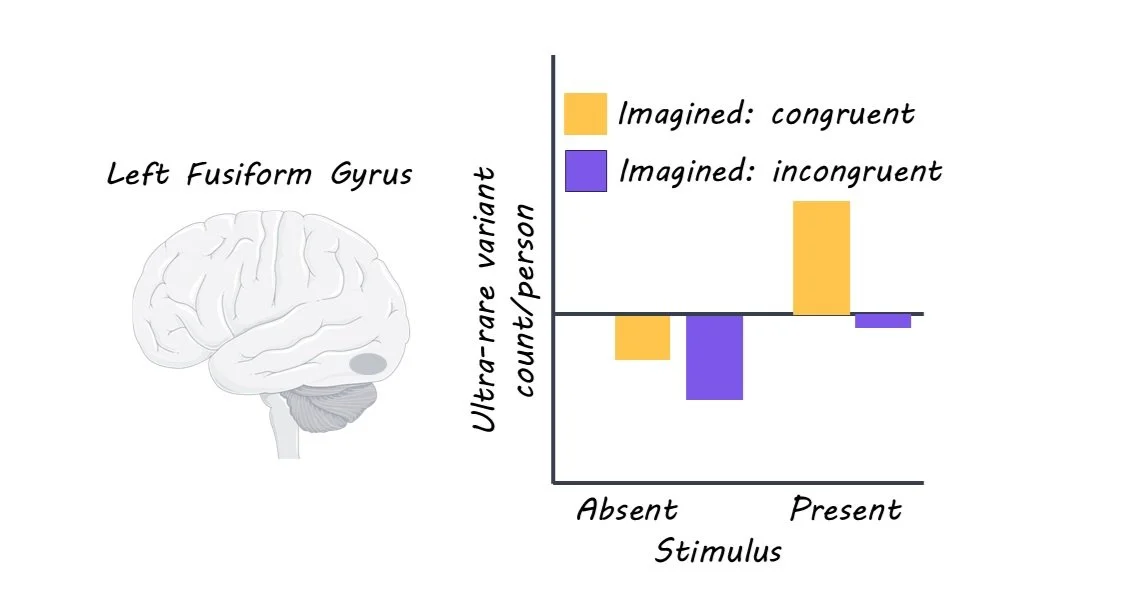
The study found that the bilateral fusiform gyrus (FG) plays a crucial role in determining whether what we see is real or imagined. Brain activity in the FG was more potent when what people imagined matched the real stimulus (called the congruent condition), especially in the left FG, where this effect was highly significant. Individuals who exhibited greater confusion between imagination and reality also showed more vigorous FG activity on the right side. Moreover, the vividness of people's mental images also influenced FG activity. In contrast, other brain areas showed some activity but lacked the specific pattern required to distinguish between reality and imagination. Significantly, activity in the left FG could predict when people mistakenly thought an imagined image was real, but only when the imagined image matched the one they were looking for (i.e., the congruent condition). This shows that the FG helps the brain distinguish between sensory signals and imagination, explaining why we sometimes confuse the two.

What's the impact?

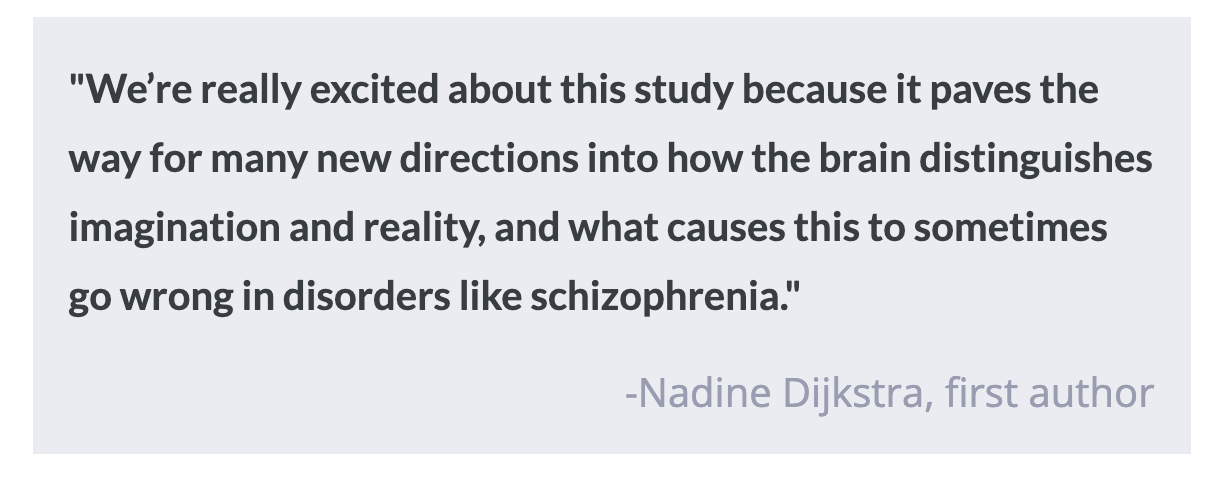
This research reveals how the brain distinguishes real experiences from imagined ones by using the FG to combine signals from perception and mental imagery into a "reality signal” or RS. This signal helps decision-making regions of the brain determine whether something is truly happening or just imagined. Disruption in this biological process could contribute to serious dysregulation of sensory perceptions, such as hallucinations, especially associated with psychiatric illnesses such as schizophrenia. This work sets the stage for developing targeted and effective treatments for individuals who struggle to distinguish between imagination and reality in everyday life.