Accelerating Transcranial Magnetic Stimulation Treatment for Depression

What's the science?

Thirty percent of people with depression are resistant to treatments like anti-depressant medication or psychotherapy. Some people with treatment-resistant depression respond to repetitive transcranial magnetic stimulation (rTMS) treatment. This technique involves inducing a magnetic field using pulses from a magnetic coil in a device resting on the scalp. However, it might take a patient many weeks of rTMS to see mood improvement, so having a faster acting treatment for those with severe depression is optimal. This week in Neuropsychopharmacology, Fitzgerald and colleagues tested a new ‘accelerated rTMS’ paradigm, to see if the same effects could be achieved faster.

How did they do it?

The authors conducted a randomised controlled trial, in which adults with depression received 63 00 rTMS pulses in total over the course of several rTMS sessions. Pulses were targeted at the dorsolateral prefrontal cortex, known to be involved in emotion regulation.  Fifty-eight adults followed the accelerated schedule: They received 3 treatments per day, for 3 days the first week, 3 treatments over 2 days the second week, and 3 treatments in one day the third week. Fifty-seven adults followed a standard schedule (not accelerated): one treatment per day, 5 days a week, for 4 weeks. They measured depression scores 1, 2, 3, 4, and 8 weeks after treatment.
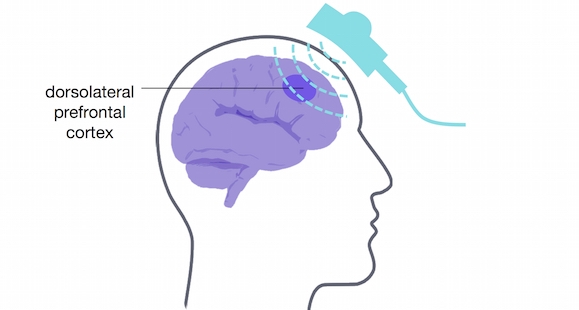
dorsolateral prefrontal cortex

What did they find?

Depression scores slowly decreased over the 8-week period in both the accelerated and standard treatment groups. The accelerated treatment did not appear to improve mood faster than the standard treatment, and participants in the accelerated group were more likely to experience discomfort such as headache. There were no differences in the efficacy of the accelerated treatment versus the standard treatment, indicating the accelerated treatment worked just as well as the standard treatment.

What's the impact?

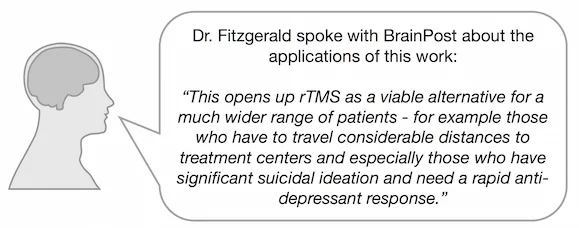
This is the first randomised controlled trial to test whether accelerated rTMS could be used as a treatment for depression. This study clarifies the effectiveness of  accelerated rTMS as a treatment for depression. Accelerated rTMS might be a viable option for individuals with depression who cannot commit to long periods of daily rTMS treatment. Depression comes in many different forms, so determining which treatments work best for which patients, and their potential side effects, is critical for treatment optimization.
Fitz_author_week5_small.jpg

Reach out to study author Dr. Paul Fitzgerald on Twitter @PBFitzgerald

P.B. Fitzgerald et al., Accelerated repetitive transcranial magnetic stimulation in the treatment of depression. Neuropsychopharmacology. (2018). Access the original scientific publication here.

Ketamine Blocks Burst Firing to Provide Depression Relief

What's the science?

Ketamine is a drug that binds to and blocks NMDA receptors found on neurons. It provides fast acting and sustained relief of depression symptoms, however, the mechanisms underlying ketamine’s effectiveness are unknown. A brain region called the lateral habenula, involved in reward processing and negative emotions, is known to have abnormal “burst” activity in patients with depression. This week in Nature, Yang and colleagues determine whether abnormal activity in the lateral habenula can drive depression-like behaviours, and how this might be reversed by ketamine.

ketamine blocks NMDA receptor

How did they do it?

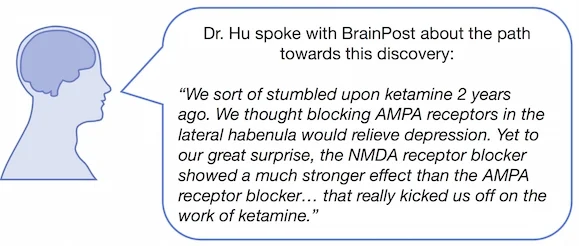
They tested to see if ketamine infusion into the lateral habenula relieved depression symptoms (improved mobility in the forced swim test) in learned helpless (depressed) rats. Next, they performed whole-cell patch-clamp (a method used to measure the electrical currents in a neuron) on lateral habenula neurons to determine : 1) whether the spontaneous neuronal activity in these cells is abnormal in depressed rats, 2) whether these abnormalities could be reversed by NMDA blockers and, 3) if changing the resting state membrane potential of the cell can alter the pattern of spiking activity in the lateral habenula. They then used optogenetic techniques to mimic the bursting activity seen in the lateral habenula of depressed mice to determine whether this activity was sufficient to induce depression behaviours.

What did they find?

Ketamine administered in the lateral habenula alleviated the depression symptoms in rats. Increased burst firing occurred in neurons in the lateral habenula of depressed rats. These burst patterns were completely blocked by ketamine, but not by other typically used antidepressant drugs. The bursting properties of the lateral habenula could be altered by changing the membrane potential of the cell, suggesting a new potential therapeutic target, the T-type calcium channel. They were also able to induce depression-like symptoms in rats by using optogenetics to control the pattern of burst firing in the lateral habenula.

What's the impact?

This is the first study to describe the mechanisms by which ketamine has fast acting depression relief. We now know that burst firing underlies depressive symptoms in rats, and that this can be blocked with ketamine. Understanding how and where ketamine acts in the brain is an important step towards developing new therapies for depression.  

Hu_author_week5_small.jpg

Yang et al., Ketamine blocks bursting in the lateral habenula to rapidly relieve depression. Nature. (2018). Access the original scientific publication here.

Rachel Bosma, PhD contributed to this BrainPost

A Model for the Spread of Tau through Connected Tracts in the Human Brain

What's the science?

In Alzheimer’s disease, tau proteins accumulate in the hippocampus resulting in neurofibrillary tangles. Beta-amyloid plaques, another form of protein aggregation, are thought to help tau proteins spread. One way that tau may spread from neuron to neuron is through neural connections, while another possibility is that it simply spreads to neurons located close by. This week in Nature Neuroscience, Jacobs and colleagues used brain imaging to ask: ‘How does  tau spread?’

How did they do it?

Healthy older participants from the Harvard Aging and Brain Study were scanned over several years with positron emission tomography (PET) imaging to measure tau and beta-amyloid in the brain, and diffusion tensor imaging (DTI) to measure connectivity (of white matter tracts) in the brain. They tested whether beta-amyloid in the brain at baseline predicts hippocampal volume loss. They then measured whether this volume loss predicts abnormalities in the hippocampal cingulum bundle (a white matter tract that innervates the hippocampus and connects it with the posterior cingulate cortex) and in turn, whether these abnormal connections predict the accumulation of tau in the posterior cingulate cortex. They ran control analyses with another tract (that does not innervate the hippocampus) and another close by region. Associations with memory and executive functions were also assessed to understand the clinical relevance. 

What did they find?

Brain beta-amyloid level at baseline predicted hippocampal volume loss. The hippocampal volume loss also predicted abnormal white matter tract connectivity over time in the hippocampal cingulum bundle, but not in other white matter tracts close by that do not directly connect with the hippocampus. The abnormal connectivity in this tract predicted the accumulation of tau in a connected region called the posterior cingulate cortex, but not in another adjacent control region. Collectively, these changes were associated with memory decline over time. This means that early Alzheimer’s pathology (beta-amyloid) initiates a cascade of hippocampal volume loss followed by abnormal tract connectivity and the spreading of tau along this tract. 

Spread of tau and beta-amyloid accumulation over time

What's the impact?

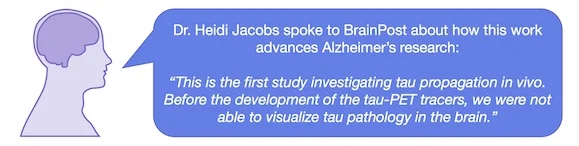
This is the first study to confirm that tau likely spreads via neural connections (rather than just to regions close by) from the hippocampus, facilitated by beta-amyloid in the brain. Clarifying the order in which Alzheimer’s pathology spreads, as well as the mechanism through which it spreads is critical for helping to target the advancement of Alzheimer’s disease.

DrJacobs_small.jpg

You can reach out to her about her work at @DrHeidiJacobs on Twitter.

H. I. L. Jacobs et al., Structural tract alterations predict down-stream tau accumulation in amyloid positive older individuals. Nat. Neurosci. (2018). Access the original scientific publication here.