Rapid Synthesis of Proteins in Human Brain Tissue

What's the science?

All cells in the body produce proteins, and certain tissues synthesize these proteins and recycle them (to produce new ones) faster than others. Skeletal muscle is an example of one tissue that recycles proteins quickly, at a rate of 1-2% per day. Historically, we have assumed that the brain does not regenerate itself as much as other tissues. This week in Brain, Smeets and colleagues report that brain protein turnover is much higher than previously assumed. 

How did they do it?

Six participants that were scheduled to undergo surgery for drug-resistant temporal lobe epilepsy were recruited. Amino acids are the precursors to proteins. Patients were given continuous intravenous infusion (before and during surgery) of an amino acid called phenylalanine, which was radiolabeled with a stable isotope. Blood and tissue samples from the cortex and hippocampus were taken, as well as from two muscle tissues throughout the surgery. These tissue samples were examined for the incorporation of phenylalanine into tissue protein. They then calculated protein synthesis rates based on phenylalanine enrichment in the tissue, and also identified what type of proteins are present in brain tissue.

What did they find?

Tissue phenylalanine enrichments were found in muscle tissue and brain tissue; however, they were higher in brain tissue, indicating that protein synthesis rates were 3-4 times higher in brain tissue compared to skeletal muscle tissue. Protein synthesis rates were higher in the cortex compared to the hippocampus. They were able to identify 1192 different proteins in brain tissue, and the most abundant form of proteins were cytoskeletal proteins (proteins that make up the structure of the neuron). 
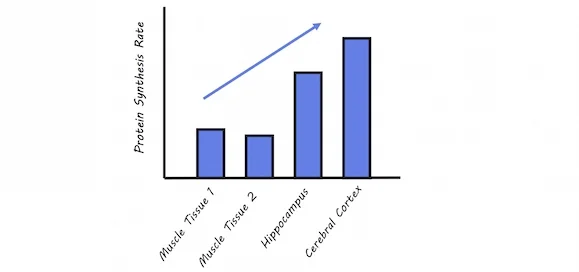
Artistic rendering of Figure 3. Brain and skeletal muscle tissue protein synthesis rates.

Artistic rendering of Figure 3. Brain and skeletal muscle tissue protein synthesis rates.

What's the impact?

This is the first study to report protein synthesis rates in the living human brain. It is well established that skeletal muscle tissue regenerates itself rapidly in order to adapt to repeated use. Until now we didn’t know that brain tissue regenerates at an even higher rate than skeletal muscle. This rapid tissue regeneration could underlie the ability of the brain to adapt and remodel itself throughout life.

J. S. J. Smeets et al., Brain tissue plasticity: protein synthesis rates of the human brain. Brain. (2018). Access the original publication here.
 

The Basal Forebrain Influences the Brain’s Default Mode

What's the science?

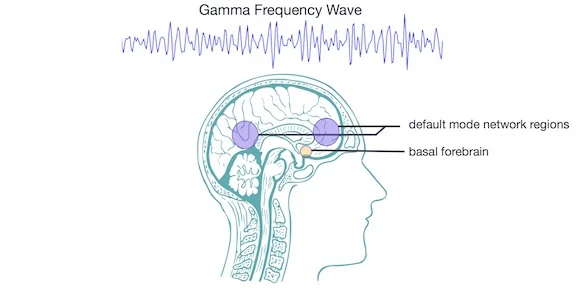
The ‘default mode network’ is a unique network of brain regions that is dysregulated in many clinical conditions, like epilepsy and depression. Typically, these regions are most active while a person is resting or reflecting internally. Brain activity in the default mode network at a particular frequency (gamma frequency) is high during rest.The basal forebrain is a brain region thought to contribute to arousal and attention - for example, it accelerates learning and boosts neural signals in response to sensory stimulation. This week in PNASNair and colleagues assessed the relationship between gamma frequency power (strength) in the basal forebrain and the default mode network, to understand how these regions might influence one another. 

How did they do it?

They studied the basal forebrain and default mode network in rats using recordings from electrodes in these regions, specifically measuring the gamma power. During the recordings, the rats were placed in their home cages where they groomed themselves and were quiet but awake, or they were placed in a large new area, where they tend to engage in active, exploratory behaviour. Next, they recorded the firing (activity) of basal forebrain neurons and tested whether it was correlated with fluctuations in gamma power, in order to understand whether the gamma frequency was generated locally. Finally, they tested whether patterns of gamma frequency activity in the basal forebrain predicted activity in the default mode network or vice versa.

What did they find?

They found that gamma power was high while the mice were in their home cages, and low while the mice explored an area. This change in gamma power was not due to movement. They also found that the neuronal firing of basal forebrain neurons was related to gamma power, indicating that these neurons were responsible for generating the signal. Finally, they found that gamma power in the basal forebrain predicted gamma power in the default mode network.

Hugo Gambo, Eeg gamma, image by BrainPost, CC BY-SA 3.0

Hugo Gambo, Eeg gamma, image by BrainPost, CC BY-SA 3.0

What's the impact?

This is the first study to observe a link between the the default mode network, active during rest, and the basal forebrain, traditionally understood to increase arousal. Basal forebrain neurons are also activated during rest along with the default mode network. This study suggests that the default mode network is influenced by the basal forebrain, which could be a new clinical target for disorders in which the default mode network is affected.

Nair et al., Basal forebrain contributes to default mode network regulation. PNAS. (2018). Access the original scientific publication here.


Hunger Affects Brain Activation in Response to Food Across the Lifespan

What's the science?

In adults, brain activity in response to food cues has been shown to predict overeating and weight gain. We do not yet understand the relationship between the brain’s response to food and overeating across the lifespan, including in children, who are especially vulnerable to food cues. Recently in Neuroimage, Charbonnier and colleagues show how certain brain regions activate in response to food depending on hunger level in different age groups.

How did they do it?

They recruited children, teens, adults and elderly participants who were scanned twice using functional MRI, once in a hungry state after fasting all night and once in a full (‘sated’) state after being fed.  Before the scan, participants rated how much they liked various foods. In the scanner, participants performed a food-viewing task where they viewed images of high and low calorie foods. The viewing of non-food images was a control task. Brain activity was compared while participants viewed high versus low calorie foods, in the hungry or full state, across different age groups.

What did they find?

Brain activation in the hungry state was greater across the lifespan when viewing high calorie foods (compared to low calorie foods) in two regions of the prefrontal cortex: the dorsolateral prefrontal cortex (involved in controlling actions) and the dorsomedial prefrontal cortex (involved in processing reward and value). Hunger state alone did not affect brain activation when viewing food. Age also did not affect brain activation for high compared to low calorie foods, even though younger participants rated liking high calorie food more.

Impact of hunger and food on brain

What's the impact?

This is the first study to look at the effects of hunger and different food cues on brain activation in different age groups. The activation of the dorsolateral prefrontal cortex could reflect inhibition of eating, whereas the dorsomedial prefrontal cortex could be activating to process the reward value of the food, however this needs to be investigated further. It is important to understand brain mechanisms for eating behaviors across the lifespan in order to develop strategies to prevent obesity.

Smeets_for_web.jpg

Reach out to study author Dr. Daniel Crabtree on Twitter @DanielCrabtree9

L. Charbonnier et al., Effects of hunger state on the brain responses to food cues across the life span. Neuroimage. 171, 246–255 (2018). Access the original scientific publication here.