
Dyskinesias in Parkinson’s disease are Caused by a Subgroup of Neurons

What's the science?

In Parkinson’s disease, dopamine neurons in the midbrain degenerate resulting in problems with body movement. A dopamine medication called levodopa can be very effective for improving symptoms, however, in some cases it causes involuntary movements called dyskinesias. We know that unwanted neural activity in brain regions such as the striatum, motor cortex and sensorimotor cortex may be involved, but the specific brain region and cells causing dyskinesias are not known. Recently in Neuron, Girasole and colleagues identify a subgroup of neurons responsible for dyskinesias.

How did they do it?

They first used a method called Targeted Recombination in Active Populations (TRAP) in transgenic (genetically modified) mice. TRAP allows certain proteins (acting as labels) to be expressed in active neurons (as opposed to inactive neurons). In mice with levodopa-induced dyskinesias, they identified neurons that were active during the dyskinesias compared to control mice. Second, they then used optogenetics: Controlling neuron activation by shining light on genetically modified neurons of interest. This allowed them to inhibit and activate these specific neurons in the mice to see if they played a causal role in dyskinesias.

What did they find?

Only neurons in the striatum were significantly more active during dyskinesias compared to control mice. When examining these neurons more closely, they found that most of the active neurons were medium spiny neurons (a specific cell type of neuron found in the striatum) that were part of the 'direct pathway', an inhibitory pathway involved in motor function that is defective in Parkinson’s disease. When these neurons were inhibited with optogenetics, the dyskinesias were reduced. Inhibiting the activity of neurons in the motor or sensorimotor cortices did not reduce dyskinesias, demonstrating a causal role for striatal neurons in producing medication-induced dyskinesias.
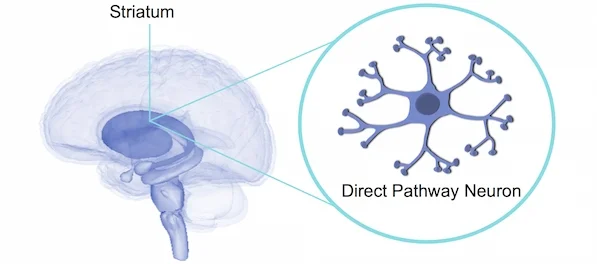
Images are generated by Life Science Databases(LSDB)., Striatum, colour by BrainPost, CC BY-SA 1.0

Images are generated by Life Science Databases(LSDB)., Striatum, colour by BrainPost, CC BY-SA 1.0

What's the impact?

This is the first study to identify the neurons within the striatum that cause dyskinesias in mice. Dyskinesias are a detrimental side effect of levodopa in Parkinson’s disease and can be debilitating to patients who experience them. Understanding which neurons cause dyskinesias brings us one step closer to finding a way to treat them.

Reach out to study author Ally Girasole on Twitter @AllyGirasole

A. E. Girasole et al., A Subpopulation of Striatal Neurons Mediates Levodopa-Induced Dyskinesia. Neuron. 97, 1–9 (2018). Access the original scientific publication here.
The Role of White Matter Connections in Adolescent Mental Health and Cognition

What's the science?

The brain’s white matter pathways connect many different regions of the brain, and these connections undergo immense change during adolescence. Psychiatric disorders or their symptoms (e.g. anxiety, depression, obsessive-compulsive disorder, attention deficit hyperactivity disorder, post-traumatic stress disorder) often develop during this time. This week in JAMA Psychiatry, Alnaes and colleagues report that cognition and psychopathology symptoms are related to the brain’s connections in the frontal lobe.

How did they do it?

6487 adolescents (without a diagnosed mental disorder) completed 1) reports on a wide variety of clinical /psychopathological symptoms, and 2) cognitive tests. Of these adolescents, 748 had MRI scans of the brain’s white matter connections, and 2946 had genetic testing done. They assessed whether psychopathological symptoms and cognitive scores were heritable (ie. genetically inherited) and whether these scores were related to brain connectivity patterns. They then used a robust technique called machine learning to test relationships, meaning they ensured that the proposed model of the relationship between the brain and cognition/psychopathy was accurate in multiple different subgroups of participants.

What did they find?

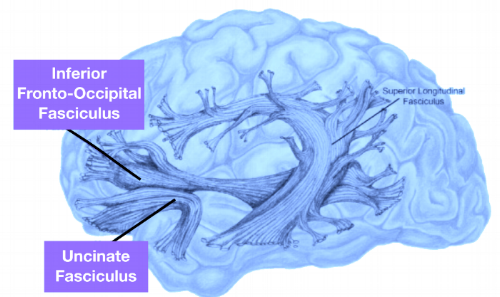
Weaker connections in two of the brain’s white matter tracts (uncinate fasciculus and inferior fronto-occipital fasciculus) were associated with lower cognitive scores, and a greater number of psychopathological symptoms. Anxiety, antisocial behaviour, and psychosis were correlated with these connections. Genetic variance explained 18% of an individual’s cognitive score and 16% of their general psychopathy score.

William Hirstein. Diagram by Katie Reinecke., White matter fiber tracts, colour by BrainPost, CC BY 3.0

William Hirstein. Diagram by Katie Reinecke., White matter fiber tracts, colour by BrainPost, CC BY 3.0

What's the impact?

This study found that psychopathological symptoms in adolescents and lower cognitive scores were predicted by lower connectivity in pathways of the brain’s frontal lobe. These pathways connect the frontal lobe with other regions known to be involved in emotion and cognition. Lower connectivity in frontal white matter pathways could play a role in the development of psychiatric disorders in youth.

D. Alnaes et al., Association of Heritable Cognitive Ability and Psychopathology With White Matter Properties in Children and Adolescents. JAMA Psychiatry. (2018) Access the original scientific publication here.


Reduced Brain Volume in Epilepsy Patients

What’s the science?

Epilepsy is a complex disorder characterized by seizures. The way that brain structure relates to the severity of epilepsy is not well understood. This week in Brain, Whelan and colleagues report structural brain changes in a large sample of epilepsy patients.

How did they do it?

Epilepsy patients were recruited from 24 research centers across 14 different countries. This resulted in 2149 epilepsy patients that were divided into 4 subgroups based on epilepsy type. The patients were scanned using MRI and the brain scans were analyzed to measure brain volumes and cortical thickness (the thickness of the outermost layer of the brain: the cerebral cortex) compared to healthy control participant brains.

What did they find?

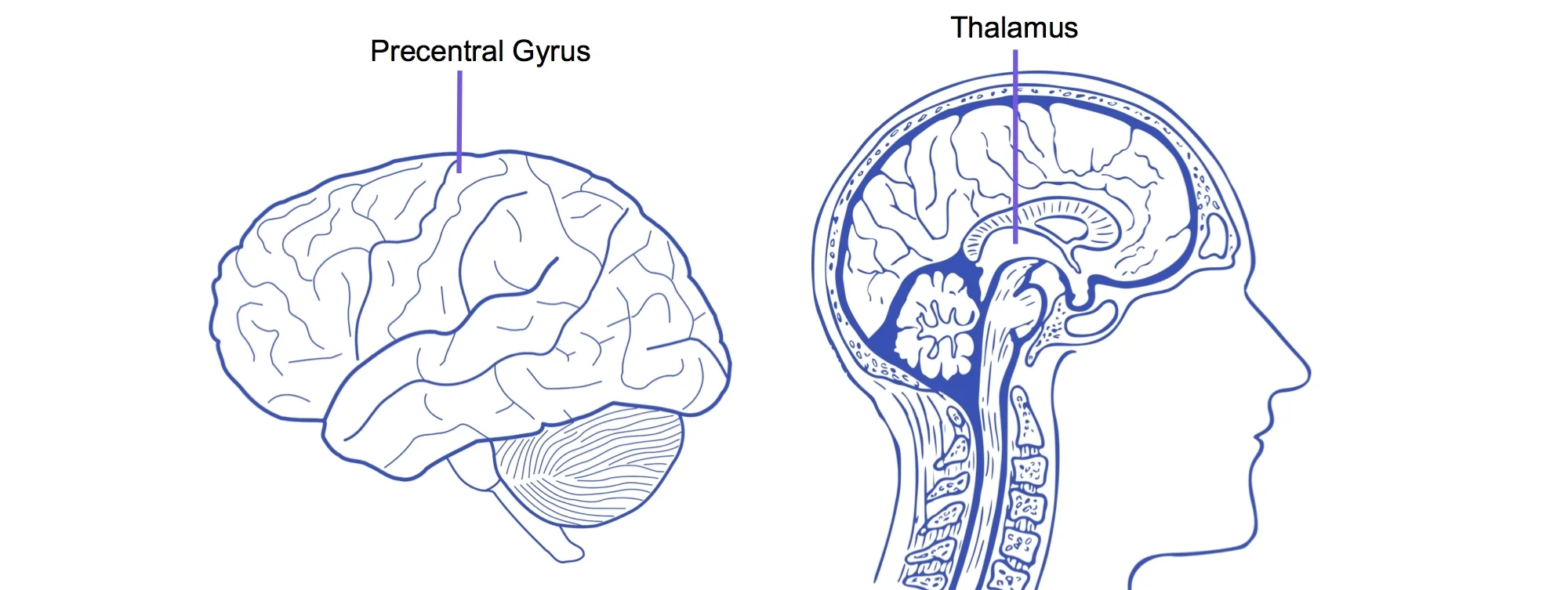
They found that in all types of epilepsy, there was reduced brain volume in the right and left thalamus and reduced cortical thickness in the right and left precentral gyrus (motor cortex), which are both important brain regions involved in movement. In the subgroup of medial temporal lobe epilepsy patients, there was reduced brain volume in the hippocampus (a region involved in memory). Lower brain volumes and cortical thickness were associated with a longer duration of epilepsy.

Precentral gyrus and  thalamus

What’s the impact?

This is the largest brain imaging study of epilepsy that has ever been done. Before this study, we didn’t know the extent to which structural brain changes occur in epilepsy. We now know that there are significant structural brain changes in the thalamus and precentral gyrus in epilepsy, which are both very important brain regions for movement and should be investigated further.

C. D. Whelan et al., Structural brain abnormalities in the common epilepsies assessed in a worldwide ENIGMA study. Brain. 0, 1–18 (2018). 

Access the original scientific publication here.