
Brain Ripple Oscillations Synchronize Distant Regions During Memory
Post by Amanda Engstrom
The takeaway
Ripple oscillations are brief bursts of high-frequency brain activity associated with memory in the cortex. This study shows that when ripples occur simultaneously across different brain regions, neurons there fire together more strongly in a context-specific manner, and this coordination strengthens with mental effort.
What's the science?
Cognition and memory in the mammalian brain rely on effective communication between distinct brain regions. Still, the mechanisms that facilitate binding of neuronal activity across regions during a task remain unclear. High-frequency (~90-Hz) ripple oscillations were first identified as components of hippocampal sharp-wave ripples associated with memory consolidation, but subsequent research shows that they occur widely across the cortex, sometimes in the absence of sharp-wave activity, and that local firing coordinates with these ripples during behavior and memory retrieval. This week in Nature Neuroscience, Verzhbinsky and colleagues measure brain activity in humans during a complex memory task to determine whether ripple oscillations coordinate neuronal firing across brain regions that scales with cognitive demand.
How did they do it?
The authors analyzed an open-access dataset of 35 patients implanted with intracranial Behnke-Fried microwires from five brain regions: hippocampus, amygdala, ventromedial prefrontal cortex, anterior cingulate cortex, and pre-supplementary motor area. Electrodes recorded simultaneous individual neuron spikes and local field potential (LFP) readings while patients performed a modified Sternberg working memory (WM) test. The WM test had varying memory loads. First, in the encoding phase, they had to remember a set of images (1 for lighter load and 3 for greater load), then maintained the memory during a delay period in the maintenance phase (2.5–2.8 seconds), and identified whether a probe image was part of the original set during the retrieval phase.
The authors detected ripple oscillations from the LFP using standard amplitude and duration thresholds, then defined a "co-ripple" whenever two regions showed overlapping ripples for at least 25 milliseconds. They separately defined "co-firing" whenever two neurons in different regions spiked within that same 25-millisecond window. Using these metrics, they measured how often co-ripples and co-firing occurred across the five brain regions and how strongly individual neurons in different brain regions fired together within narrow time windows. They then compared these measurements across each phase of the task and between levels of task difficulty (lighter vs. greater load).
What did they find?
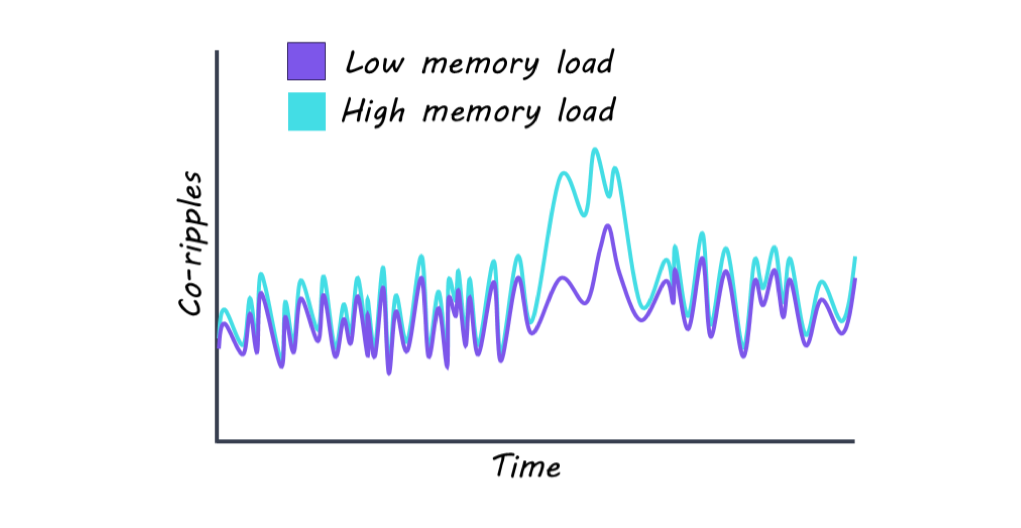
Through this analysis, the authors reached three main conclusions. First, whenever there was a co-ripple, even between distant brain regions (over 220 mm apart), neurons in those regions “co-fired” together roughly 30% more than usual. The cross-region coordination didn’t weaken with distance, and reflected precisely timed coordination between the brain regions, not just an increase in activity in both regions. This coordinated co-firing and co-ripple effect was observed in all three phases of the task. Second, they observed that when a participant was asked to remember three images, there were more cross-region ripples and neuronal co-firing compared to when they only had to remember one image. This shows that, at the level of individual neurons, ripple-driven co-firing between brain regions increases with mental load. Finally, they found that the pattern of cross-region co-firing evoked by a specific stimulus during encoding reappeared during retrieval of the same stimulus, and that during high-load trials, co-firing during co-ripples was significantly greater on trials with faster response times compared to slower ones. This demonstrates that co-ripple-mediated repetition (co-firing of the same neurons in each brain region) is associated with more efficient responses in a WM task, suggesting that ripples don’t just increase general neuronal activity, but carry context-specific content and coordinate better memory recall.
What's the impact?
This study is the first to analyze simultaneous single-unit firing and LFP across the brain during memory formation. They showed that ripple oscillations synchronize neuronal firing, coordinating long-range, stimulus-specific activation that increases with mental effort. This work lends support to the “interactive” over “hierarchical” model of cognition, providing evidence and a new method of studying this framework. Beyond immediate memory, establishing ripples as a demand-sensitive, context-carrying signal allows for further investigation or therapeutic targeting in memory loss disorders such as dementia.