
How The Brain Determines Controllability of an Outcome
Post by Shalana Atwell
The takeaway
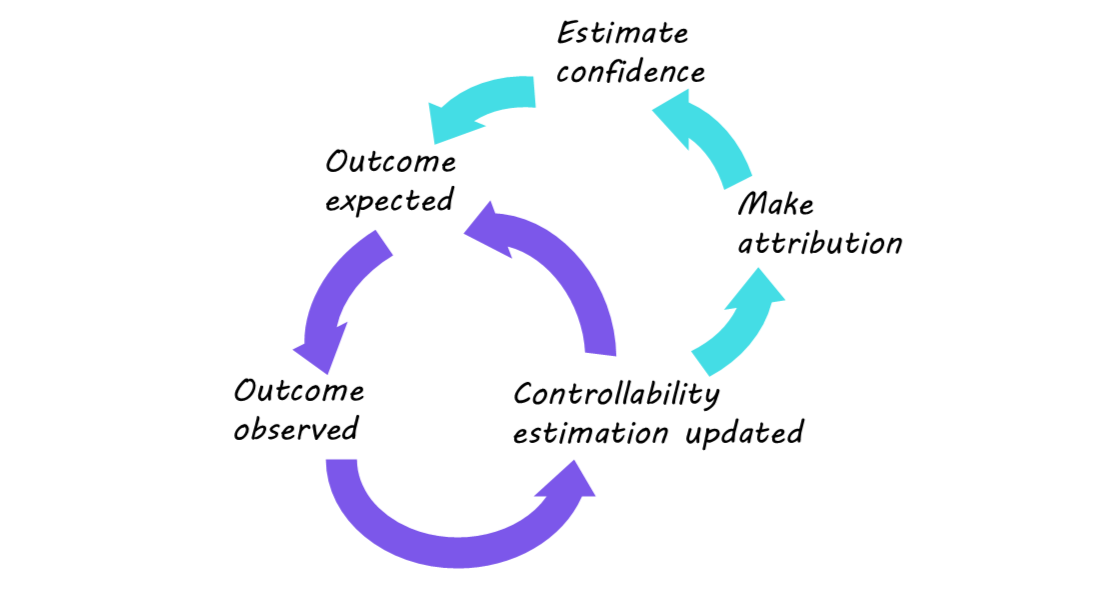
Determining whether an outcome is within our control relies on combining decision confidence with learned expectations about control. The dorsomedial prefrontal cortex (dmPFC) tracks confidence in decisions and interacts with the dorsal raphe nucleus (DRN) to estimate the controllability of an outcome.
What's the science?
Understanding the level of control we have over an outcome is crucial for motivation, decision-making, and learning. While prior research demonstrates that beliefs about control alter learning strategies and affective states, how the brain establishes an estimation of environmental controllability and how that influences learning is poorly understood.
Recently in Neuron, Liu and colleagues investigated how human participants construct dynamic estimates of environmental controllability, how post-decision confidence contributes to outcome attribution, and which prefrontal-subcortical pathways mediate these processes.
How did they do it?
The authors designed a behavioral task paired with high-resolution 7T functional magnetic resonance imaging (fMRI) to measure neural activity in small, deep brain areas like the DRN and midbrain dopaminergic (MBD).
Healthy participants completed visual minigames varying in perceptual difficulty (10%, 40%, or 80% visible dots). On each trial, participants reported:
Decision confidence on a continuous scale
Outcome attribution – whether feedback came from a “neutral committee” based on their performance or a “random committee” producing arbitrary outcomes
Overall environmental controllability estimates for the block
Blocks were pseudo-randomly assigned as controllable (90% neutral trials) or uncontrollable (10% neutral trials). Identical test trials were integrated throughout to assess how prior beliefs biased attribution under ambiguous conditions. Computational modeling was used to capture trial-by-trial updates in confidence, expectation, and control. To evaluate causality, the authors conducted a separate experiment applying continuous theta-burst stimulation (cTBS) – a form of TMS that transiently disrupts cortical activity – targeted at the dmPFC, a control area (vertex), or a sham condition.
What did they find?
Behaviorally, participants updated controllability estimates in response to task contingencies. High-confidence positive outcomes were consistently attributed to self-performance, whereas high-confidence negative outcomes were attributed to external randomness. Prior block experiences significantly biased how participants interpreted identical test trials. Neuroimaging and brain stimulation identified two distinct underlying functional networks:
Controllability Estimation Circuit:
Neural activity in the dmPFC represented decision confidence, outcome attribution, and block-wise controllability estimates.
Updates to controllability estimates corresponded with activity within the DRN, accompanied by enhanced functional connectivity between dmPFC and DRN during major updates.
Individual differences in dmPFC and DRN signal strength predicted overall attribution accuracy.
Feedback modulation circuit:
Reward prediction error signals in the MBD nuclei adjusted based on perceived control: MBD activity correlated positively with positive outcomes when attributed to self-performance, but negatively when attributed to random chance.
Functional interaction between ventrolateral prefrontal-orbitofrontal cortex (47/12o) and MBD regulated these credit-assignment signals.
Causal role of dmPFC:
Applying cTBS over the dmPFC significantly delayed controllability estimate updating across blocks and reduced attribution accuracy compared to control area stimulation or shams, without altering basic task performance or confidence reporting.
What's the impact?
This study demonstrates that the brain relies on two distinct prefrontal-subcortical circuits to estimate environmental control and adjust downstream reinforcement learning, providing a mechanistic model for how beliefs shape outcome processing. These insights provide a neurobiological framework for understanding clinical conditions. Altered connectivity within these prefrontal-subcortical circuits may underlie psychiatric disorders characterized by distorted agency or learned helplessness, such as depression and anxiety.