
Mechanisms of Recovering Forgotten Memories
Post by Anastasia Sares
The takeaway
This study in fruit flies showed it is both possible to recover forgotten memories and to create false memories. However, true and false memories resulted from different processes in the brain.
What's the science?
There has been considerable debate about the recovery of latent (or silent) memories in humans: events from the past that someone had previously forgotten. Along with that debate is the one surrounding false memories, which can be created through the power of suggestion. This week in Nature Neuroscience, Yang and colleagues investigated the neural mechanisms underlying the recovery of true and false memories in the humble fruit fly.
How did they do it?
The authors performed a conditioning task with flies, where they exposed them once to an odor paired with a mild shock, and once to another odor that was not paired with a shock. This is a common experiment, and we already know that after about 24 hours, the flies lose their memory of the pairing and return to normal behavior if they are not reminded about the experience. We can tell the flies have forgotten the association because if they are put in a container with two arms, one with the odor that was paired with the shock and the other which was not, they show no preference, spending equal amounts of time in each arm (see image). This forgotten association is a latent memory that could potentially be re-activated if it is still stored somewhere in the brain of the fly. The authors tested different conditions for trying to re-activate the memory: reminding the flies of the odor throughout the day (without shock), and varying things like texture of the enclosure or lighting along with those reminders. They also tested to see if there were ways for a fly to form a false memory, learning to avoid an odor that had never been paired with a shock.
The authors then used genetic techniques to selectively block the activity of certain brain cells in the fly (a fruit fly brain has around 150,000 neurons, which have been mapped and documented). With this, they hoped to understand which cells were involved in retrieving forgotten memories. Finally, they observed the brain of the fly (pinned to a microscope slide), as they presented it the same protocol (one smell paired with a shock and another smell not paired with a shock) and tested its responses later in the day. They used calcium imaging to observe where brain activity was happening in the fly.
What did they find?
If flies were reminded of the aversive odor in between the initial experience and testing, they were able to recover and retain the shock-odor association—but only if important parts of the original context were also replicated (same floor texture, lighting). On the other hand, if the flies were reminded of the unpaired odor in between the initial learning and testing, they created a false memory, associating the unpaired odor with the shock instead, and preferring the odor that had originally been paired with the shock!
Contextual cues were necessary to help the flies retrieve aversive memories. When reminded of the texture or lighting where they had first experienced the shock, the flies were more likely to avoid the odor. When the flies were placed in a completely different environment (different texture/lighting), they acted neutrally. This indicates that, in order to recover lost memories, it might be necessary to re-create the original context of the memory in a multi-sensory way.
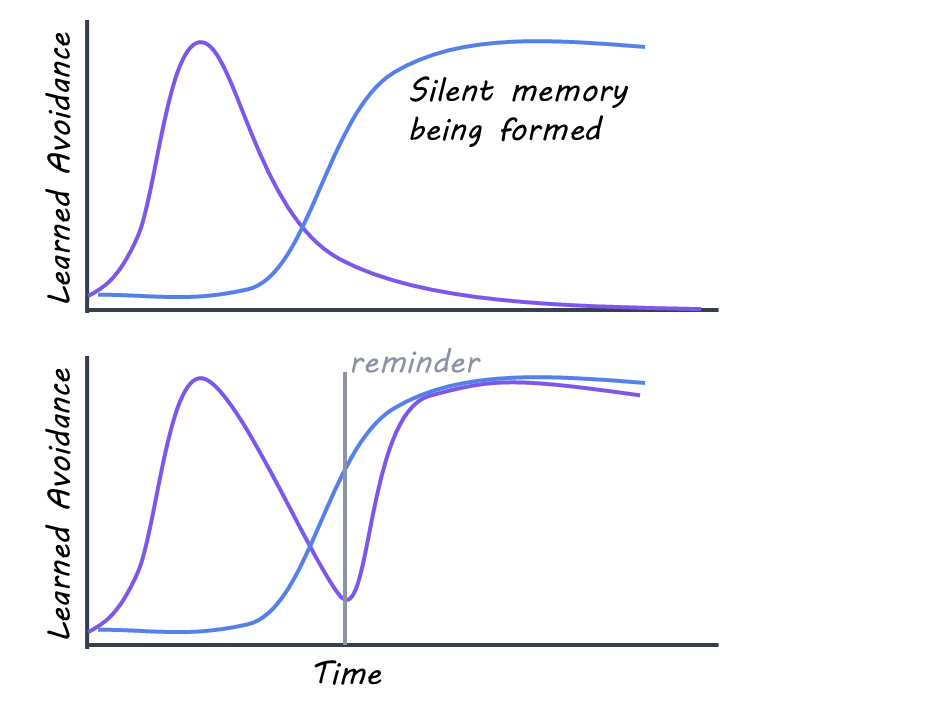
As for the cell-level interactions that occur to recover these memories, the authors found specific neurons that were necessary for the reactivation of memories, even though they weren’t involved in the initial learning. These neurons developed their connections even as the original memory was being forgotten. Stimulating these neurons allowed the flies to recover the aversive memory even in the absence of reminders, as well as during changes in the context (lighting, texture). However, stimulating these neurons did not lead to false memories, which meant that false memories are developed through an entirely different pathway.
It was a different set of neurons that turned out to be responsible for creating false memories (a similar class of neurons, but still distinct). Still, false memories were fragile and could be interfered with by changing the context. This means that even though it’s possible to form false memories, these can only form in contexts very similar to the true memory.
What's the impact?
This work shows that there are different brain mechanisms for retrieving silent memories versus creating false memories. It’s an important distinction, but of course this study was performed in fruit flies, so more work would be needed to understand these kinds of memories in other animals or humans.