
Brain Stages of Aging Across the Lifespan
Post by Lila Metko
The takeaway
Topology in neuroscience is the study of the motifs that arise when observing how neural connections are interrelated and arranged. This research revealed that there are five major phases of topological development, with a significant topological turning point occurring between each phase at approximately the ages of 9, 32, 66, and 83 years old.
What's the science?
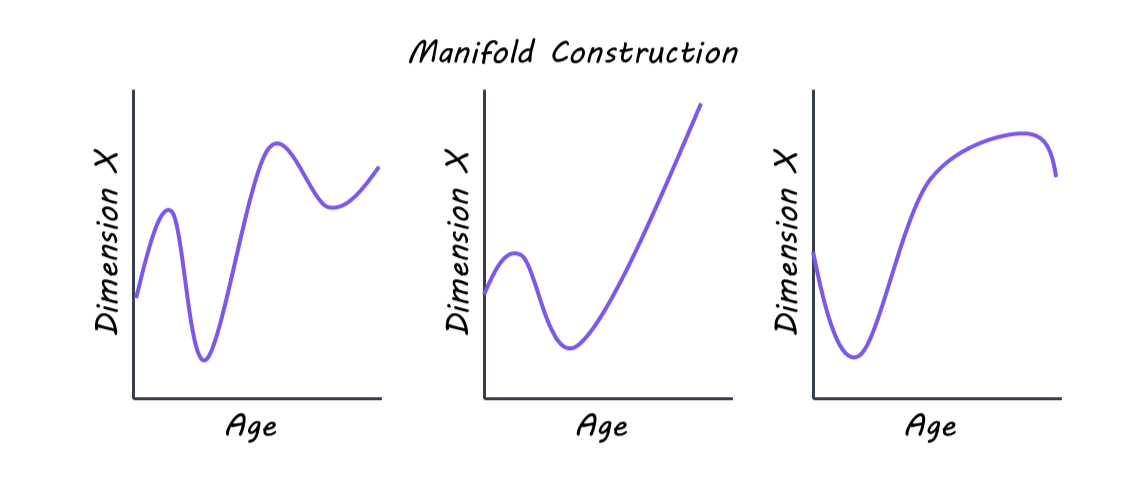
Many scientists who study the development of the human brain look for linear trends in the developmental trajectory, or differences between age groups. To date, there are few papers that look at development outside of the confines of linear relationships. Recently, in Nature Communications, Mousley and colleagues analyzed brain imaging data from a large sample of individuals aged zero to 90 and found that rather than smooth trends in topographical organization, the human brain undergoes major age-specific turning points in topography.
How did they do it?
The study included nine separate data sets, so the first step was to harmonize the data to ensure the differences between the data sets, such as the brain scanners and data acquisition protocols used, did not create nuisance variation. A double harmonization method was used to harmonize the data across atlas and study. Next, the authors used UMAP (Uniform Manifold Approximation and Projection), a manifold learning method, to project high-dimensional data onto a lower-dimensional space. Doing this makes highly complex data easier to understand while still maintaining its intrinsic structure. They mathematically analyzed the lower-dimensional manifold to find topological turning points within the data set. Finally, to understand the topological characteristics of these turning points, they did a principal components analysis of the data with eleven different topological metrics. These topological metrics measured how efficient communication was throughout a network, how many non-overlapping, communicating nodes can be found within a network, and to what extent different nodes are particularly important for network function.
What did they find?
The major topological turning points were characterized by differences in three properties: segregation, integration, and centrality. Segregation is defined as the partitioning of the network into subgroups, integration measures the ease of communication across the network, and centrality is network communication’s dependency on a few nodes that are particularly important for network function. Segregation measures loaded most heavily onto principal component 1 (PC1), and integration measures onto PC2. Both segregation and centrality load most heavily onto PC3. Significant shifts in PC 1 and 2 (network subdivision and network communication ease) are found at roughly the ages of 9 and 32. At roughly the age of 66, there are significant shifts in segregation, integration, and centrality (network subdivision, network communication ease, and dependence on central nodes). At around age 83, there is a significant shift in integration, or network communication. The two epochs with the biggest differences in trajectories were epochs three and four, suggesting that topological change is particularly dissimilar in the years before around age 66 and after around age 66.
What's the impact?
This study is the first to examine a large dataset with the goal of finding true qualitative transitions in brain topology, not just age group comparisons or linear trends. This paper allows us to see aging as unique stages rather than just progression and decline. Moreover, understanding the impact of therapeutics on different brain aging stages can allow for a more targeted approach.