How Does the Brain Create Social Network Maps?

Post by Amanda Engstrom

The takeaway

The brain constructs an internal map of social networks, even for relationships never directly observed. New research shows that the hippocampus and entorhinal cortex encode these maps, enabling us to infer and navigate complex real-world social connections.

What's the science?

The brain's ability to navigate complex social networks, like tracking how individuals are connected within a broader group, is fundamental to human social life. Neurons in the medial temporal lobe (MTL) are known to encode cognitive maps of physical space, and converging evidence suggests the MTL may similarly represent abstract relational structures; however, how the brain encodes large-scale, real-world social networks remains unknown. This week in PNAS, Teoh and colleagues combined computational modeling with fMRI and a longitudinal study of a real-world social network to investigate how activity in the hippocampus and entorhinal cortex scales to represent naturalistic social structures.

How did they do it?

To uncover how social network structure is encoded across individuals, the authors recruited undergraduates within a real-world social network and asked them to identify their friends within that network at multiple timepoints, generating a ground-truth friendship map (defined as mutual recognition between two individuals). Participants were asked to judge the relationships between other network members in a pairwise manner, including pairs they had never directly interacted with, to assess participants' ability to infer unseen social connections. The authors then tested four computational models of network representation to determine which best explained participants' behavioral patterns. These models varied in their relational complexity, the weight they gave to connections between individuals, the shortest path distance between two people, and the structural complexity of those paths.

To identify the brain regions supporting these representations, the authors used functional MRI (fMRI) to measure MTL activity while participants viewed photographs of community members and judged whether each person belonged to their network. Regions of interest included both the left and right hemispheres of the anterior hippocampus (aHC), posterior hippocampus (pHC), and the entorhinal cortex (EC). To link brain activity patterns to the computational models, they applied representational similarity analysis (RSA), a method that asks whether the pattern of similarity across brain responses mirrors the structure predicted by a given model of representation.

Finally, to assess whether these neural maps translate into functional social reasoning, the authors administered an Information Flow task where participants were asked to determine how information would travel from one participant across the network; a measure of how well participants could navigate their social network to trace indirect connections. Responses were linked to individual neural representations to determine how MTL activity patterns relate to real-world social inference.

What did they find?

Participants demonstrated structured, non-random judgments about unseen relationships, and their accuracy decreased with social distance: participants were most accurate when judging pairs close to their own friendships, with performance declining as the path distance between pairs increased. This suggests that participants do not simply recall direct ties but actively infer indirect connections using a structured internal representation of the network. Of the computational models tested, the Katz communicability model, which captures integration across multiple indirect paths between individuals, rather than just the shortest or most direct route, provided the best fit to participants' behavioral data. This indicates that people represent their social networks as distributed, multi-path structures rather than simple maps of direct connections.

At the neural level, the RSA revealed that the right EC encoded an abstract map of multistep network connections, while the right aHC may encode a more veridical representation of directly observed social ties. This regional dissociation suggests the MTL supports social network representation through at least two complementary encoding mechanisms, paralleling its known role in spatial navigation. 
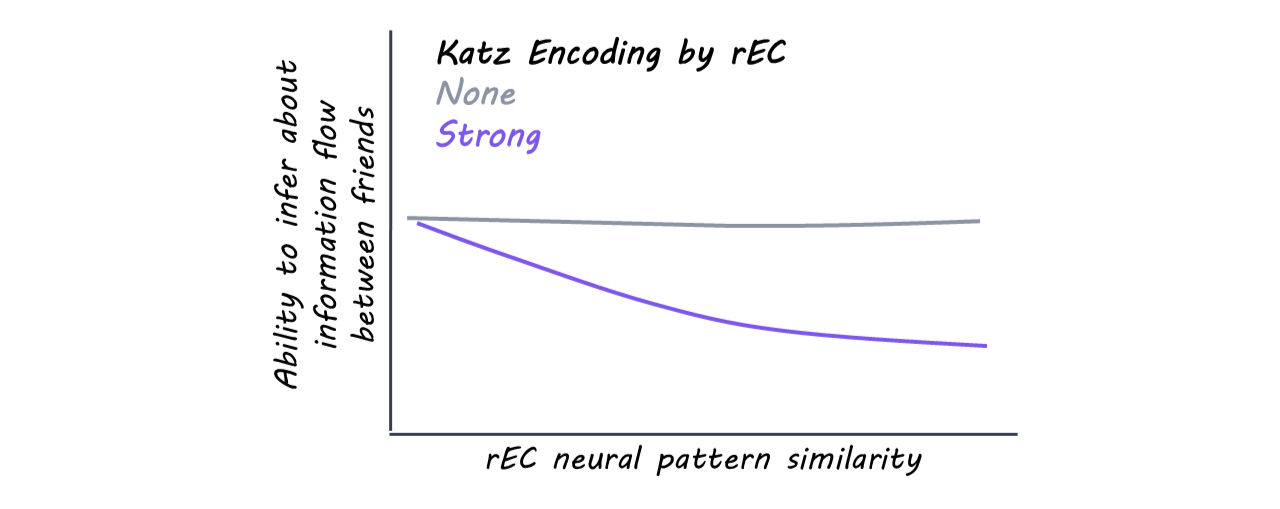
Finally, participants again relied on a Katz communicability-based strategy when reasoning about how news would spread through the network. Critically, when the right EC strongly encodes Katz communicability, the more strongly the right EC predicts task performance.

What's the impact?

This study is the first to demonstrate that the human brain encodes large-scale, real-world social networks as structured cognitive maps, within the MTL. These findings extend the MTL's known role in spatial navigation into the domain of complex social cognition. This work lays the foundation for investigating how social cognitive maps are updated over time, and how their disruption may contribute to deficits seen across neurological and psychiatric conditions.
Access the original scientific publication here

How Do Pain Pathways Drive the Placebo Effect?

Post by Lila Metko

The takeaway

Placebo pain reduction is a phenomenon where prior experience or expectations suppress pain in response to the administration of an inactive treatment. Placebo reduction of pain involves input from multiple cortical regions to the brainstem, which gates brainstem endogenous opioid release, reducing the experience of pain. 

What's the science?

Placebo analgesia (reduction of pain) is well known for its ability to complicate experimental procedures. It can also be a useful phenomenon relevant to therapeutic development. For example, if systems involved in placebo analgesia are understood, clinicians may be able to provide treatments that deliberately engage them to provide pain relief. This week in Neuron, Livrizzi and colleagues reverse translate a human placebo conditioning paradigm to mice, and uncover cortex to brainstem connections that gate release of endogenous opioids to downstream pain-modulatory regions. 

How did they do it?

The authors used a conditioning paradigm where contextual cues were paired with either morphine + pain stimulus or saline injection (placebo) + pain stimulus. For the morphine conditioning, the idea is that in the absence of morphine, these contextual cues would trigger placebo analgesia in the mice. After conditioning, the placebo test included placing these conditioned mice in similar contexts to the morphine conditioning, but with a saline (placebo) injection to induce placebo analgesia. They measured pain in animals by how long it took them to remove their paw from a pain-inducing apparatus (withdrawal latency). The tools they used to manipulate and record pathways involved in placebo analgesia were chemogenetics to activate pathways and fiber photometry to record opioid signaling. The authors used TRAP2 mice - mice that have genetic modifications that allow for labelling and then selectively analyzing neurons involved in a certain behavior or process. In this case, that behavior was placebo analgesia. They also used an interesting approach called in-vivo drug uncaging, which allowed the release of an opioid receptor antagonist over a specific temporal window, in this case, the placebo analgesia test window. 

What did they find?

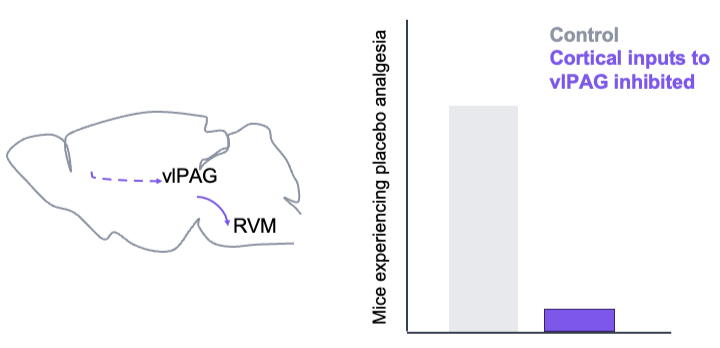
This study found that the vlPAG (ventrolateral periaqueductal grey), a brainstem region with glutamatergic neurons that activate to produce analgesia, is involved in placebo analgesia. They also found that neurons active in the vlPAC during placebo analgesia receive projections from neocortical and insular regions, while neurons in the rostroventral medulla (RVM) received projections from PAG analgesia neurons. After further experiments, they found that placebo analgesia was reduced when the neocortical regions, and not the anterior insular regions, were inhibited. Similar findings occurred when the PAG to RVM connections were inhibited, although both morphine and placebo nociception were altered in this case, not just placebo nociception. They additionally showed that placebo analgesia can be transferred between multiple pain modalities.

What's the impact?

This is the first research study to provide causal evidence of circuits involved in placebo analgesia. Importantly, it moves from correlational human evidence of cortex to brainstem circuits being involved in placebo analgesia to causational data using animal models. Understanding this circuit, especially its role in lasting analgesia after injury, opens up possibilities for future therapeutics. 

Access the original scientific publication here.

How the Hippocampus Combines Place and Emotion in Memory

Post by Anastasia Sares

The takeaway

In this study, the authors show that different parts of the hippocampus, a memory formation structure in the brain, work together to bind environmental location and emotional information to form memories of reward or danger.

What's the science?

The hippocampus is a brain structure involved in memory formation. When an animal is navigating its environment, cells in the dorsal (“upper”) hippocampus called “place cells” fire when the animal is in different locations. Then, when an animal is sleeping, these cells fire again, in special bursts called “sharp-wave ripples.” This process reactivates other parts of the brain that were involved in the experience, and this is one way scientists think memories are consolidated and strengthened.

However, the hippocampus is not just for remembering where we’ve been. The ventral (“lower”) hippocampus has strong connections to the limbic system, a collection of deep brain structures that helps us process emotion. The limbic system includes the amygdala, which is involved in fear and other strong emotions, and the ventral tegmental area, which is involved in reward and motivation. This week in Nature Neuroscience, Morici and colleagues proposed that the ventral hippocampus is a key linking structure that helps us associate specific emotions with specific environments, driving behavior.

How did they do it?

The authors recorded brain activity from both the dorsal and ventral hippocampus of rats as they completed a navigation task, either to avoid danger (in the form of mild shocks) or to get a reward (in the form of a drink). They recorded this activity both as the animal was learning the task, as well as when the animal was sleeping that night and consolidating their memories from the day.

During learning, both the dorsal and ventral hippocampus were active, but the authors were specifically interested in whether they were working together or not. They used independent component analysis to identify patterns of coherent neural activity, which the authors called “assemblies.” They then tracked these assemblies during learning and during sleep.

What did they find?

During learning, the authors found 446 neural assemblies with coordinated activity. About 62% of these reflected activity mainly in the dorsal hippocampus, 14% reflected activity mainly in the ventral hippocampus, and 24% reflected activity in both regions (which they called “joint assemblies”). These joint assemblies looked very different between the reward and danger conditions, potentially indicating that the hippocampus was changing its internal connectivity depending on the emotional content of the experience. About half of the assemblies were associated with rewarding experiences, and half with dangerous experiences.

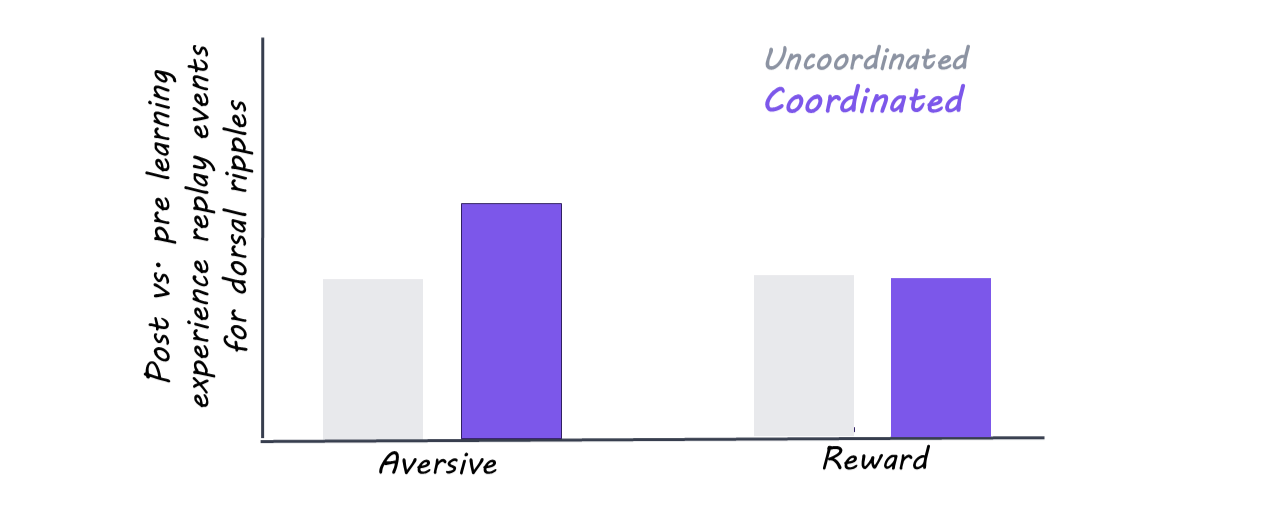
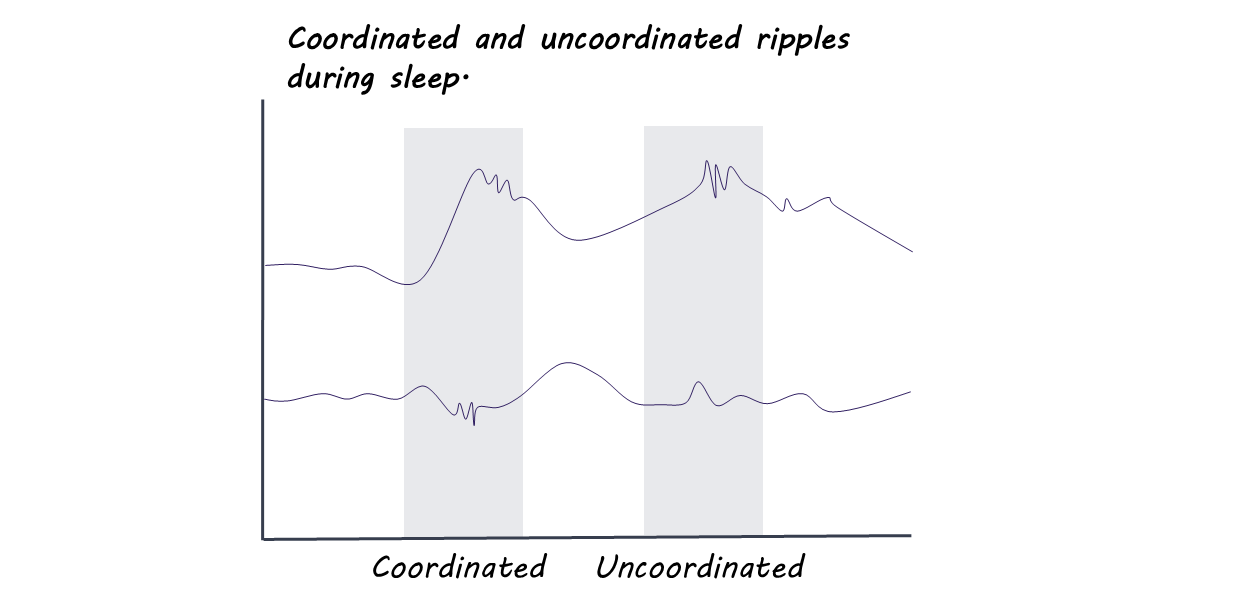
During sleep, the authors continued to track neural activity in both regions. Many of the ripples, those bursts of activity that help reactivate memories, were coordinated between the dorsal and ventral hippocampus. Depending on the experience of the day, different assemblies would be activated: specifically, on the days the animal had been learning from shocks, the cells in the ventral hippocampus responding to danger were more coordinated with place cells in the dorsal hippocampus. Again, this shows that the hippocampus may have different internal connectivity when linking a memory to reward or to danger.

What's the impact?

This work helps us understand the mechanism that links environmental location to emotional memories. It helps us tie what we know about the binding of memories to specific, anatomically connected parts of the brain.


Access the original scientific publication here.