
How and When Does the Brain Show Resilience After Stress?

Post by Annika Matthiesen 

The takeaway

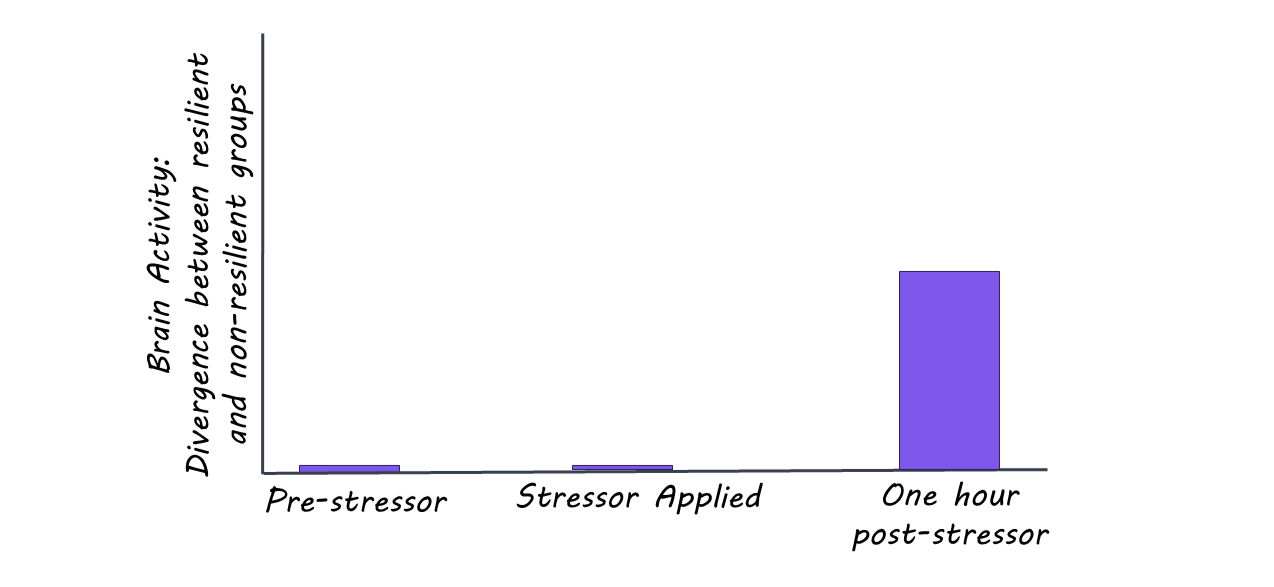
Resilience enables us to navigate challenges and recover from stress. Notably, resilience is not immediate; key neurophysiological changes emerge in a distinct window approximately one hour after stress exposure, revealing a delayed but dynamic process of recovery.

What's the science?

Stress is part of everyday life, whether it is a looming deadline or a never-ending list of chores. Humans are uniquely equipped to cope with these challenges, yet we vary widely in how well we adapt and recover from stress. This week in PNAS, Watanabe and colleagues set out to understand how the brain responds to acute stress by examining time-specific changes in neural activity and physiological responses following stress exposure.

How did they do it?

To explore how people respond to stress, the authors followed about 100 participants through a carefully timed experiment, beginning with self-reported assessments of their baseline stress levels. They measured both brain activity and physical stress responses, like heart rate, breathing, pupil size, and cortisol (a hormone released during stress). Brain activity was assessed using fMRI, which shows active brain areas, and EEG, which measures electrical brain signals. These measurements were taken before, immediately after, and up to 1.5 hours after the stress event to understand how responses change over time. The stress itself was induced using a cold pressor test, where participants placed their hand in ice-cold water for two minutes. By comparing responses across time and between individuals who were more stress-resilient vs. more stress-susceptible, the researchers were able to investigate when stress responses peak.

What did they find?

The researchers first found that self-reported stress levels did not clearly match immediate changes in brain and body activity, suggesting there is no simple biological pattern that separates more resilient from less resilient individuals right away. However, when they looked at brain activity over time, the most pronounced activity changes appeared about one hour after the stressor. At this point, two key brain networks showed opposite patterns, one becoming more active while the other became less active depending on individuals’ stress levels. This same one-hour window was confirmed by machine learning analyses as the most important time point for distinguishing resilience, highlighting that this time point after stress is especially dynamic in the context of stress response. Interestingly, EEG showed similar changes during this time in the same brain region, particularly in the prefrontal cortex (the part of the brain involved in decision-making and emotional regulation), suggesting this region may play a crucial role in stress recovery.
What's the impact?

This study is the first to show that the biggest differences between people who cope well with stress and those who don’t appear about one hour after a stressful event. In other words, resilience isn’t immediate; the brain takes time to shift into a recovery mode. There may be a critical window where the brain is most actively adapting to stress. Understanding this timing could help us better support mental health and develop treatments that target the right moment to improve recovery from stress.
Access the original scientific publication here.

Does Growing New Neurons Improve Memory?

Post by Rebecca Glisson

The takeaway

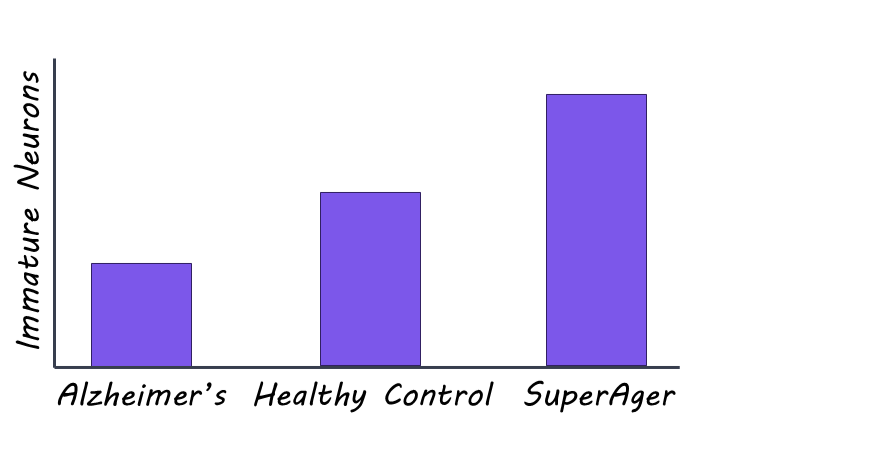
Recent studies have shown that humans can grow new neurons (neurogenesis) even as adults. Individuals with Alzheimer’s disease have much lower neurogenesis than normal, while older adults with high cognitive capacity have abnormally high neurogenesis.

What's the science?

It was long thought that adults do not grow new brain cells (neurogenesis), but more recently, we have come to understand that neurogenesis happens throughout our lives. Most studies use rodents as a model for human brains, which doesn’t yield enough insight into how neurogenesis occurs in adult humans. This week in Nature, Disouky and colleagues studied the brains of humans at all ages, with and without Alzheimer’s disease, to better understand the link between neurogenesis and cognitive functioning.

How did they do it?

To study neurogenesis in humans, the authors used the brains of deceased donors. The donors were groups of individuals at different ages and cognitive abilities, including young and older adults with normal cognitive ability, individuals who had or were starting to show signs of Alzheimer’s disease, as well as adults they called “SuperAgers”, or individuals who had high memory test scores. The authors identified neurogenesis from the genetic sequence present in cells in the hippocampus, a part of the brain involved in memory, using a method called RNA-seq. Cells that have just grown, immature cells, have a specific genetic sequence that the authors analyzed to determine how much neurogenesis had occurred.

What did they find?

Both younger and older adults with healthy cognitive ability had high levels of neurogenesis in their hippocampi. In contrast, individuals with Alzheimer’s disease or symptoms of it had less neurogenesis and fewer immature neurons. This suggests that the slowing of neurogenesis may impact memory in diseases such as Alzheimer’s. One interesting result was that the “SuperAger” adults had significantly more neurogenesis and more immature neurons than any other group, including the healthy adults, suggesting that neurogenesis may help support healthy cognitive functioning as we age. 

What's the impact?

This study is the first to analyze the sequence of new immature neurons in humans and the first to link neurogenesis to cognitive function in individuals of different age groups and cognitive ability. Studies like these can help us better understand mechanisms of memory preservation or memory decline and how to develop better preventative care and treatment for those impacted.

Access the original scientific publication here.

Reducing Loneliness: Comparing an AI Chatbot to a Human

Post by Lila Metko

The takeaway

Given the global loneliness epidemic, many scientists are looking to technology to find scalable solutions. A recent study shows that artificial intelligence (AI) may be a good solution when an immediate boost in affect is needed, but that over the long term, real human relationships can better foster a reduction in loneliness.

What’s the science?

Generative AI is used by a large number of people not just for information, but for a meaningful source of connection. In recent years, a growing number of scientific studies have examined the effects of chatbots on social connection and positive mood. While many studies have shown positive immediate effects of chatbots, few have assessed the benefits over time. Interestingly, one long-term study found that chatbots may negatively impact emotional state, with seeking chatbot social support predicting increased loneliness. This week in Journal of Experimental Social Psychology, Li and colleagues assessed the cumulative impact of interacting with a custom AI chatbot on emotional outcomes in a population vulnerable to loneliness.

How did they do it?

The authors conducted this study using two experimental groups (chatbot and human) and one control group (daily journaling) to compare the impact of a supportive chatbot on loneliness with that of conversing with a random peer. They conducted this two-week study using a custom chatbot named Sam, designed to have the qualities of an ideal supportive friend, and a subject pool of first-semester college students at a Canadian university. Conversations for each group, including the journaling group, were held on the social media platform Discord, a popular platform among students. The human peer group met with their human conversation partners in person at the beginning of the study. The chatbot and peer group participants were asked to send one meaningful message each day. Each participant was asked to perform their assigned task and take a short survey for 14 consecutive days. The participants were also assessed via a survey pre and post-study.

What did they find?

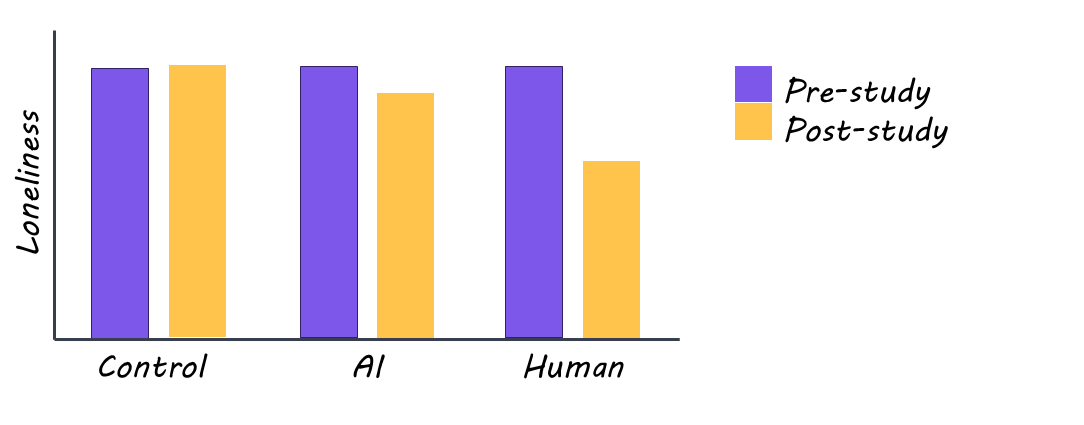
The authors found that only the human peer group showed a decrease in loneliness post-study. A similar pattern was found for positive mood and perceived isolation. Interestingly, both the human peer group and the chatbot group displayed decreased negative mood post-study compared to the control group. Participants were allowed to use their Discord room for one week following the study. The percentage of the human peer group that continued to engage with their human conversation partner in the Discord room was more than double the percentage in the group that continued communication with their chatbot during this one-week time period. These findings overall suggest that interactions with a human peer may be more beneficial than interactions with an AI chatbot to reduce loneliness.

What’s the impact?

This study’s results suggest a “middle ground” role of AI chatbots on emotional outcomes in individuals vulnerable to loneliness, demonstrating that a chatbot can reduce negative affect, while a human’s support may have a more positive impact in the longer term. This study sheds light on when to use AI or human-based support in vulnerable populations to reduce loneliness. The authors suggest that it is better to view AI as a tool to ameliorate rather than mimic human connection.

Access the original scientific publication here.