
How and When Does the Brain Show Resilience After Stress?
Post by Annika Matthiesen
The takeaway
Resilience enables us to navigate challenges and recover from stress. Notably, resilience is not immediate; key neurophysiological changes emerge in a distinct window approximately one hour after stress exposure, revealing a delayed but dynamic process of recovery.
What's the science?
Stress is part of everyday life, whether it is a looming deadline or a never-ending list of chores. Humans are uniquely equipped to cope with these challenges, yet we vary widely in how well we adapt and recover from stress. This week in PNAS, Watanabe and colleagues set out to understand how the brain responds to acute stress by examining time-specific changes in neural activity and physiological responses following stress exposure.
How did they do it?
To explore how people respond to stress, the authors followed about 100 participants through a carefully timed experiment, beginning with self-reported assessments of their baseline stress levels. They measured both brain activity and physical stress responses, like heart rate, breathing, pupil size, and cortisol (a hormone released during stress). Brain activity was assessed using fMRI, which shows active brain areas, and EEG, which measures electrical brain signals. These measurements were taken before, immediately after, and up to 1.5 hours after the stress event to understand how responses change over time. The stress itself was induced using a cold pressor test, where participants placed their hand in ice-cold water for two minutes. By comparing responses across time and between individuals who were more stress-resilient vs. more stress-susceptible, the researchers were able to investigate when stress responses peak.
What did they find?
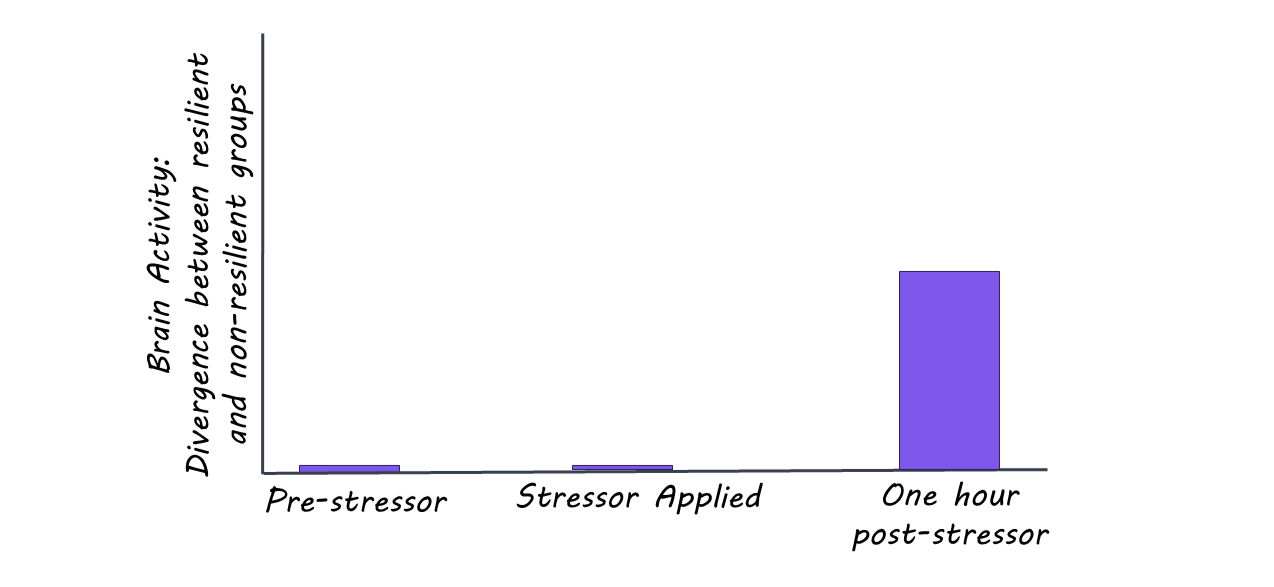
The researchers first found that self-reported stress levels did not clearly match immediate changes in brain and body activity, suggesting there is no simple biological pattern that separates more resilient from less resilient individuals right away. However, when they looked at brain activity over time, the most pronounced activity changes appeared about one hour after the stressor. At this point, two key brain networks showed opposite patterns, one becoming more active while the other became less active depending on individuals’ stress levels. This same one-hour window was confirmed by machine learning analyses as the most important time point for distinguishing resilience, highlighting that this time point after stress is especially dynamic in the context of stress response. Interestingly, EEG showed similar changes during this time in the same brain region, particularly in the prefrontal cortex (the part of the brain involved in decision-making and emotional regulation), suggesting this region may play a crucial role in stress recovery.
What's the impact?
This study is the first to show that the biggest differences between people who cope well with stress and those who don’t appear about one hour after a stressful event. In other words, resilience isn’t immediate; the brain takes time to shift into a recovery mode. There may be a critical window where the brain is most actively adapting to stress. Understanding this timing could help us better support mental health and develop treatments that target the right moment to improve recovery from stress.