Large Language Models Could Influence Voter Attitudes in Elections

Post by Rebecca Glisson

The takeaway

Large language models (LLMs) such as ChatGPT can engage people in persuasive conversations that may change their opinions. When voters had conversations with an LLM about election candidates, they were more likely to change their political opinion on the candidate.

What's the science?

Large language models (LLMs) are used today as a way for the general public to quickly gather information about a topic they are unfamiliar with, despite how often these models can present misleading or false information as facts. There is a developing concern about how this will affect voter decisions in democratic elections. This week in Nature, Lin and colleagues studied how interacting with LLMs can change voter attitudes towards political candidates.

How did they do it?

The authors tested the effects of human-AI conversations on voter attitudes for four elections: a United States presidential election, a ballot election in Massachusetts for legalizing psychedelic drugs, a Canadian federal election, and a Polish presidential election in 2024 and 2025. They asked participants to rate their attitude toward each candidate or voting option and how likely they would be to vote on a scale of 0 to 100. Each participant would then have a “conversation” with an LLM which would try to persuade them for one candidate (or ballot measure), or the other. The authors used several different LLMs for the experiment, including the widely-known ChatGPT, but also DeepSeek, Llama, and a combination of models using Vegapunk. The model was instructed to have a positive and respectful conversation with the participant while working to increase the participant’s support for the model’s assigned candidate. After the experiment, participants were again asked to rank their support from 0 to 100 and the authors compared how their answers changed before and after the interaction with the LLM. Finally, the authors used a combination of Perplexity AI’s LLM and professional fact-checkers to study how accurate the statements in each of the LLM’s interactions with participants were.

What did they find?

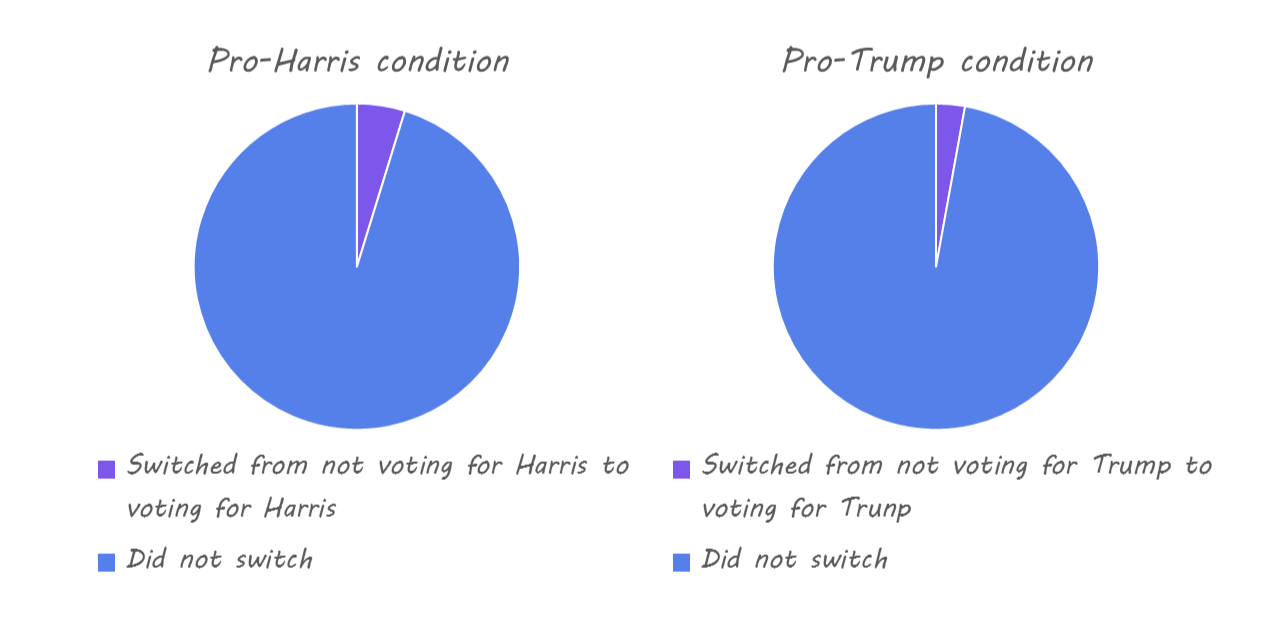
The authors found that for each group and election, participants were persuaded in whichever direction the model was assigned to work towards. This effect was even stronger if the participants interacted with an LLM that was advocating for the opposite of their initial preference. For example, if a person said they supported Trump for the US presidential election, and interacted with a pro-Harris LLM, they were more likely to lean towards Harris than someone who had initially been a Harris supporter. These same trends were true for the ballot measure in Massachusetts and the elections in Canada and Poland. The authors also found that overall, the statements made by the LLMs were mostly accurate. However, they found an interesting trend that LLMs that were arguing in support of the right-leaning candidates in each country made more inaccurate statements.
What's the impact?

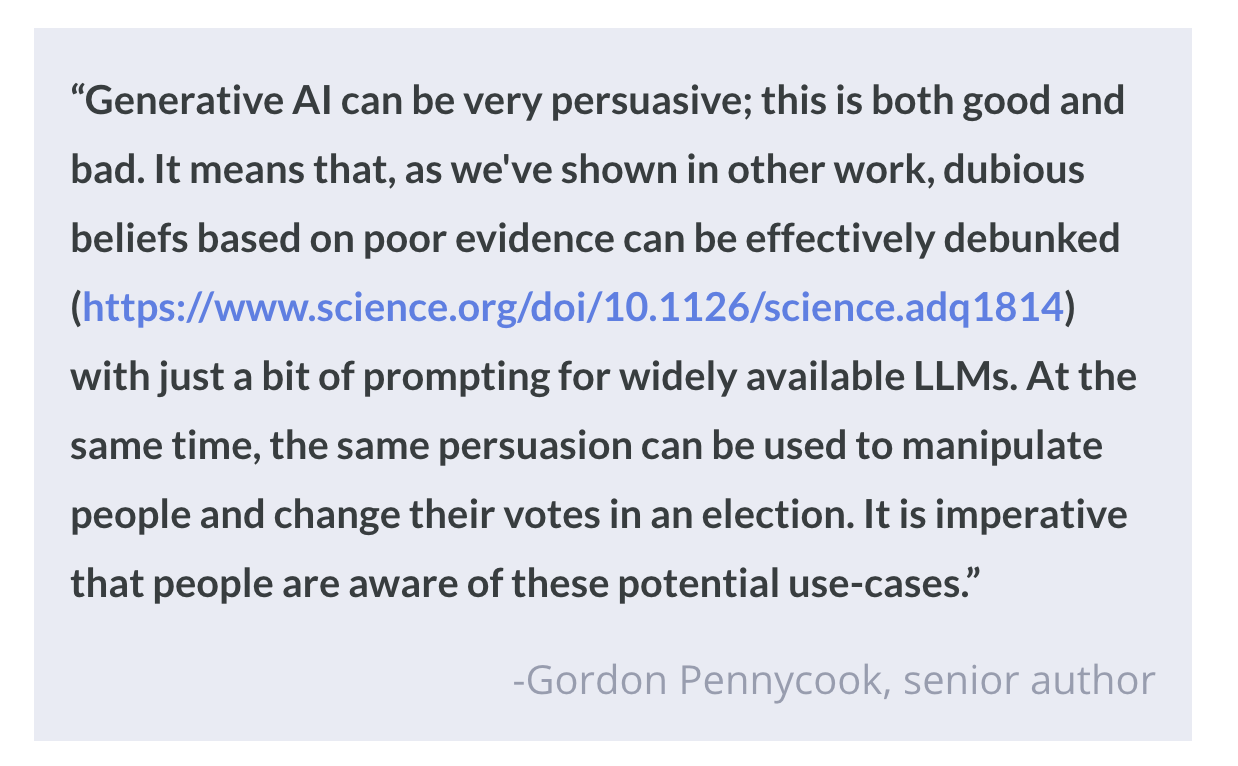
This study is the first to show that LLMs, which have recently gained popularity among the population, can persuade people to change their opinions towards political elections and candidates. While some might consider this an exciting development in how to persuade voters in elections, the tendency of LLMs to produce misinformation is important to consider before trying to use them on a larger scale. Studies like these can be extremely valuable for understanding the risks of using new technology before it is properly understood and regulated.
How Are Cognitive And Physical Endurance Linked?

Post by Amanda Engstrom 

The takeaway

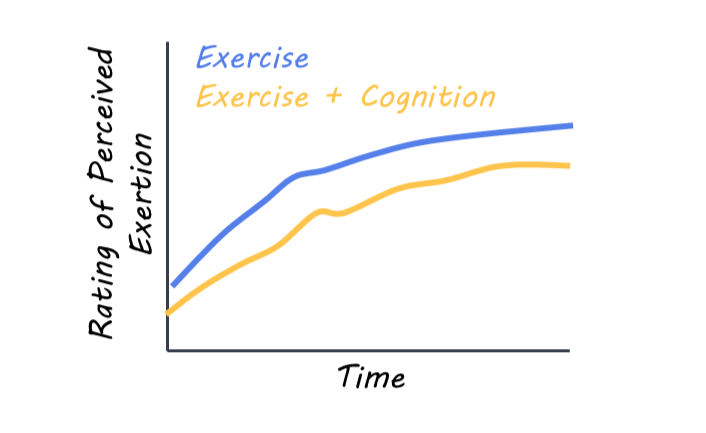
Engaging in cognitive tasks during physical activity makes exercise feel harder. Individuals with stronger cognitive abilities are less affected by this mental “cost,” suggesting that cognition and endurance capacity are closely linked. 

What's the science?

The combination of physical activity and cognitive tasks (such as navigation and working memory), known as cognitive-motor dual tasks, may play a critical role in the evolution of human foraging strategies and sustaining goal-oriented physical effort. In ancestral environments, humans had to perform dual functions for hunting and foraging, which likely shaped the evolution of human cognition. Prior work has shown that cognitive demands during short-duration movement can compete with locomotor resources and reduce physical endurance. This negative association has been attributed to the increased perception of physical effort and mental fatigue; however, this has not been directly tested. This week in PNAS, Aslan and colleagues conduct a randomized trial to elucidate how cognitive demands influence long-term endurance and fatigability.

How did they do it?

The experiment included thirty healthy individuals ages 18-53 (17 females, 13 males). Participants completed two endurance walking sessions at roughly 65% of their estimated maximum heart rate. One exercise session was done while simultaneously performing various executive function tasks (Exercise + Cognition; E+C), and the other was walking alone (Exercise alone; EA). During each session, the authors measured the participants' perceived effort using the Borg Rating of Perceived Exertion (RPE) scale and their perception of fatigability, which is the change in the participants' perception of effort. The authors also tracked the participants' oxygen consumption and carbon dioxide production to estimate the energetic cost of exercise and their respiratory exchange rate. Finally, to test whether higher cognitive function might buffer the negative effects of dual tasking on endurance, the authors evaluated participants’ cognitive performance before any physical activity, focusing on skills relevant to foraging success, like executive function, visuospatial abilities, and memory. 

What did they find?

Perceived effort was significantly greater during the E+C condition compared to EA. Six participants chose to stop early from exercise in the E+C condition, compared with only one participant stopping early in both conditions. 

This supports the idea that cognitive-motor dual tasks increase perceived effort during endurance activities. However, perceived fatigability—the rate of change in perceived effort—did not differ between conditions. The physical expenditure of participants, measured by net metabolic power and overall respiratory exchange rate, was significantly lower during the E+C condition compared to EA. Interestingly, participants had a greater respiratory exchange rate initially in the E+C condition compared to EA, but the values converged as the trial went on. This indicates that early in the E+C condition, participants utilized a greater proportion of carbohydrates as fuel than in the EA condition, but this proportion declined at a slightly more rapid rate over the duration of the E+C condition. In both the E+C and EA conditions, participants with better delayed memory had lower perceived effort. Additionally, participants with lower visuospatial ability and figure recall scores had a larger increase in perceived effort from the E+C to EA conditions compared to participants with higher scores on these tests.

What's the impact?

This study demonstrates a bidirectional relationship between aerobic endurance and cognitive function. Dual tasking appears to reduce endurance by increasing the overall perception of effort. The findings also show that the subjective feeling of effort does not necessarily track actual physiological cost. Overall, this study provides a framework for understanding how cognition can both constrain and support goal-oriented physical activity from an evolutionary standpoint as well as for modern training practices.


Access the original scientific publication here.

How Speech Relates to Brain Structural Changes in Psychiatric Illnesses

Post by Lila Metko 

The takeaway

Deficits in the ability to produce coherent, organized language are a common feature across many psychiatric disorders. The authors found that regardless of which specific psychiatric diagnosis an individual has, different types of deficits in their language correlate with specific changes in the brain structure. 

What's the science?

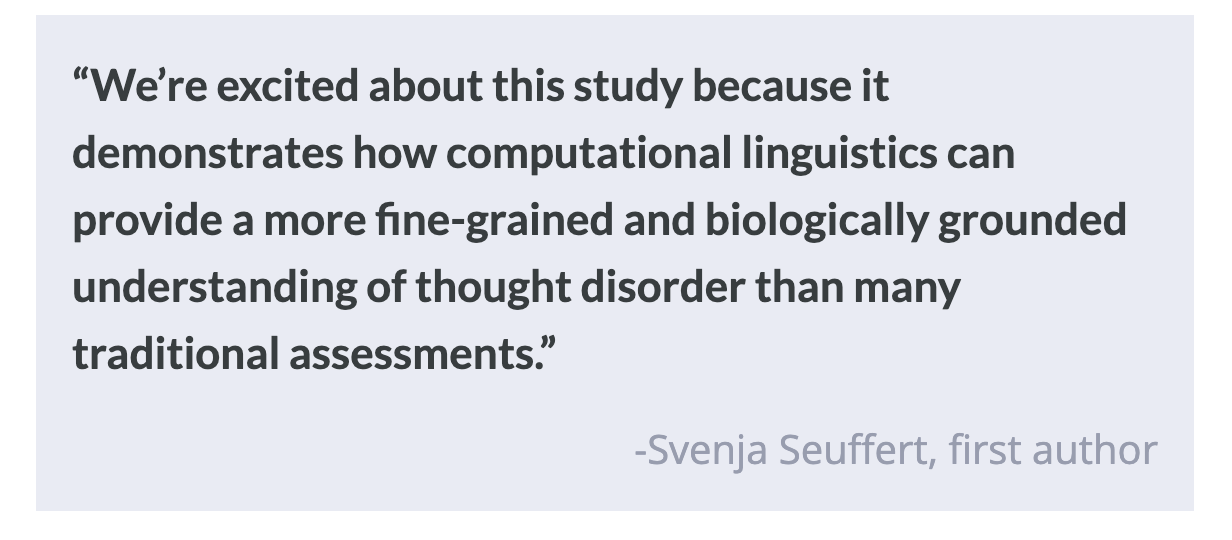
Language deficits are a feature of many psychiatric illnesses, and they span across several illness types, including both mood disorders and psychotic disorders. Formal thought disorder (FTD) is a disorder of deficits in the organization of thinking, writing, and verbal communication. Formal thought disorder and language deficits in general are associated with a poorer quality of life for individuals with psychiatric illnesses like schizophrenia spectrum disorder (SSD) or bipolar disorder. In a transdiagnostic sample - a sample containing individuals with multiple diagnoses - it was found that higher FTD disorganization is associated with lower grey matter in some regions of the brain. There have been few transdiagnostic studies that formally investigate the relationship between spoken language, the multiple dimensions of formal thought disorder, and neuroimaging analysis. This week in Molecular Psychiatry, Seuffert and colleagues used computer processing of human language to help map different features of speech onto brain structure

How did they do it?

The authors used natural language processing (NLP), a form of artificial intelligence to analyze and interpret language. They asked the participants, 194 with a mood disorder or psychotic disorder, and 178 healthy controls, to speak naturally to describe a set of four pictures. The total time they collected speech for each participant was 12 minutes, 3 minutes per picture. NLP was used to extract a broad set of linguistic features from each participant’s speed, which were entered into an exploratory factor analysis to identify the underlying dimensions that best explained variance across speakers. The factors were syntax complexity, richness and diversity in vocabulary, and breadth of focus in the narrative. Each participant underwent MRI imaging, and after excluding poor-quality images and artifacts, the researchers ended up with 303 participants with grey matter volume data and 247 participants with diffusion tensor imaging data. Diffusion tensor imaging is a specialized MRI technique that visualizes the diffusion of water molecules through tissue and is a particularly useful technique for visualizing the structure of white matter. 

What did they find?

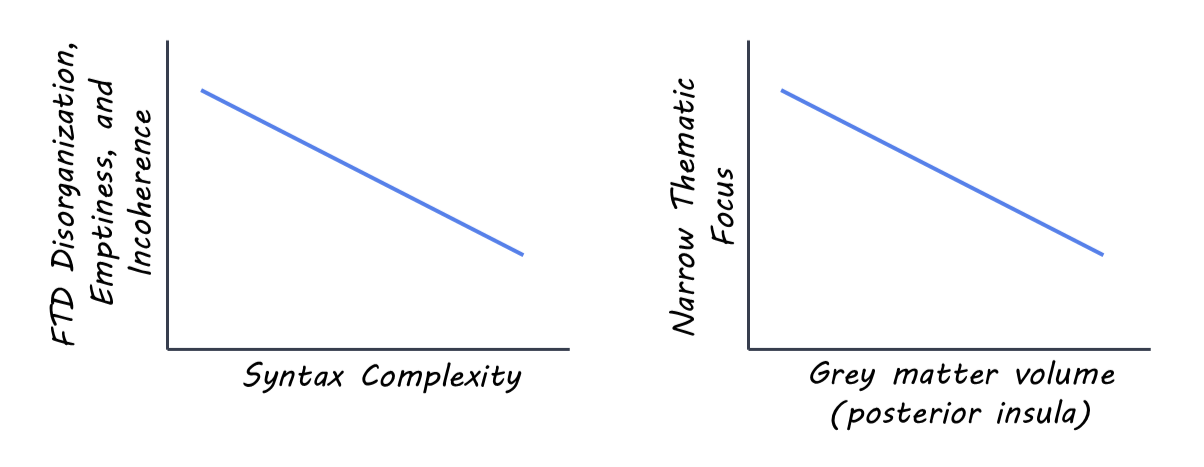
The authors analyzed the relationship between the explorative analysis factors and dimensions of FTD. Syntax complexity correlated negatively with FTD Disorganization, Emptiness, and Incoherence, while vocabulary richness and diversity correlated negatively with only FTD Emptiness. This means that as these aforementioned FTD dimensions increased, the respective factors decreased. Narrow Thematic Focus (a narrow theme/narrative) was not associated with clinician-rated FTD, but showed a distinct neuroanatomical signature: a significant negative association with grey matter volume in a right-hemispheric cluster centered in the posterior insula and extending into the planum polare and putamen. No grey matter correlates were observed for the other two linguistic factors after stringent correction. In white matter analysis, each explorative analysis factor was negatively associated with functional anisotropy, a measure of white matter health, of at least one white matter tract. Vocabulary richness and diversity were associated with seven different white matter tracts, particularly within the frontotemporal regions. 

What's the impact?

This is the largest transdiagnostic study to date to map specific features of human speech onto structural brain changes in psychiatric illness. Since the quality of language is highly predictive of outcomes and quality of life in individuals with psychiatric disorders, this knowledge is especially important in the detection and treatment of these disorders. In understanding which regions of the brain are responsible for different aspects of spontaneous speech pathology, scientists are better equipped to discover treatments for them.