How Speech Relates to Brain Structural Changes in Psychiatric Illnesses
Post by Lila Metko
The takeaway
Deficits in the ability to produce coherent, organized language are a common feature across many psychiatric disorders. The authors found that regardless of which specific psychiatric diagnosis an individual has, different types of deficits in their language correlate with specific changes in the brain structure.
What's the science?
Language deficits are a feature of many psychiatric illnesses, and they span across several illness types, including both mood disorders and psychotic disorders. Formal thought disorder (FTD) is a disorder of deficits in the organization of thinking, writing, and verbal communication. Formal thought disorder and language deficits in general are associated with a poorer quality of life for individuals with psychiatric illnesses like schizophrenia spectrum disorder (SSD) or bipolar disorder. In a transdiagnostic sample - a sample containing individuals with multiple diagnoses - it was found that higher FTD disorganization is associated with lower grey matter in some regions of the brain. There have been few transdiagnostic studies that formally investigate the relationship between spoken language, the multiple dimensions of formal thought disorder, and neuroimaging analysis. This week in Molecular Psychiatry, Seuffert and colleagues used computer processing of human language to help map different features of speech onto brain structure.
How did they do it?
The authors used natural language processing (NLP), a form of artificial intelligence to analyze and interpret language. They asked the participants, 194 with a mood disorder or psychotic disorder, and 178 healthy controls, to speak naturally to describe a set of four pictures. The total time they collected speech for each participant was 12 minutes, 3 minutes per picture. NLP was used to extract a broad set of linguistic features from each participant’s speed, which were entered into an exploratory factor analysis to identify the underlying dimensions that best explained variance across speakers. The factors were syntax complexity, richness and diversity in vocabulary, and breadth of focus in the narrative. Each participant underwent MRI imaging, and after excluding poor-quality images and artifacts, the researchers ended up with 303 participants with grey matter volume data and 247 participants with diffusion tensor imaging data. Diffusion tensor imaging is a specialized MRI technique that visualizes the diffusion of water molecules through tissue and is a particularly useful technique for visualizing the structure of white matter.
What did they find?
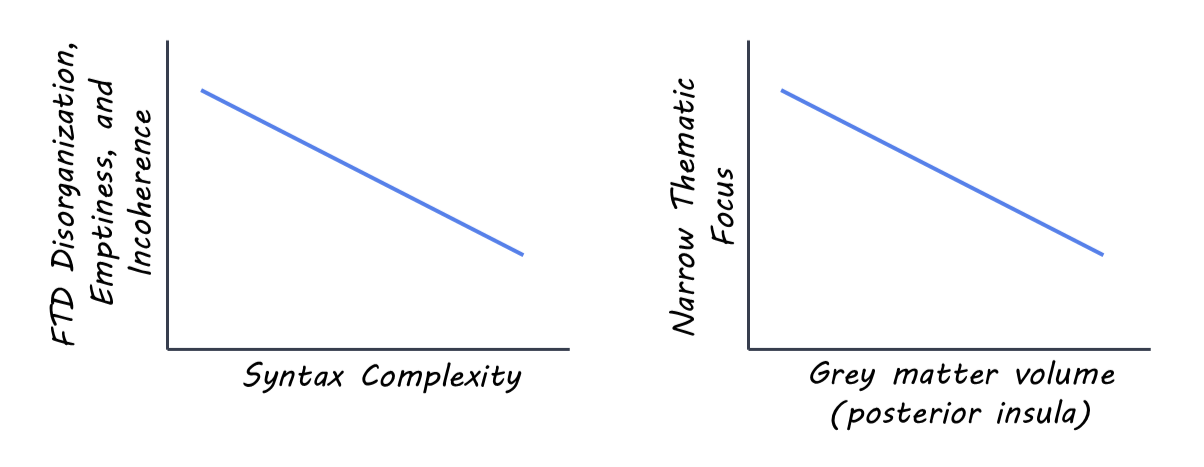
The authors analyzed the relationship between the explorative analysis factors and dimensions of FTD. Syntax complexity correlated negatively with FTD Disorganization, Emptiness, and Incoherence, while vocabulary richness and diversity correlated negatively with only FTD Emptiness. This means that as these aforementioned FTD dimensions increased, the respective factors decreased. Narrow Thematic Focus (a narrow theme/narrative) was not associated with clinician-rated FTD, but showed a distinct neuroanatomical signature: a significant negative association with grey matter volume in a right-hemispheric cluster centered in the posterior insula and extending into the planum polare and putamen. No grey matter correlates were observed for the other two linguistic factors after stringent correction. In white matter analysis, each explorative analysis factor was negatively associated with functional anisotropy, a measure of white matter health, of at least one white matter tract. Vocabulary richness and diversity were associated with seven different white matter tracts, particularly within the frontotemporal regions.
What's the impact?
This is the largest transdiagnostic study to date to map specific features of human speech onto structural brain changes in psychiatric illness. Since the quality of language is highly predictive of outcomes and quality of life in individuals with psychiatric disorders, this knowledge is especially important in the detection and treatment of these disorders. In understanding which regions of the brain are responsible for different aspects of spontaneous speech pathology, scientists are better equipped to discover treatments for them.