The Role of Extracellular Potassium in Regulating Wakefulness

Post by Christopher Chen

The takeaway

Extracellular potassium ([K+]e) in the brain has long been linked to arousal states. Researchers demonstrate that potassium dynamics affect neuromodulator release and impact cortical activation, suggesting that potassium may influence phenomena like local sleep during wakefulness and abnormal sleep/wake cycles following brain injuries.

What's the science?

Our brains cycle through various states of alertness over the course of the day. For example, when we sleep our brains experience high-amplitude slow-wave activity, representing the synchronized firing and inactivity of large neuron populations. Conversely, during wakefulness, our brains experience low-amplitude high-wave activity characterized by desynchronized firing and elevated neuronal activity. Monoamine neurotransmitters, or neuromodulators, are closely tied to changes in brain activity patterns and arousal levels. 

In a region of the brain called the locus coeruleus (LC), a subset of monoaminergic neurons that release neuromodulators like norepinephrine (NE) and dopamine (DA) project to the cortex and show different discharge rates during wakefulness, nonrapid eye movement (NREM) sleep, and rapid eye movement (REM) sleep. Changes in cortical potassium levels have also been linked to arousal, particularly the sleep-wake cycle. When we sleep, potassium levels are low ~(3 mM) but gradually increase to ~4 mM as we enter a wakeful state. Despite the role of potassium in arousal, researchers have not extensively studied how directly manipulating potassium alters NE levels and behavioral states. 

Recently in PNAS, Dietz et al. manipulated potassium levels in mice to measure its effects on LC activity and NE levels as well as its overall impact on the brain. In doing so, they provide a new perspective on how our brains undergo behavioral state changes and suggest that potassium may have an underappreciated role in cortical function. 

How did they do it?

In order to manipulate potassium levels as well as measure NE levels and the levels of other well-known neuromodulators like DA and serotonin (5-HT), the researchers used a process called in vivo microdialysis that allowed them to inject various concentrations of potassium into the brains of mice, and a process called high-performance liquid chromatography (HPLC) to measure the levels of potassium and neuromodulators. 

To test how potassium changes affected arousal they utilized a tail shock to induce arousal in the mice and measured how this arousal response differed in conditions with various potassium levels. They also measured how changes in potassium levels affected sleep/wake cycles by comparing brain activity in mice implanted with EEG electrodes. Finally, as disturbances in the sleep/wake cycle have been shown to affect physical activity and performance on motor tasks, researchers measured how changes in potassium levels influenced wheel running and motor performance.    

What did they find?

To test potassium-dependent effects on neuromodulator levels, researchers injected various concentrations (2.5, 3.5, and 5 mM) of potassium into the brain during the light phase and dark phase of the day. They discovered that in both phases, increasing potassium levels induced parallel increases in NE, DA, and 5-HT and decreasing potassium levels resulted in parallel decreases in NE, DA, and 5-HT.

Having established the direct effects of changes in potassium levels on neuromodulators, researchers tested whether these potassium changes influenced arousal. Following the injection of various potassium levels, they discovered that injecting low levels of potassium prior to a tail shock limited the mouse’s response as measured by NE levels. In fact, these mice expressed almost no tail shock-induced increase in NE. Conversely, NE levels in mice injected with high (5 mM) potassium were nearly 2x as high as the NE levels induced by a baseline startle response, highlighting the influence of potassium on arousal state.

In terms of the sleep/wake cycle, mice injected with 2.5 mM spent significantly more time in NREM and REM sleep and significantly less time in the wake state as measured by EEG activity. These mice were also less active than the control group, expressing less overall spontaneous movement.

Lastly, the researchers sought to measure the effects of potassium changes on wheel running and motor performance. Interestingly, increasing potassium levels correlated with further distance traveled on a wheel but did not significantly affect the number of times the mice used the wheel, suggesting that potassium levels influence the sustainment of running. As for motor performance, increases in potassium levels directly correlated with decreases in the number of falls from a rotarod, suggesting high levels of potassium contributed to heightened motor performance.  

What's the impact?

While changes in potassium levels have been linked to changes in brain function, this study provides a detailed explanation of how direct manipulations of in vivo potassium levels in mice alter the brain as well as discrete behaviors. Clinically, researchers may rely on these findings to inform therapeutic approaches for aberrant sleep/wake cycles caused by brain injury. Finally, it provides evidence that a local (cortical) source in the form of potassium may be influencing local NE release, a novel finding that may potentially reconfigure our understanding of how arousal is processed in the brain.
Gray Matter Loss in Psychosis is Present in Brain Regions Connected by White Matter

Post by Lani Cupo

The takeaway

Grey matter changes associated with the psychosis spectrum occur in networks connected by white matter, with the hippocampus as a central hub connecting regions of gray matter loss. 

What's the science?

The psychosis spectrum, from early first episodes to chronic psychotic disorders like schizophrenia, is associated with gray matter abnormalities, especially atrophy, across the brain. It is yet unknown, however, what mechanism underlies these changes. This week in JAMA Psychiatry Chopra and colleagues demonstrate that gray matter changes are constrained to networks connected by white matter (axonal connections), identifying the hippocampus as a potential source spreading volume loss to different regions.

How did they do it?

The authors acquired magnetic resonance imaging (MRI) data from 534 people in several groups: patients who had a first episode of psychosis (FEP), but no exposure to antipsychotics, patients who had been exposed to antipsychotics for less than three years, patients with established schizophrenia, and age-matched control groups for each patient group. Comparisons between each patient group and the corresponding control group were made to identify statistical differences in gray matter volume associated with psychotic disorders. In the FEP group, however, additional longitudinal analyses were conducted to isolate the effects of the disorder from those associated with antipsychotics. The authors examined change over time in a control group, patients receiving antipsychotics, and patients receiving a placebo. They could compare changes between the placebo group and control group to identify disorder-related changes and compare changes in the group that received antipsychotics to the placebo group to isolate antipsychotic-related changes. Using images that reflect which brain regions are connected (diffusion weighted imaging and functional MRI), the authors constructed a model of brain networks in a separate healthy dataset. They could then assess whether regions with volume change in the psychosis groups were part of the same brain networks using a coordinated deformation model. Next, the authors used a network diffusion model to assess whether changes in gray matter volume spread evenly throughout the network, or whether certain brain regions served as a hub, or epicenter for volume change.

What did they find?

First, the authors demonstrate that changes in gray matter across stages of illness are constrained by networks connected by white matter. Brain regions that were more strongly connected were more likely to show similar levels of gray matter loss. This suggests changes in various brain regions are not wholly independent, but rather connected in networks. In order to provide evidence that gray matter changes actually spread through axonal connections, however, the authors found that patterns of change associated with both illness and antipsychotic exposure were constrained by brain networks, implying that illness and medication-related changes over time are also related to the connectome. Finally, the authors identified the hippocampus as an epicentre for volume loss, as it was significantly different between patients and controls across all datasets.

What's the impact?

The results of this study suggest gray matter changes associated with psychosis may spread through axonal connections between regions. While there is little evidence for a protein-related spreading of psychosis-related pathology, the cellular profiles of connected regions may share alterations that underlie brain volume changes. Understanding the network-related changes may help future researchers identify the mechanism by which psychopathology impacts the brain to provide better treatment and prevention.

Neural Activity in Subcortical Regions is Highly Correlated with Resting State Cortical Network Dynamics

Post by Meredith McCarty

The takeaway

Despite the high interconnectedness of cortical and subcortical regions, the subcortex remains an understudied area of the human brain. High-resolution fMRI reveals that the subcortex is highly functionally connected (i.e. a high degree of correlated brain activity) with distinct cortical regions, demonstrating a gradient of connectivity for both integrative and segregated patterns of information processing.

What's the science?

In daily life, humans integrate information constantly, a process thought to be orchestrated by a highly interconnected brain. The brain is composed of many cortical and subcortical structures (i.e. neural formations deep within the brain), and there are complex patterns of connectivity between these regions that enable rapid network dynamics to unfold. To study these dynamics in healthy subjects, researchers can utilize noninvasive imaging techniques, although these methods are often limited in resolution to recording from the cortex. The lack of access to subcortical structures occurs primarily due to tooling and analysis limitations, including low signal-to-noise ratios and the varying properties of brain tissue in deeper structures. Because of these limitations, it is unknown how subcortical regions participate in neural information processing at a network level. This week in The Journal of Neuroscience, Groot and colleagues utilize high-resolution fMRI imaging techniques to measure the level of correlated activity between cortical and subcortical structures in humans.

How did they do it?

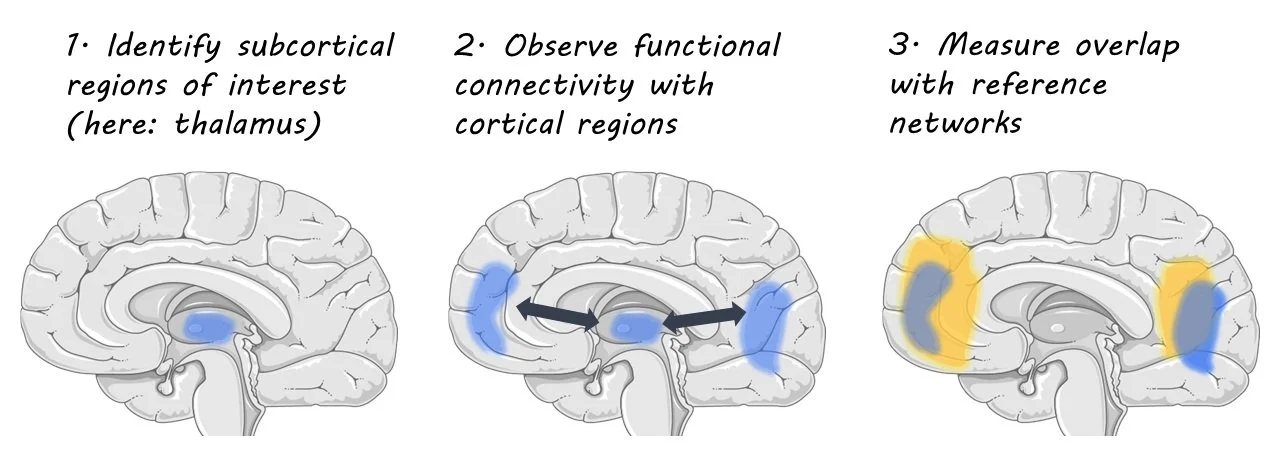
The authors utilized functional magnetic resonance imaging (fMRI) at a high-field resolution in order to record changes in BOLD signal across cortical and subcortical regions. They recruited 40 adults (21f) to participate in wakeful rest fMRI data collection, which consisted of two 15-minute sessions during which participants fixed their gaze on a central fixation point. They next determined cortical and subcortical regions of interest through use of automated parcellation algorithms. Their method of fMRI data analysis enabled the identification of patterns of intrinsic functional connectivity (FC) in the brain at a resolution that revealed more subtle functional organization. They compared subcortical FC patterns data with ‘reference networks’; common patterns of resting-state fMRI activation in the cortex known to be highly correlated with various behavioral and cognitive activities. These include the salience, visual, and default mode networks. By comparing the overlap between areas with FC to subcortical regions and the reference networks, the authors were able to measure the degree of network correlation between cortical and subcortical regions.

What did they find?

First, the authors found 7 subcortical regions that had high spatial correlation between brain regions they were functionally connected to and reference networks. These regions were the Thalamus, Striatum, Claustrum, Globus pallidus external, Hippocampus, Ventral tegmental area, and Substantia nigra. The authors dub the patterns of network correlation discovered to be “echoes” of intrinsic connectivity networks within cortical regions. Upon closer examination, they found a heterogeneous organization of echoes within subcortical subregions, with some regions exhibiting high correlation with many reference networks, while other regions exhibited very little to no significant connectivity. This suggests that there is a gradient within subcortical regions of distinct and integrated network dynamics.

What's the impact?

This study found activity in distinct subcortical regions to be highly correlated with distinct resting state cortical networks. These results suggest that the subcortex is involved in integrated multi-network neural activity with many cortical regions, an area of research previously restricted by methodological constraints. Altered subcortical dynamics are linked to many brain disorders, therefore a greater understanding of the role of subcortical regions in resting state healthy brain dynamics is pivotal.

Access the original scientific publication here