The Role of Extracellular Potassium in Regulating Wakefulness
Post by Christopher Chen
The takeaway
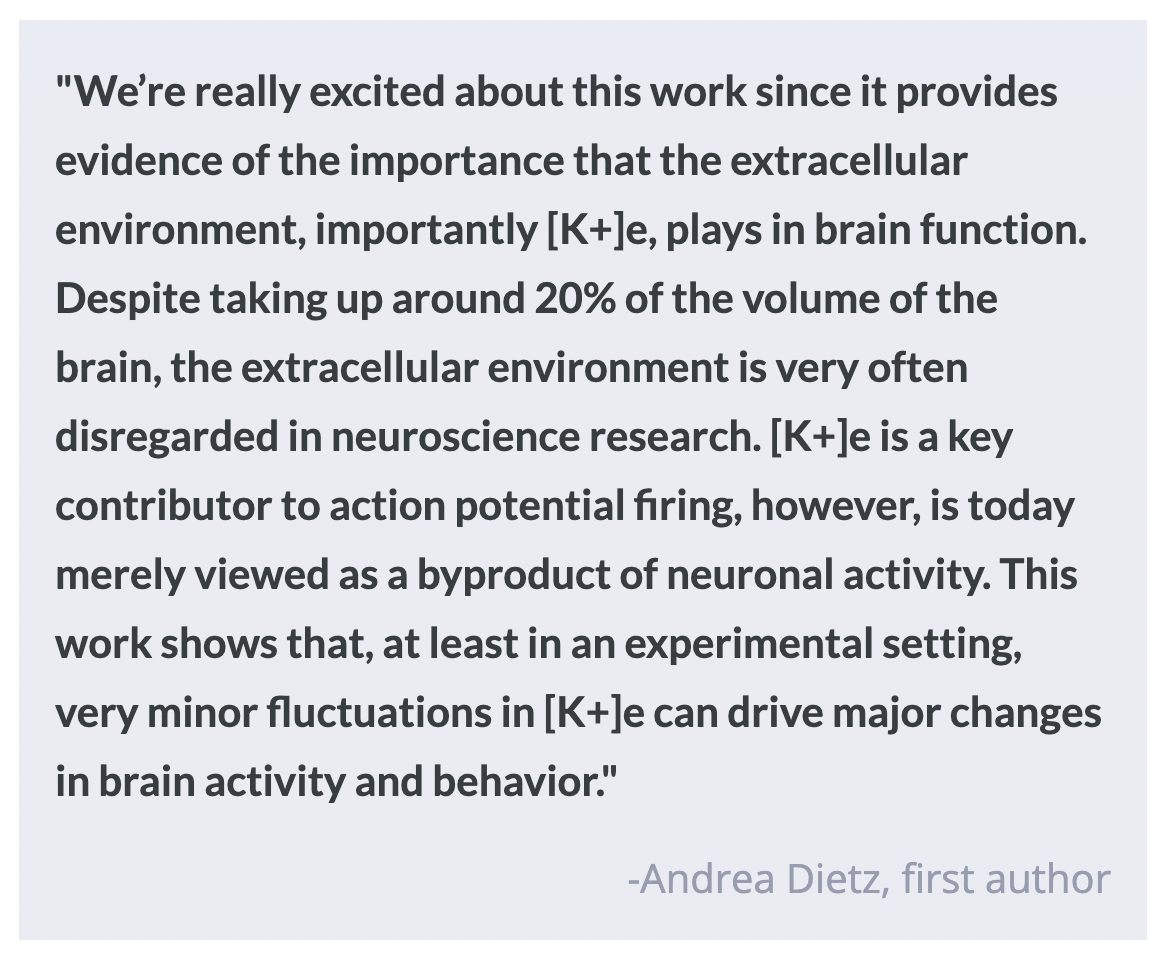
Extracellular potassium ([K+]e) in the brain has long been linked to arousal states. Researchers demonstrate that potassium dynamics affect neuromodulator release and impact cortical activation, suggesting that potassium may influence phenomena like local sleep during wakefulness and abnormal sleep/wake cycles following brain injuries.
What's the science?
Our brains cycle through various states of alertness over the course of the day. For example, when we sleep our brains experience high-amplitude slow-wave activity, representing the synchronized firing and inactivity of large neuron populations. Conversely, during wakefulness, our brains experience low-amplitude high-wave activity characterized by desynchronized firing and elevated neuronal activity. Monoamine neurotransmitters, or neuromodulators, are closely tied to changes in brain activity patterns and arousal levels.
In a region of the brain called the locus coeruleus (LC), a subset of monoaminergic neurons that release neuromodulators like norepinephrine (NE) and dopamine (DA) project to the cortex and show different discharge rates during wakefulness, nonrapid eye movement (NREM) sleep, and rapid eye movement (REM) sleep. Changes in cortical potassium levels have also been linked to arousal, particularly the sleep-wake cycle. When we sleep, potassium levels are low ~(3 mM) but gradually increase to ~4 mM as we enter a wakeful state. Despite the role of potassium in arousal, researchers have not extensively studied how directly manipulating potassium alters NE levels and behavioral states.

Recently in PNAS, Dietz et al. manipulated potassium levels in mice to measure its effects on LC activity and NE levels as well as its overall impact on the brain. In doing so, they provide a new perspective on how our brains undergo behavioral state changes and suggest that potassium may have an underappreciated role in cortical function.
How did they do it?
In order to manipulate potassium levels as well as measure NE levels and the levels of other well-known neuromodulators like DA and serotonin (5-HT), the researchers used a process called in vivo microdialysis that allowed them to inject various concentrations of potassium into the brains of mice, and a process called high-performance liquid chromatography (HPLC) to measure the levels of potassium and neuromodulators.
To test how potassium changes affected arousal they utilized a tail shock to induce arousal in the mice and measured how this arousal response differed in conditions with various potassium levels. They also measured how changes in potassium levels affected sleep/wake cycles by comparing brain activity in mice implanted with EEG electrodes. Finally, as disturbances in the sleep/wake cycle have been shown to affect physical activity and performance on motor tasks, researchers measured how changes in potassium levels influenced wheel running and motor performance.
What did they find?
To test potassium-dependent effects on neuromodulator levels, researchers injected various concentrations (2.5, 3.5, and 5 mM) of potassium into the brain during the light phase and dark phase of the day. They discovered that in both phases, increasing potassium levels induced parallel increases in NE, DA, and 5-HT and decreasing potassium levels resulted in parallel decreases in NE, DA, and 5-HT.
Having established the direct effects of changes in potassium levels on neuromodulators, researchers tested whether these potassium changes influenced arousal. Following the injection of various potassium levels, they discovered that injecting low levels of potassium prior to a tail shock limited the mouse’s response as measured by NE levels. In fact, these mice expressed almost no tail shock-induced increase in NE. Conversely, NE levels in mice injected with high (5 mM) potassium were nearly 2x as high as the NE levels induced by a baseline startle response, highlighting the influence of potassium on arousal state.
In terms of the sleep/wake cycle, mice injected with 2.5 mM spent significantly more time in NREM and REM sleep and significantly less time in the wake state as measured by EEG activity. These mice were also less active than the control group, expressing less overall spontaneous movement.
Lastly, the researchers sought to measure the effects of potassium changes on wheel running and motor performance. Interestingly, increasing potassium levels correlated with further distance traveled on a wheel but did not significantly affect the number of times the mice used the wheel, suggesting that potassium levels influence the sustainment of running. As for motor performance, increases in potassium levels directly correlated with decreases in the number of falls from a rotarod, suggesting high levels of potassium contributed to heightened motor performance.
What's the impact?
While changes in potassium levels have been linked to changes in brain function, this study provides a detailed explanation of how direct manipulations of in vivo potassium levels in mice alter the brain as well as discrete behaviors. Clinically, researchers may rely on these findings to inform therapeutic approaches for aberrant sleep/wake cycles caused by brain injury. Finally, it provides evidence that a local (cortical) source in the form of potassium may be influencing local NE release, a novel finding that may potentially reconfigure our understanding of how arousal is processed in the brain.