Neural Representations for Working Memory are Affected by Long-Term Learning

Post by Lina Teichmann

The takeaway

Neural representations of working memory in lateral prefrontal areas are influenced by past experiences. These results help to disambiguate conflicting findings with regard to the role of lateral prefrontal cortex in working memory.

What's the science?

Many studies have shown the involvement of lateral prefrontal cortex (lPFC) in working memory function, however, its specific role in successful working memory performance is unclear. In particular, previous studies have shown that on the one hand lPFC stores working memory content, and on the other hand lPFC controls working memory content that is stored in sensory cortices. This week in Neuron, Miller and colleagues clarify the role of lPFC by showing how long-term learning affects prefrontal activity during working memory.

How did they do it?

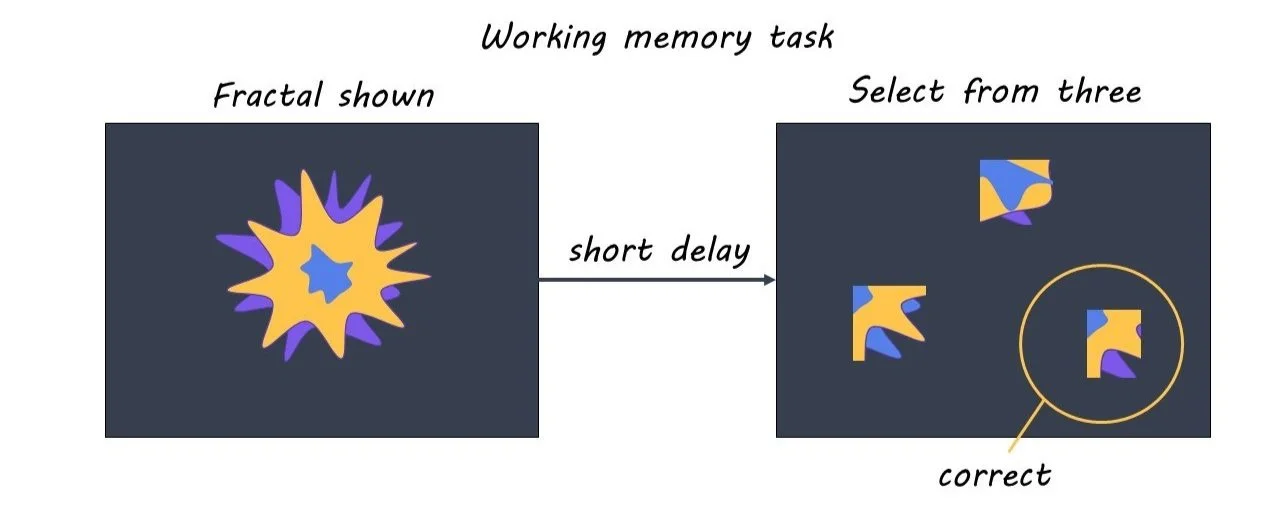
The authors acquired densely sampled behavioral and functional Magnetic Resonance Imaging (fMRI) data from a small sample of participants across three months and tested how long-term learning affects working memory. In all tasks, participants viewed colorful fractal stimuli. In a working memory task, they saw a single sample fractal at a time and had to select that sample fractal from a display of three fractals after a short delay – these three fractals could be ones they had trained on before, or novel. The same fractal stimuli were used in a serial reaction time task participants also trained on, where 12 of the fractals were shown in set sequences. Using set sequences allowed for establishing new associations between stimuli and sequence categories. The behavioral data was used to examine the extent of learning over the course of the three-month data collection period. To examine the neural working memory representations activity over the course of long-term learning, fMRI was sampled from lPFC.
What did they find?

Long-term learning had an effect on the neural representations of working memory in lPFC. There was an increase in the spread of activity during working memory maintenance as training progressed as well as stronger stimulus-specific (but not category-specific) representations in lPFC. Long-term exposure to stimulus associations that were not relevant for working memory task performance also influenced working memory representations in prefrontal areas. Overall, this highlights that working memory representations are shaped by long-term experience.

What's the impact?

The current study contributes to our understanding of the specific role of lPFC during working memory: that long-term learning strengthens specific working memory representations in the lPFC. By using the approach of densely sampling behavioral and neuroimaging data over time, the authors were able to address competing theories on the role of the lPFC.
Histone Acetylation and its Role in Mental Illnesses

Post by Leanna Kalinowski

Exploring the epigenetic mechanisms of mental illnesses is a promising avenue for better understanding how these disorders develop and can be treated. The vast majority of mental illnesses are attributed to a combination of genetic and environmental factors. By studying their epigenetic mechanisms – including histone acetylation – we can gain a better understanding of how our environment influences the expression of our genes to influence the development of mental illnesses.

What are histones and how are they organized?

If you were to unravel all the DNA contained within a single human cell, it would be nearly six feet long – taller than the average human adult! With our cells containing so much DNA, there is a uniform biological system for packing it tightly enough so that it fits within the cell’s nucleus without becoming tangled – a system that relies on tiny proteins called histones

Histones are organized into nucleosomes, which each contain eight histones – two of each of the four histone subtypes (i.e., H2A, H2B, H3, and H4). Think of each nucleosome as a spool, and DNA like a strand of yarn. Our DNA tightly wraps itself around each nucleosome, which then combine and condense into chromatin, which makes up our chromosomes. In addition to this structural support, histones play a crucial role in determining whether genes are expressed. This has wide implications for nearly all aspects of our biology, including the development and treatment of mental illnesses.

How do histones impact gene expression?

The density of nucleosomes when they are packed into chromatin directly impacts whether a gene is transcribed (i.e., the first step in gene expression). When nucleosomes are tightly packed together, many of the genes within them cannot be transcribed; this type of chromatin is called heterochromatin. On the other hand, when nucleosomes are loosely packed together, their genes are much more accessible and able to be transcribed; this type of chromatin is called euchromatin. 

This overall arrangement of chromatin – and therefore the accessibility of genes to be transcribed – can be influenced by modifications to histones. Among the most well-known histone modifications are histone acetylation and deacetylation. During histone acetylation, an acetyl group is added to the histone tail, which leads to a relaxed chromatin structure (i.e., euchromatin) and greater accessibility for its genes to be transcribed. The opposite happens during histone deacetylation, where the acetyl group is removed, leading to a more densely packed chromatin structure (i.e., heterochromatin) and decreased ability for genes to be transcribed. These modifications are generally driven by two classes of enzymes: histone acetyltransferase (HATs), which acetylate histones, and histone deacetylase (HDACs), which deacetylate histones.

How does histone acetylation impact mental illnesses?

Several mental illnesses, along with their environmental risk factors, have been associated with changes in histone acetylation. In particular, histone acetylation has been implicated in the development of depression, anxiety, schizophrenia, and bipolar disorder. Further, a common risk factor for all these disorders – chronic stress – exerts widespread impacts on histone acetylation, particularly in limbic brain regions. Similarly, negative prenatal and early-life experiences, including prenatal stress, maternal separation, and child neglect, have been shown to increase HDAC expression in the prefrontal cortex. Taken together, these findings suggest promising avenues for future explorations into how mental illness impacts gene expression, particularly through histone acetylation. 

Another current direction in histone acetylation research is whether these mechanisms can be targeted as a treatment option, particularly for depression. HDAC inhibitors, which increase histone acetylation and therefore increase gene expression, show particular promise in treating depression in rodent models. For example, increasing histone acetylation has been associated with a reversal of the negative impacts following chronic stress and maternal separation. However, given that HDAC inhibitors can have widespread effects beyond just the brain, the authors of this work caution that therapeutic administration to humans will have unwanted and unintended consequences. Further research and drug development are needed to (1) selectively administer HDAC inhibitors to the human brain and (2) determine whether this is an effective treatment option for depression and other mental illnesses. 

References +

Abel & Zukin. Epigenetic targets of HDAC inhibition in neurodegenerative and psychiatric disorders. (2008). Current Opinion in Pharmacology.

Chen et al. Research progress on the correlation between epigenetics and schizophrenia. (2021). Frontiers in Neuroscience.

Nestler. Epigenetic mechanisms of depression. (2014). JAMA Psychiatry.

Nestler et al. Epigenetic basis of mental illness. (2016). Neuroscientist.

Park et al. Epigenetic targeting of histone deacetylases in diagnostics and treatment of depression. (2021). International Journal of Molecular Sciences.

Sun et al. Epigenetics of the depressed brain: Role of histone acetylation and methylation. (2013). Neuropsychopharmacology.

Using Machine Learning to Predict Individual Responses to Meditation App Use

Post by Megan McCullough

The takeaway

Machine learning algorithms may be helpful in determining which individuals have the most potential to benefit from the use of meditation apps. 

What's the science?

Recently, there has been a rise in users of mental health apps that provide meditation and mindfulness training. Despite this increase in popularity, there is limited research describing who might be most likely to benefit from a meditation app. Machine learning is a helpful tool for predicting health outcomes and previous mental health research has used machine learning to predict patient responses to various treatments. This week in The Journal of Medical Internet Research, Webb and colleagues aimed to develop and test a machine learning algorithm to predict which individuals from a randomized control trial would benefit the most from a meditation app.

How did they do it?

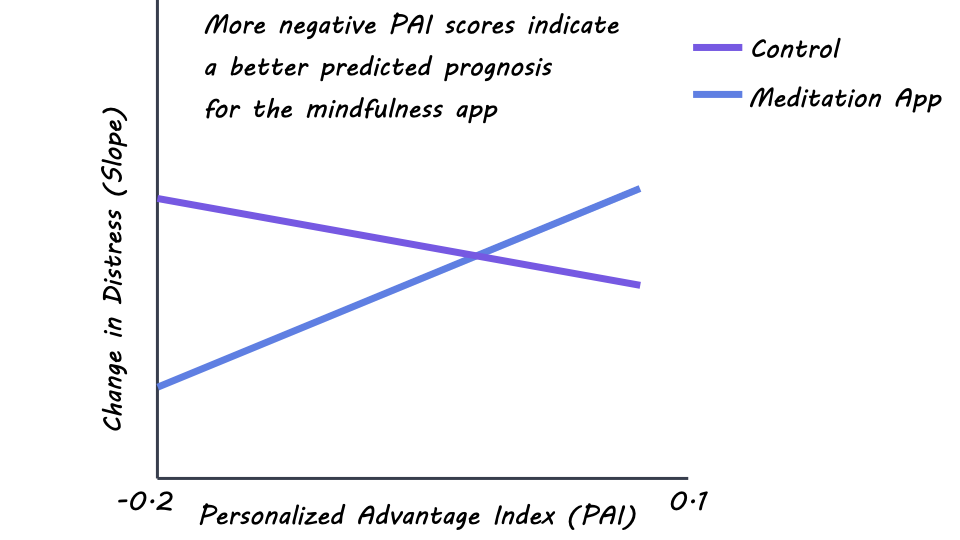
Participants included 666 adults recruited from employees in a Wisconsin school district. Participants were randomly assigned to either use of a meditation app for four weeks, or to an assessment-only control group that did not use the app. In addition to completing a pre-test, all participants completed weekly questionnaires, a post-treatment test, and a follow-up assessment. These assessments were designed to measure psychological distress. The authors developed a machine learning model that predicted the individuals most likely to benefit the most from the use of the meditation app. The baseline assessment results and demographic information were submitted to the algorithm which developed a Personalized Advantage Index (PAI) for each participant, reflecting their expected reduction in distress over the course of the trial. The predictions from the algorithm were then compared to the actual changes in distress over the course of the study.

What did they find?

The authors found that the data-driven model could predict individualized responses to the use of a meditation app. Individuals with more negative PAI scores (indicating a better-predicted prognosis for the mindfulness app) had significantly better outcomes if randomly assigned to the meditation app relative to the assessment-only control condition. The model was able to predict whether individuals will experience reductions in distress as well as the magnitude of this reduction if they were to use a meditation app.

What's the impact?

This study found that predictive models can be useful tools for determining individual responses to the efficacy of a meditation app. This research is a step towards precision medicine, an approach that aims to improve health outcomes by matching patients with treatments that are most likely to be therapeutically beneficial for them (as opposed to the current reliance on trial and error).