
Selective Attention Modulates Activity in the Auditory Nerve

Post by Lina Teichmann

The takeaway

Studying the effects of selective attention on subcortical structures is usually not feasible in humans, however, testing cochlear implant (CI) users offers a unique opportunity to examine how top-down effects modulate activity in the auditory nerve. Using a cross-modal attention task, the current study shows that activity in the auditory nerve in humans is modulated by attention.

What's the science?

Attention relies on selecting relevant features from our environment while ignoring irrelevant features. For example, when listening to someone speak, we are able to focus our attention on the words they are saying while ignoring irrelevant background sounds. Direct evidence from animal studies suggests that these attentional mechanisms modulate auditory nerve action potentials. Studying similar effects in humans is usually difficult, as direct recordings from the auditory nerve are generally not feasible. However, this week in the Journal of Neuroscience, Gehmacher, Reisinger and colleagues present data from CI users, showing that auditory nerve activity in humans is modulated by attention.

How did they do it?

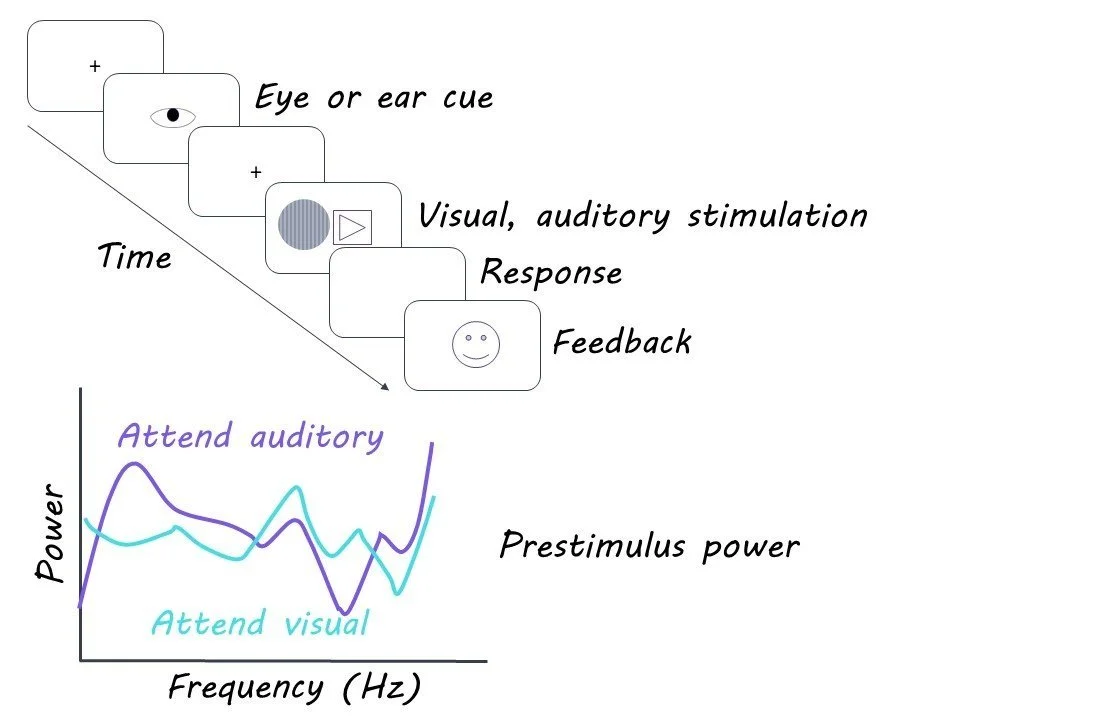
A group of CI users completed a cross-modal attention task while recordings were taken from a coil that temporarily replaced their CI. In every trial, participants saw a cue on a computer screen (either an eye or ear) to indicate whether to attend to an auditory or visual stimulus. Then an audiovisual stimulus was presented. The auditory stimulus was a tone delivered directly to the CI coil. The visual stimulus was a circle with black and white stripes oriented vertically. In some trials, oddball auditory (slightly different tone) and visual (slightly tilted version of visual stimulus) stimuli were presented, and participants were asked to press a button when they detected an oddball in the cued domain. 
What did they find?

Using a frequency analysis, the results showed that cochlear activity was modulated by selective attention. In the theta frequency range (5-8Hz), a higher power was associated with attending to the auditory domain. Relating these results to a concurrently recorded electroencephalography (EEG) dataset from one participant, the authors showed that the auditory nerve, as opposed to a source located elsewhere in the brain, was the most likely origin of the signal. Lastly, the authors showed that classification algorithms trained on single-trial activity recorded from the CI could distinguish whether the participant was attending to the visual or auditory stimulus. Together, these results support the hypothesis that auditory nerve activity is modulated by attention in humans.

What's the impact?

Previous work has shown that the neural signal is modulated by attention at the cortical level. However, evidence for attentional modulation in subcortical structures such as the cochlea was scarce, partially because direct recordings in humans are usually not feasible. The current study addressed this gap in the literature by studying auditory nerve activity directly in CI users. The results highlight that auditory nerve activity is modulated by attention in humans, providing new insights into the interplay between top-down and bottom-up effects in hearing.
Access the original scientific publication here.

High Cognitive Load is Associated with Increased Associative Interference

Post by Shireen Parimoo

The takeaway

Associative interference occurs when our prior knowledge interferes with our memory for newly learned associative information. This effect is enhanced when processing resources are reduced under high cognitive load. 

What's the science?

Our brain functions by linking related items in memory - otherwise known as associative memory. Sometimes, our prior knowledge or associations can hinder our ability to learn new associations, an effect known as associative interference. How our brain reacts to associative interference when cognitive resources are low, is not clear. This week in Scientific Reports, Baror and Bar conducted a series of associative memory tests with varying levels of cognitive load and memory demands to investigate the impact of reduced processing capacity on associative interference.

How did they do it?

The authors conducted several memory experiments that assessed associative interference under different levels of cognitive load using explicit (Exp. 1-3) and implicit (Exp. 4) memory paradigms. In Exp. 1a and 1b, participants first intentionally learned word pairs (learning phase) that consisted of semantically related (e.g., Salt-Pepper) or unrelated words (e.g., Salt-Mouse). They then completed a cued recognition test in which a cue word (e.g., Salt) was followed by a target and distractor. There were three conditions based on the semantic relatedness of the cue-distractor pair: (i) related target, unrelated distractor (Pepper/Tree), (ii) unrelated target, unrelated distractor (Mouse/Tree), and (iii) unrelated target, related distractor (Mouse/Cheese). During the test phase, participants also performed a working memory task ranging from low to high cognitive load. High cognitive load was hypothesized to reduce the processing resources available for memory encoding. Exp. 1b included an additional block of learning and test phase trials that were expected to further reduce processing resources over time.

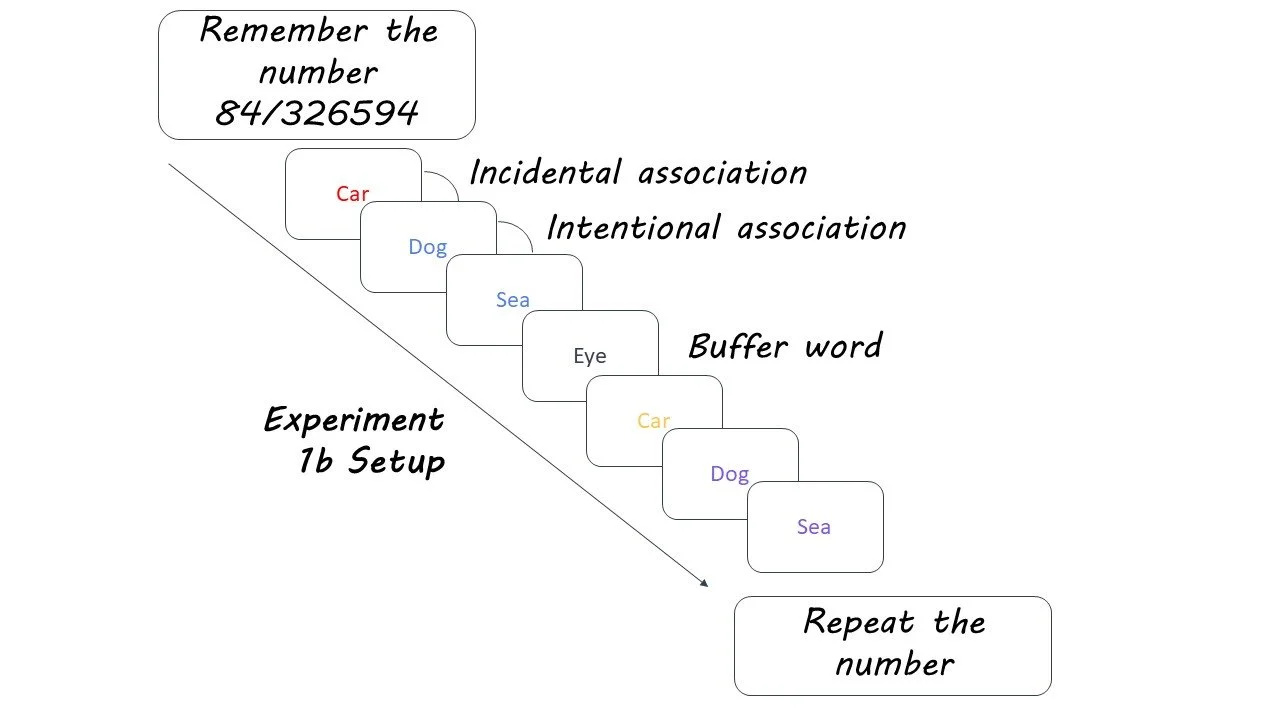
In Exp. 2 and 3, rather than relying on prior knowledge, the authors assessed associative interference from incidentally learned associations. In Exp. 2, individual words were sequentially presented in different colored fonts and participants were instructed to associate consecutive words that appeared in the same color (cue-target pair; intentional learning). These word pairs appeared four times throughout the learning phase and were always preceded by the same word in a different color (pre-cue word), forming an incidental association with the cue word. In the cued recognition test, the distractor was either the pre-cue word or an unrelated word. As before, participants completed a working memory task with low and high cognitive load during the test phase. Exp. 3 was similar, except participants learned associations between pairs of pictures (intentional learning) that were always preceded by the same pre-cue picture (incidental learning).

Lastly, the authors used a contextual priming task to assess associative interference under implicit memory conditions (Exp. 4). They used prime-target pairs that were unrelated or were weakly, moderately, or strongly related to each other. Participants provided object/non-object judgments for the targets while concurrently performing the digit span task under low and high cognitive load. Reaction times to target object recognition were examined as a function of cognitive load and prime-target relatedness.

What did they find?

Target recognition was generally higher under low cognitive load than high cognitive load (Exp. 1 and 2). However, the effect of cognitive load was only present when the distractor was related to the cue word. Thus, reduced processing capacity under high load led to interference from previously learned associations between the cue and distractor. Similarly, reduced processing resources from completing an additional block of the experiment (Exp. 1b) only affected memory when the distractor was related to the cue, but not when the distractor was unrelated to the cue. Together, these results indicate that reducing processing resources by increasing cognitive load and time on task independently contribute to associative interference during recognition.

A similar pattern of results emerged when cue-distractor associations were incidentally learned during the learning phase (Exp. 2 and 3). There was no load effect on target memory with unrelated distractors, but memory accuracy was reduced under high load when the distractor was incidentally associated with the cue. High cognitive load, therefore, interfered with associative retrieval and generalized to both words and pictures. Finally, participants were faster to identify objects that were related to the prime than those that were unrelated (Exp. 4). Interestingly, object recognition for strongly related targets was fastest under low load but slowest under high load, suggesting that reduced cognitive processing capacity also delays the perceptual processing of strongly related information.

What's the impact?

The results of this study provide evidence in favor of the idea that decreasing the available processing resources increases associative interference in memory. These findings are important for informing social and educational domains, where increased stress or too much cognitive load might result in biasing towards previously learned, and potentially misleading information.

Access the original scientific publication here.

EMDR Therapy: What’s Happening in the Brain?

Post by Anastasia Sares

Eye movements to treat traumatic disorders

In 1989, Francine Shapiro published a technique for treating trauma using eye movements. In the technique, a client will bring a traumatic incident to mind, and recall it while simultaneously following the therapist’s finger as it moves back and forth across their field of vision. A session also includes repeated evaluations of thoughts, emotions, and body sensations surrounding the event. This therapeutic approach came to be known as Eye Movement Desensitization and Reprocessing, or EMDR. Shapiro observed its effectiveness in treating severe post-traumatic stress disorder (PTSD). However, both scientists and the public viewed the technique with skepticism. For starters, it seemed “too easy,” (the words of one patient in Shapiro’s 1989 paper). It didn’t help that it was unclear how the technique worked and that it seemed similar to less scientifically reputable techniques such as hypnosis.

Despite its detractors, EMDR has slowly grown to become one of the preferred treatments for PTSD. Scientists and clinicians have teamed up to run randomized controlled trials, where people are assigned randomly to either EMDR or another treatment condition. These experiments are considered the gold standard for determining a treatment’s efficacy in the medical field, and enough of them have been done that we can now perform meta-analyses, which synthesize all the results from different experiments into one big analysis. The results? EMDR is at least as effective as other well-established treatments like cognitive-behavioral therapy or exposure therapy.

What does EMDR do in the brain?

The main hypothesis developed by Shapiro and colleagues to explain EMDR is called the Adaptive Information Processing model. According to this model, traumatic memories are not fully processed in the brain and create their own maladaptive networks that can be triggered, leading to flashbacks and other unwanted phenomena. EMDR encourages the traumatic memory to be brought up, fully processed, and reconsolidated in a more adaptive manner, integrating it with the rest of an individual’s life experience and diminishing its power to cause fear. Shapiro emphasizes the difference between memory reconsolidation (the hypothesized mechanism for EMDR), and memory extinction (the basis for exposure therapy).

EMDR responsiveness has indeed been linked with memory structures, such as the parahippocampal gyrus, deep in the brain. One study showed that at the start of EMDR therapy, there was greater activation in the frontal cortex (responsible for executive control) and the occipital cortex (responsible for visual stimuli). By the end of therapy, activity had shifted towards the parahippocampal gyrus and parietal lobe. Thus, the idea that eye movements promote memory reprocessing does not seem too far-fetched, but the exact mechanisms of EMDR are still being worked out.

One idea is that eye movements may take space in working memory, giving less “bandwidth” to the traumatic memory and therefore making it less vivid. Another is that they mimic the eye movements of REM sleep (the period of the sleep cycle where memories are consolidated) and thus promote reconsolidation of the traumatic memory. It's important to note here that EMDR can be done with methods other than eye movement, including tapping one’s shoulders on the right and left side or holding buzzers in the hands that vibrate in a right/left pattern. These methods are collectively called bilateral stimulation.

Some research shows that the bilateral stimulation used in EMDR can be effective even in animals who cannot be told the goal of the “therapy.” A recent study showed that when rodents were exposed to lights moving back and forth, their response to a previously fearful stimulus decreased (See a previous BrainPost).

What’s new?

Shapiro never intended EMDR to be applied solely to PTSD, and lately, there have been studies looking at its efficacy for other conditions, such as obsessive-compulsive disorder, psychosis, substance use disorders, and depression. While some results may look promising, there is not yet enough information to run the kind of meta-analyses that have established EMDR’s efficacy for PTSD.

Finally, Otgaar and colleagues have cautioned that undergoing EMDR therapy may change the validity of witness testimony in court, since it is, after all, a form of memory reprocessing, and could affect details of an event as the victim remembers it.

What's the bottom line?

EMDR therapy is a validated, non-pharmaceutical technique for the treatment of PTSD, and perhaps other mental health issues. While we don’t fully understand how it works, it involves memory processing and reconsolidation of previously acquired memories. As with any mental health treatment, make sure you ask a licensed therapist about this technique regarding your own situation.

References +

Jeffries, F. W., & Davis, P. (2013). What is the Role of Eye Movements in Eye Movement Desensitization and Reprocessing (EMDR) for Post-Traumatic Stress Disorder (PTSD)? A Review. Behavioural and Cognitive Psychotherapy, 41(3), 290–300. https://doi.org/10.1017/S1352465812000793

Marsden, Z., Lovell, K., Blore, D., Ali, S., & Delgadillo, J. (2018a). A randomized controlled trial comparing EMDR and CBT for obsessive-compulsive disorder. Clinical Psychology & Psychotherapy, 25(1), e10–e18. https://doi.org/10.1002/cpp.2120

Nardo, D., Högberg, G., Looi, J. C. L., Larsson, S., Hällström, T., & Pagani, M. (2010). Gray matter density in limbic and paralimbic cortices is associated with trauma load and EMDR outcome in PTSD patients. Journal of Psychiatric Research, 44(7), 477–485. https://doi.org/10.1016/j.jpsychires.2009.10.014

Novo Navarro, P., Landin-Romero, R., Guardiola-Wanden-Berghe, R., Moreno-Alcázar, A., Valiente-Gómez, A., Lupo, W., García, F., Fernández, I., Pérez, V., & Amann, B. L. (2018). 25 years of Eye Movement Desensitization and Reprocessing (EMDR): The EMDR therapy protocol, hypotheses of its mechanism of action and a systematic review of its efficacy in the treatment of post-traumatic stress disorder. Revista de Psiquiatría y Salud Mental (English Edition), 11(2), 101–114. https://doi.org/10.1016/j.rpsmen.2015.12.002

Otgaar, H., Houben, S. T. L., Rassin, E., & Merckelbach, H. (2021). Memory and eye movement desensitization and reprocessing therapy: A potentially risky combination in the courtroom. Memory, 29(9), 1254–1262. https://doi.org/10.1080/09658211.2021.1966043

Pagani, M., Di Lorenzo, G., Monaco, L., Daverio, A., Giannoudas, I., La Porta, P., Verardo, A. R., Niolu, C., Fernandez, I., & Siracusano, A. (2015). Neurobiological response to EMDR therapy in clients with different psychological traumas. Frontiers in Psychology, 6. https://doi.org/10.3389/fpsyg.2015.01614

Roberts, B. R. T., Fernandes, M. A., & MacLeod, C. M. (2020). Re-evaluating whether bilateral eye movements influence memory retrieval. PLOS ONE, 15(1), e0227790. https://doi.org/10.1371/journal.pone.0227790

Santarnecchi, E., Bossini, L., Vatti, G., Fagiolini, A., La Porta, P., Di Lorenzo, G., Siracusano, A., Rossi, S., & Rossi, A. (2019). Psychological and Brain Connectivity Changes Following Trauma-Focused CBT and EMDR Treatment in Single-Episode PTSD Patients. Frontiers in Psychology, 10, 129. https://doi.org/10.3389/fpsyg.2019.00129

Shapiro, F. (1989). Efficacy of the eye movement desensitization procedure in the treatment of traumatic memories. Journal of Traumatic Stress, 2(2), 25.

Solomon, R. M., & Shapiro, F. (2008). EMDR and the Adaptive Information Processing Model: Potential Mechanisms of Change. Journal of EMDR Practice and Research, 2(4), 315–325. https://doi.org/10.1891/1933-3196.2.4.315

Talbot, D. (2021). Examination of Initial Evidence for EMDR as a Treatment for Obsessive-Compulsive Disorder. Journal of EMDR Practice and Research, 15(3), 167–173. https://doi.org/10.1891/EMDR-D-21-00004

Valiente-Gómez, A., Moreno-Alcázar, A., Treen, D., Cedrón, C., Colom, F., Pérez, V., & Amann, B. L. (2017). EMDR beyond PTSD: A Systematic Literature Review. Frontiers in Psychology, 8, 1668. https://doi.org/10.3389/fpsyg.2017.01668