The Use of Neuropixels Probes in Humans

Post by Megan McCullough

The takeaway

Neuropixels probes can successfully measure the electrical activity of many neurons at once with high resolution and specificity in humans.

What's the science?

Neuronal electrophysiology is the branch of neuroscience that focuses on the electrical properties of neurons through recording techniques that allow scientists to measure the flow of electricity through the brain. Current techniques used in humans allow researchers either to record only a few neurons per electrode or to measure the combined signal of thousands of neurons. In animal models, recent advances have allowed more specificity in the recording of large groups of neurons. This week in Nature Neuroscience, Paulk and colleagues translate these advances into human research by describing the use of Neuropixels probes to simultaneously record from over 200 individual neurons during neurosurgery in humans.

How did they do it?

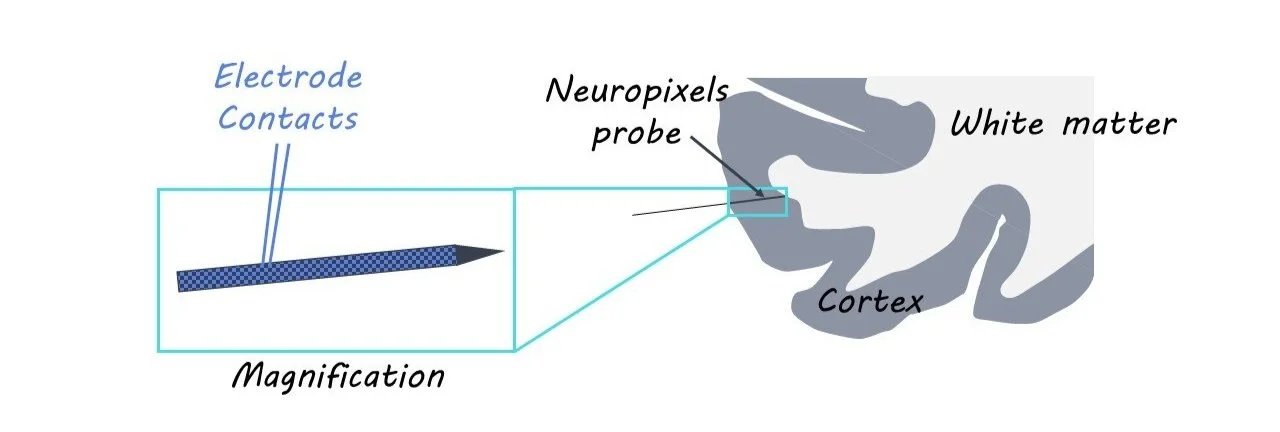
Neuropixels probes, first introduced in 2017, is a silicon array of microelectrodes with microelectrode contacts spaced throughout. It differs from previously used probes primarily because of the high density of electrodes, allowing for more sensitive detection of individual cells. The authors used Neuropixels probes to record electrical activity in the outer layer of the temporal and frontal lobes in three individuals undergoing brain surgery to treat epilepsy or movement disorders. Since this technology was previously only used in animal research, the authors needed to adapt Neuropixels to be used in humans. The use of the original Neuropixels probe was found to be too fragile so the authors developed a thicker variant. They also needed to avoid excessively noisy recordings, and made adjustments to grounding and reference electrodes to carefully control for sources of external electrical noise (e.g. monitors) in a human operating room. These sources of noise would not have typically been present in an animal laboratory environment. Once data was collected, the authors classified the neurons based on waveform type to test the specificity and resolution of the electrical recordings.
What did they find? 

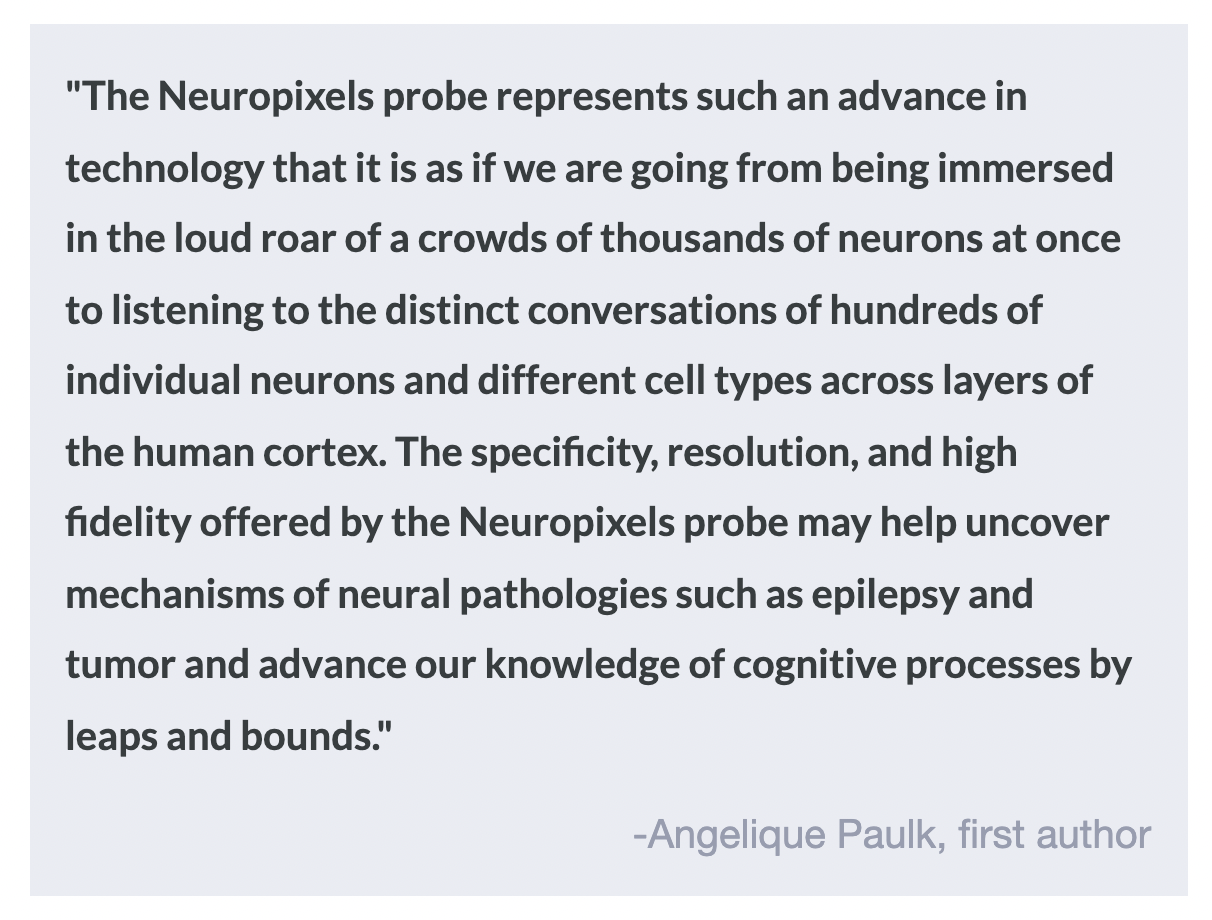
The authors found that adapted Neuropixels probes were able to be used to record spiking activity from neuronal populations in the human cortex in a surgical setting. The authors observed electrical data from up to 200 individual neurons within minutes of inserting the probe – and some of these neurons could be observed via multiple different channels. Because of the closely spaced number of electrodes in the probe, the voltage of each cell generated during action potentials was able to be mapped and then classified. This illustrates that the use of Neuropixels probes can generate high-resolution electrical data previously not available in humans.

What's the impact?

This study is the first to outline techniques for using Neuropixels probes to record brain activity in humans. The use of Neuropixels probes enables high-quality recordings of action potentials from multiple neurons. High-resolution electrical data at the level of single neurons increases our understanding of both cognitive processes and neurological conditions. This research is imperative as it allows for future advancements in understanding the relationship between brain activity at the cellular level and cognitive function. 
The Role of Perceived Control in Stress Management

Post by Elisa Guma

Stress and goal achievement

The ability to cope with and persist through adversity is often associated with success. However, stress may diminish our capacity to cope with difficult tasks or challenges, increasing the likelihood of mental and emotional distress including stress overload and burnout. Exposure to stress is accompanied by a myriad of physiological changes that have both short and long-term effects. These physiological changes likely also influence our psychological state, alter our behaviour, and perhaps prevent us from overcoming obstacles to pursue our goals. Interestingly, the decision to persist can differ when setbacks feel controllable, versus those that are or feel uncontrollable. Perceived control over one’s outcomes can have positive effects on emotion regulation, motivation, and learning, potentially buffering some of the negative effects of stress. 

How does perceived control influence stress management?

Perceived control is the perception that one has the ability, resources, or opportunities to achieve positive outcomes or avoid negative effects through one’s own actions. Perceived control may be further broken down into two strategies: 1) primary perceived control describes the attempt to modify the environment to align with one’s wishes, while 2) secondary perceived control refers to using mental strategies to change one’s wishes to reflect the environment. Typically, a sense of perceived control is associated with the belief that our personal actions control outcomes, and that we have the skill required to enact those actions (internal locus of control), rather than believing that external factors will control the outcome (external locus of control). Research has found associations between perceived control and enhanced emotional well-being or improved ability to cope with stress.

Given the positive benefits on mindset, perceived control is thought to be a key protective factor for well-being in general. Indeed, some studies have found that individuals with higher perceived control over their cardiovascular disease and immunocompetence had decreased risk of physical decline. Although these relationships are likely multifactorial, this mindset may have benefits extending beyond psychological health to physical health as well.

Perceived control and COVID-19

The COVID-19 pandemic has negatively impacted the psychological states of many individuals worldwide, increasing feelings of distress and anxiety. In addition to the physical disease burden that COVID-19 has caused, there are other stressors to consider such as uncertain prognoses, isolation (especially when paired with grief and loss), unfamiliar public health measures, and financial distress, all of which may have substantial and potentially long-lasting effects on mental health. Several recent studies have investigated potential buffers against the stress related to the COVID-19 pandemic. Some evidence from studies conducted in China, the United States, and Norway/Austria/Germany indicate that individuals who believe they have control over their environment and future (i.e., higher internal locus of control) may have better mental health outcomes. Additionally, the latter study also found that individuals who feel as though external factors beyond their control influence their success and failure (external locus of control) were prone to higher levels of anxiety and depression. These associations are likely more nuanced and require more research. However, these initial insights may help to identify certain traits that increase susceptibility to stress. Furthermore, policy makers and public health officials can implement strategies to try and enhance citizens' sense of certainty and control, for example by promoting clear, transparent, and science-backed communication.

Mindfulness as a stress management technique

Given the numerous benefits associated with feelings of perceived control, finding ways to foster perceptions of control may be beneficial. Mindfulness, or the moment-to-moment awareness and acceptance of our feelings and experience, may promote flexibility in responding to a changing environment, rather than relying too heavily on previously learned patterns. Mindfulness practice has been linked to higher levels of both primary and secondary perceived control – helping people to see that there is a possibility to change our environment, or that our perception can be altered. This practice has been associated with numerous other benefits and may help us navigate feelings of distress in uncertain times or stressful situations.

What’s next?

As we navigate a changing world, many will experience varying levels of perceived control. Further, many factors can influence perceived control, such as individual differences, early life experiences, or previous success or reward. More research is needed to better understand the factors that affect perceived control, how feelings of control can change over time, and how they can be fostered to improve stress management.  

References +

  1. Bhanji et al. Perceived Control Alters the Effect of Acute Stress on Persistence. Journal of experimental psychology General (2016).
  2. Compas et al. Perceived Control and Coping with Stress: A Developmental Perspective. Journal of Social Issues (1991).
  3. Daly & Robinson. Psychological distress and adaptation to the COVID-19 crisis in the United States. Journal of Psychiatric Research (2021).
  4. Krampe et al. Locus of control moderates the association of COVID-19 stress and general mental distress: results of a Norwegian and a German-speaking cross-sectional survey. BMC Psychiatry (2021).
  5. Hortop et al. The why and how of goal pursuits: Effects of global autonomous motivation and perceived control on emotional well-being. Motivation and emotion (2013).
  6. Kozela et al. Perceived control as a predictor of cardiovascular disease mortality in Poland. The HAPIEE study. Journal of Cardiology (2015).
  7. Paganini et al. Perceived Control and Mindfulness: Implications for Clinical Practice. Journal of Psychotherapy Integration (2016).
  8. Pfefferbaum & North. Mental health and the Covid-19 pandemic. New England Journal of Medicine (2020).
  9. Wallston. Control Beliefs: Health Perspectives. International Encyclopedia of the Social & Behavioral Sciences (2001).
  10. Wiedenfeld et al. Impact of perceived self-efficacy in coping with stressors on components of the immune system. Journal of Personality and Social Psychology (1990).
  11. Zheng et al. Perceived Control Buffers the Effects of the COVID‐19 Pandemic on General Health and Life Satisfaction: The Mediating Role of Psychological Distance. Applied Psychology Health Well Being (2020).


A Causal Link Between Epstein-Barr Virus and Multiple Sclerosis

Post by Negar Mazloum-Farzaghi

The takeaway

To investigate the cause of multiple sclerosis, researchers examined data from over 10 million US military recruits. Examination of blood samples provided strong evidence that Epstein-Barr virus is linked to multiple sclerosis.

What's the science?

Multiple sclerosis (MS) is a chronic neurodegenerative disease of the central nervous system that attacks the nerve fibers and myelin sheathing of the brain and spinal cord. While the cause of MS is currently unknown, previous evidence has pointed to viral infection with Epstein- Barr virus (EBV) as a potential trigger of MS. EBV is one of the most common human viruses that can give rise to infectious mononucleosis and can persist in latent form throughout the life of the host. Evidence of causality between EBV and MS remains to be investigated.

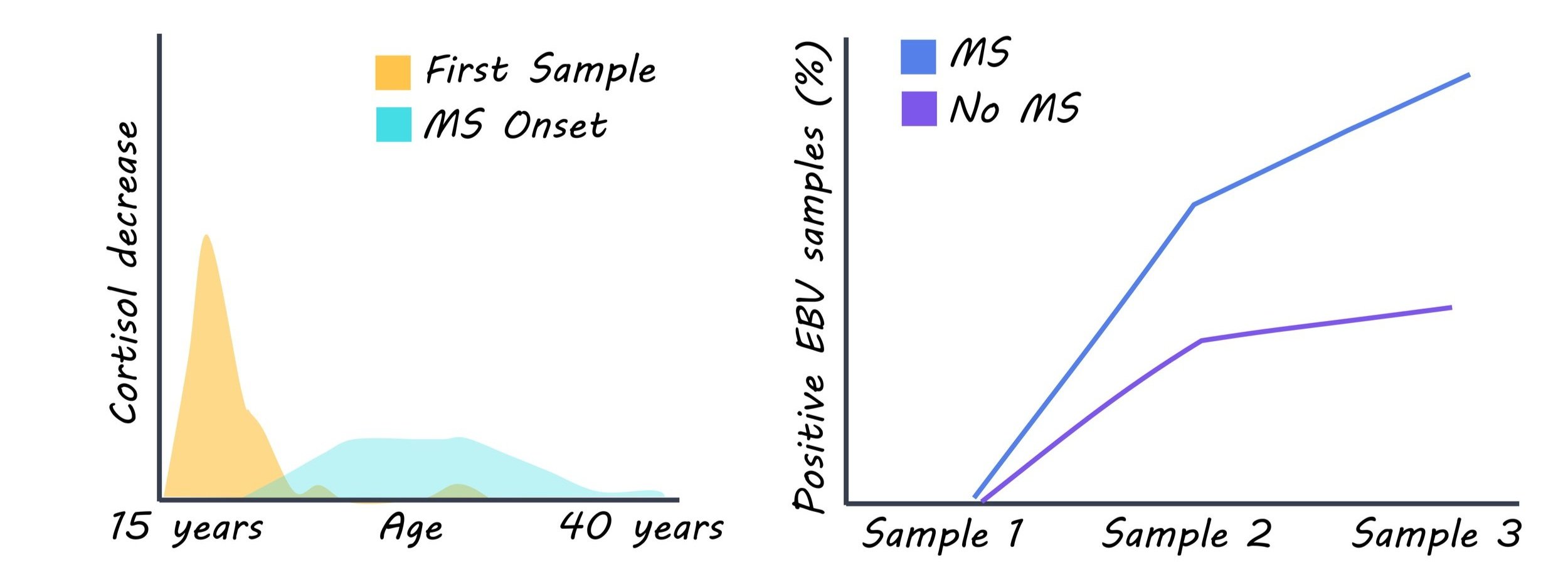
This week in Science, Bjornevik and colleagues examined a cohort of over 10 million young adults in the US military, 955 of whom were diagnosed with MS over a 20-year period, to test the hypothesis that there is a causal link between EBV and MS.

How did they do it?

In order to investigate the relationship between EBV and MS, the authors collaborated with the US military to examine blood samples of more than 10 million racially diverse individuals who were serving in the US military over the span of 20-years. The US military screens for HIV at the start of service and biennially thereafter, and residual serum from these tests are archived in a repository. Using the archived serum, the authors determined EBV status at the time of the first sample and the association between EBV infection and MS development during active military duty. They found that 5.3% of individuals were negative for the EBV virus at the time of first sample.

In total, 955 MS cases were documented among active-duty military personnel. For each MS case, evidence for EBV infection was assessed by examining three serum samples which were collected before the start of MS onset (the first collected sample, the last collected sample prior to disease onset, and one sample in between). Next, the MS cases were matched (for age, sex, and race) to two randomly selected individuals without MS. There were 801 individuals with MS and 1566 control individuals with samples available to assess EBV infection status. Most individuals in the study were 20 years of age or younger at the time of their first blood sample, and those who developed MS had a symptom onset of a median of 10 years after the time of their first sample.

What did they find?

To investigate the risk of MS from EBV infection, the authors identified 35 MS cases and 107 controls who were EBV-negative in their initial collected blood sample. All but one of these 35 EBV-negative MS cases eventually tested positive for EBV antibodies, indicating that almost all MS cases were infected with EBV prior to MS symptom onset. Importantly, there were no cases of MS among individuals who remained EBV-negative. To assess whether other viruses were also associated with the MS cases, the authors investigated cytomegalovirus, a similar virus to EBV. They found that cytomegalovirus infection was not associated with an increased risk of MS.

The authors also investigated serum concentrations of neurofilament light chain (sNfL), a biomarker of neuroaxonal degeneration in the samples of MS cases and controls who were EBV-negative at baseline. They found that sNfL levels in EBV-negative individuals at baseline who eventually went on to develop MS were similar to control levels before the time of EBV infection in those who went on to develop MS. However, sNfL levels increased after EBV infection. Thus, there was no indication of neuroaxonal degeneration before EBV infection in individuals who later developed MS, suggesting that EBV infection preceded MS pathological onset.

What's the impact?

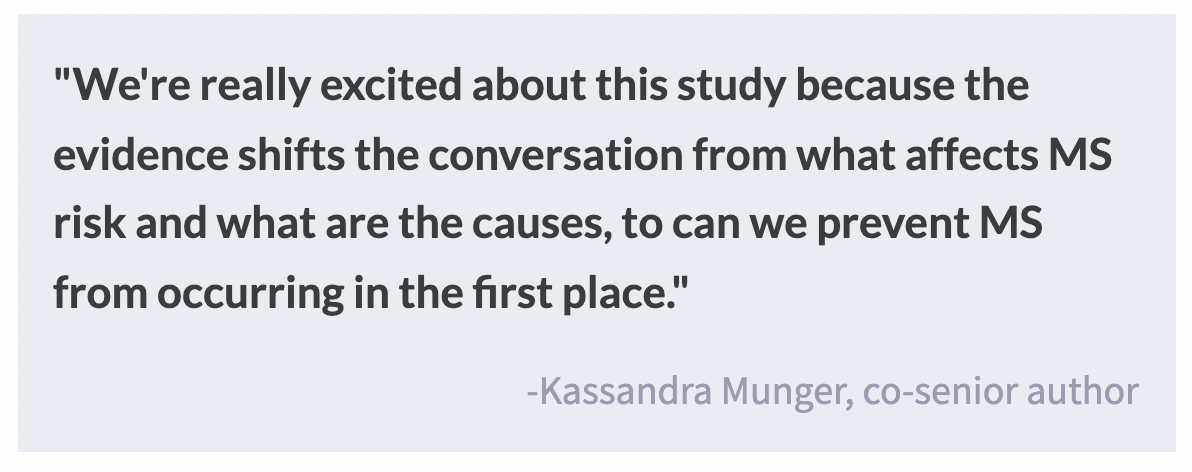
This study provides the strongest evidence to date that EBV infection can lead to MS. Future research should investigate the underlying biological mechanisms involved in the relationship between EBV and MS, which could ultimately lead to the development of interventions, such as vaccination, to prevent MS before onset.