Sensory-Motor Brain Networks are Coupled with the Stomach’s Rhythm

Post by Leanna Kalinowski

The takeaway

Natural electrical rhythms produced in the stomach are coupled with resting-state activity in sensory and motor brain regions, providing insights into how the brain and body communicate. 

What's the science?

The study of resting state brain networks (RSNs) – areas of the brain that work synchronously even during times of rest – has taught neuroscientists a lot about how brain activity is organized across distinct brain regions. Traditionally, these networks have been broadly categorized into groups of sensory-motor regions, which allow for interaction with the external environment, and groups of transmodal regions, which control cognitive processing. However, despite a growing interest in how the brain and body interact, little work has been done to identify potential relationships between RSNs and internal bodily rhythms outside of the brain.

Scientists have previously identified a connection between brain activity at rest and the gastric rhythm, which is a slow electrical rhythm that is continuously produced in the stomach. This week in the Journal of Neuroscience, Rebollo and Tallon-Baudry further characterized the connections between this gastric rhythm and RSNs.

How did they do it?

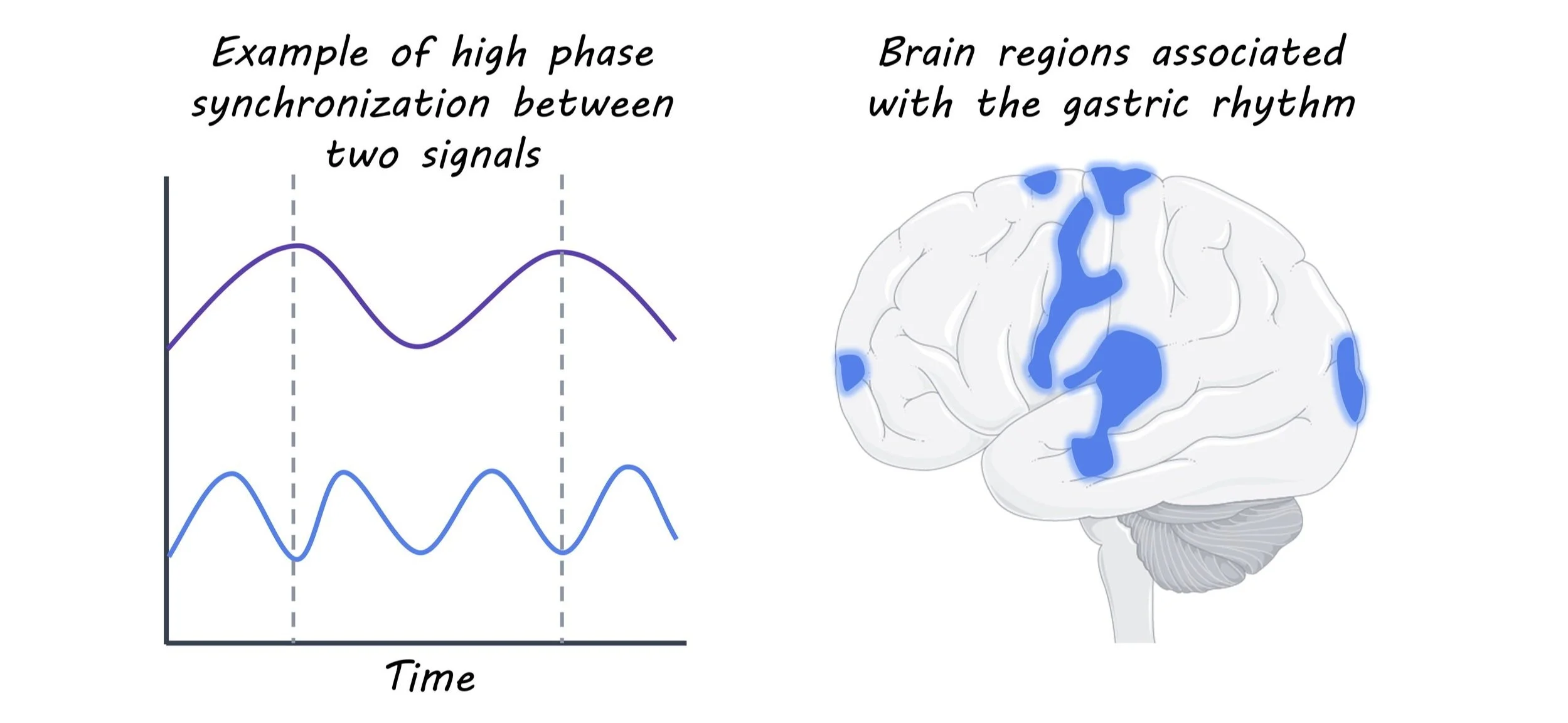
To measure brain activity at rest, 72 participants underwent functional magnetic resonance imaging (fMRI) scans while resting; they were instructed to lay still and fixate on a bull’s eye on a grey screen. To measure gastric rhythm, the participants simultaneously underwent electrogastrogram (EGG) recordings in which non-invasive electrodes were placed over their abdomen. The researchers then filtered the fMRI signals to match the slow electrical rhythm of the stomach; a technique called phase synchronization. This way, they were able to measure how stable the lag between the two signals was over time.

What did they find?

The researchers found that rhythms in all sensory and motor cortices are coupled with the gastric rhythm, including brain regions that respond to touch, vision, audition, and interoception. In contrast, very few brain regions associated with cognitive processing (i.e., transmodal RSNs) are coupled with the gastric rhythm. Taken together, these results suggest that gastric rhythm and sensory-motor processes likely interact while bypassing cognitive processes.
What's the impact?

The results from this study transform what we previously knew about how brain activity is organized. Notably, fluctuations in the activity of brain regions that have been largely considered to be independent are in fact coupled with gastric activity. Future research should be conducted to further characterize connections between the brain and body.  

Access the original scientific publication here.

Using EEG to Assess the Impact of a Poverty Reduction Intervention On Brain Development

Post by Lani Cupo

The takeaway

While poverty can impact brain activity in children, this study shows predictable, unconditional, monthly money transfers to low-income homes can serve as a positive intervention in altering the brain activity of low-income children.

What's the science?

The first year of infants’ lives represents a period of great plasticity and sensitivity. In humans, it is difficult to assess the causality of variables such as income, as they often covary with other salient variables, like education or urbanicity. Previous evidence suggests early life poverty is associated with certain patterns in brain activity as measured with electroencephalograms (EEG). This week in PNAS, Troller-Renfree and colleagues seek to experimentally investigate whether financial intervention can alter brain activity associated with the development of cognitive skills.

How did they do it?

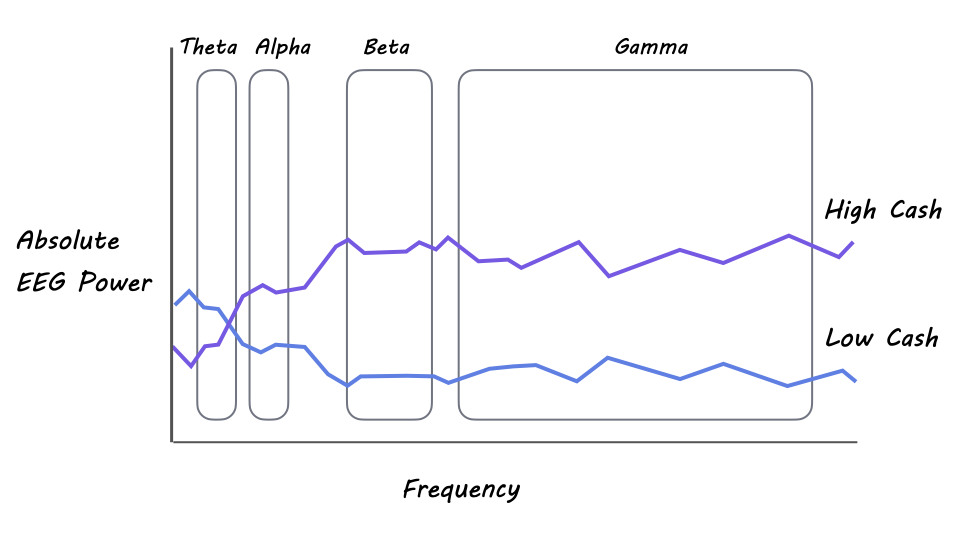
EEG provides researchers with noninvasive measures of two main variables: frequency (the waves of brain activity that occur at different rates) and power (the amount of activity at a specific frequency per region). From infancy to middle childhood, children show characteristic changes in EEG signals, with decreasing power in low frequency bands (slow oscillations called theta) and increasing power in high frequency bands (higher oscillations, alpha, beta, and gamma). Differences in this changing pattern are associated with poorer cognitive outcomes, often correlated with poverty during the first years of life. To assess whether poverty reduction strategies could alter brain activity in infants, 1000 low-income women from 4 urban areas in the United States were randomized to receive a gift of either $20 per month (low-cash gift) or $333 (high-cash gift) per month, to be used as they chose. When the infants were one-year old and the mothers had received the gifts for one year, surveys and EEG recordings were completed in 435 infants. The authors examined both absolute and relative power, where absolute power refers to the amount of power measured at a specific frequency band and relative power refers to the fraction of absolute power over total power. For example, absolute power would reflect the power measured in the low-frequency theta band, and the relative power would reflect the theta power over the combined alpha, beta, and gamma power.

What did they find?

Compared to the low-cash group, children in the high-cash group had higher absolute power in the mid-high frequency ranges (alpha, beta, and gamma), as hypothesized. Higher power in mid-to-high-frequency bands has been associated with better cognitive and language outcomes. Of the three frequency ranges, the greatest effect size was observed in the beta range, indicating it was the most impacted. Of note, beta frequencies have been associated with eye movement artifacts, and potentially with concentrated activity.

The same patterns were reflected in relative power, although the effects were smaller. The high-cash group showed increased frontal beta and gamma power, as well as more central beta power, indicating regions consistent with previous work linking income, brain activity, and cognitive outcomes. There was no impact on theta-power, contrary to hypotheses. Previous work in children indicates high theta power is associated with poorer behavioral outcomes, and the authors expected to see reduced theta power in the high-cash group.

What's the impact?

This study is the first to report a causal relationship between income level and brain activity in young children by implementing a poverty-reduction intervention for low-income mothers. They found an unconditional payment of $333 per month was sufficient to increase mid-high frequency power in EEG recordings at age 1. This work provides important experimental evidence that could impact public policy to reduce inequality and ensure better outcomes for low-income children.

The Link between Conspiracy Mentality and Political Affiliation

Post by Megan McCullough

The takeaway

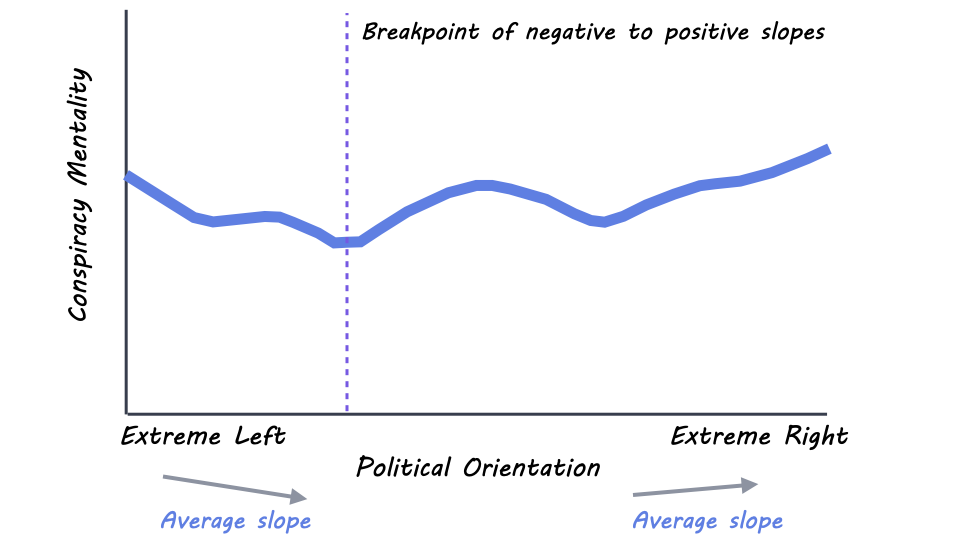
There is a relationship between political affiliation and the tendency to support conspiracy theories, with those on both the extreme left and the extreme right showing a greater conspiracy mentality than those in the political center.

What's the science?

Conspiracy mentality describes the tendency for individuals to endorse conspiracy theories, defined as beliefs that a certain group of people are secretly working together to achieve a malicious goal. Previous studies into the effect of political orientation on conspiracy mentality have shown a U-shaped relationship between political views and conspiracy mentality, suggesting that individuals at both political extremes have a higher tendency to support conspiracy theories than those in the political center. This week in Nature Human Behavior, Imhoff and colleagues used data from 26 countries to conduct the largest study to date into this relationship between political orientation and conspiracy mentality. The authors investigated the relationship between political affiliation and the tendency to support conspiracy theories while controlling for the theory that conspiracy mentality increases among a specific political party when their preferred political party is not in power.

How did they do it?

Data for this study came from two surveys that aimed to investigate the relationship between political leaning and conspiracy mentality. The first survey had a dataset from 23 countries and the second survey had samples from 13 countries, with over 100,000 surveyed individuals between the two surveys. Political orientation was measured using a self-reported scale that asked participants to rank themselves from extremely left-wing to extremely right-wing. Voting intentions were also gathered as a measure of political orientation. Both methods for determining political orientation were used because interpretations of right or left in a political context can be different across countries. Next, the Conspiracy Mentality Questionnaire was administered to assess conspiracy mentality in each of the participants. To determine if perceived lack of political control was a factor in the U-shaped relationship seen in previous research, the authors of this study collected whether the preferred political party was in power at the time of data collection and used this along with demographic information as control variables.

What did they find?

The authors found a consistent relationship between political orientation and conspiracy mentality across the 26 countries of study. Individuals at the extreme ends of the political spectrum were more likely to believe in conspiracies compared to individuals in the middle. The U-shaped relationship was not symmetrical; conspiracy mentality tended to be higher for those on the far right. The authors also found that individuals who supported political parties not included in the current government of their countries were more likely to exhibit conspiracy mentality compared to individuals whose parties were included in government. However, the U-shaped relationship was still intact when this variable was controlled for. This shows that although a perceived loss of control of a political party does influence conspiracy mentality, there are other more important factors at play to explain increased conspiracy mentality at both ends of the political spectrum.

What's the impact?

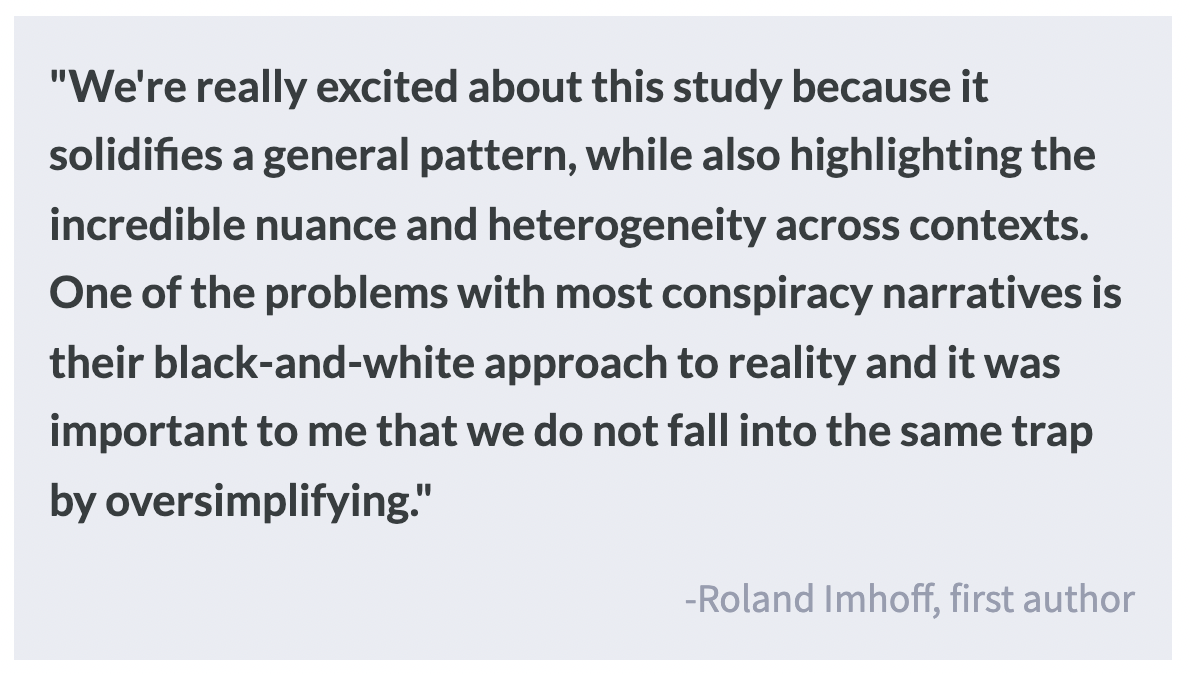
This is the largest study to investigate the relationship between political orientation and conspiracy mentality. This research is important as it provides nuance into the psychology behind conspiracy mentalities and provides a greater understanding of the connection with political affiliation.