Detecting Fake Videos With AI and Human Judgement

Post by Lina Teichmann

The takeaway

Videos manipulated with neural networks can make it very difficult to distinguish fiction from reality. These ‘deepfakes’ can be used to spread false information, thereby posing a serious challenge to society. Combining artificial intelligence (AI) models and human judgment results in superior performance when detecting deepfakes in comparison to models or human judgment alone.

What's the science?

Machine-manipulated videos called ‘deepfakes’ can have harmful consequences when undetected. Leading AI models can be used to detect fake videos, however, in a large competition on deepfake detection, the leading model achieved an accuracy of only 65%, with chance level being at 50%. This week in PNAS, Groh and colleagues examined how humans, AI models, and the combination of the two perform in deepfake detection. They investigated the error patterns and specific strengths and weaknesses of AI models and large groups of humans when distinguishing between real and fake videos.

How did they do it?

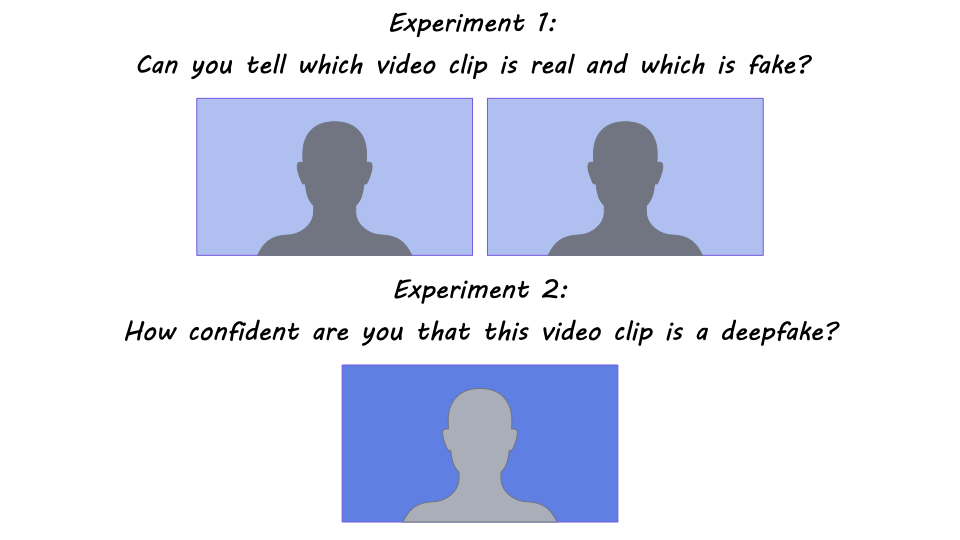
The authors ran two separate experiments. In Experiment 1, a deepfake video was shown alongside the authentic video and participants had to indicate which one was fake. In Experiment 2, participants viewed one video and had to indicate how confident they were that the video was real or fake. In this experiment, participants could also see the AI model’s prediction and update their confidence rating accordingly. Both experiments included random manipulations to evoke a specific emotion and to obstruct facial features in the video. These manipulations were used to test whether incidental emotion has an effect on deepfake detection and whether specialized face processing abilities in humans influence their performance.
What did they find?

The leading AI model could correctly identify 80% of a test set of videos as either real or fake. This was similar to the participants’ response averaged per video, however, there was some variance between individuals. While the overall accuracy between the human crowd and the model was similar, the types of mistakes they made differed. When participants had access to the model predictions, they outperformed both the model and the participants who did not access model predictions. However, inaccurate model predictions had a negative impact on humans’ ability to detect deepfakes. There was some evidence that eliciting anger in participants lowered the ability to detect deepfake videos, highlighting why deepfake videos in social media may be even more problematic. The results also show that face processing is critical for people to distinguish fake from real videos.

What's the impact?

The emergence of neural networks in computer vision has led to many new opportunities, such as improving medical diagnoses and enhancing accuracy in forensic examinations. On the flipside, neural networks are able to generate pictures and videos that look authentic but are fake. Classifying machine-manipulated videos as fake is critical in fighting the spread of misinformation. Overall, this study highlights that groups of humans are just as capable in detecting deepfakes as leading AI models. Groh and colleagues illuminate how we can best combine the strengths of AI models and humans to flag deepfakes and ultimately overcome a massive challenge for society at large.
Aerobic Exercise Stalls Brain Atrophy in Parkinson’s Disease

Post by Anastasia Sares

The takeaway

Compared to a regimen of stretching, aerobic exercise (riding a stationary bike) helped people with Parkinson’s disease maintain cognitive control. It also changed the connectivity within cognitive and motor regions of the brain. This offers us some clues as to how exercise can stall the progression of symptoms in Parkinson’s disease.

What's the science?

In Parkinson’s disease, dopamine-producing cells in a brain region called the substantia nigra begin to atrophy and die. This leads to many different symptoms, including tremors, difficulty with movement, emotional changes, and cognitive decline. The substantia nigra is part of the basal ganglia, a series of nuclei (clusters of neurons) near the middle of the brain, which have strong connections to the motor cortex, helping us decide when and how to perform movements. In Parkinson’s, researchers have observed a shift in which basal ganglia regions are connected to the motor cortex. Specifically, the posterior putamen inevitably deteriorates over the course of the disease, and its function is gradually taken over by the anterior putamen.

Some drugs can slow the progression of Parkinson’s, but lately, researchers are looking into non-drug therapies to complement a patient’s medication. Simple aerobic exercise is an example of such a therapy: it has been shown to slow the progression of Parkinson’s symptoms in both animal and human studies. This week in Annals of Neurology, Johansson and colleagues compared aerobic exercise to stretching, this time asking: what exactly does this kind of exercise do to the brain?

How did they do it?

The study was part of a clinical trial, which was designed to evaluate the effect of exercise on Parkinson’s symptoms. The trial was carefully designed: all the participants had mild to moderate Parkinson’s, and were randomly assigned to a therapy involving either aerobic exercise or stretching. They were evaluated before and after the therapy. This is called an active control study—the goal is to compare two active groups, as opposed to one active group and one passive group. This way, both groups go through the same experience of being in contact with the researcher, scheduling their therapy, and following up— which can have placebo effects of their own that aren’t of interest to the researcher.

A subset of the participants volunteered to undergo MRI scans. The authors measured their brain structure as well as recording brain activity at rest. Finally, participants performed a cognitive control test, where they had to stare at a screen and then move their eyes towards a small dot or away from it, depending on the color of another dot in the center of the screen. The authors measured their eye movements and recorded correct/incorrect responses.

What did they find?

First, the authors looked at measures of overall gray matter (brain tissue that houses neuronal cell bodies). In Parkinson’s and other degenerative diseases, thinning gray matter can be a sign of neural atrophy. In the group that had done the aerobic exercise, however, there was no sign of this atrophy for the 6-month period of the study. Next, the authors looked at neural connectivity. As mentioned above, in the normal course of Parkinson’s, they expected to see a shift in connectivity of the motor cortex—after six months, the motor cortex should shift from being more connected with the posterior putamen to being more connected with the anterior putamen. This compensatory mechanism was strengthened in patients from the aerobic exercise group. Finally, the patients in the aerobic exercise condition improved on the cognitive control test. This came along with increased connectivity in frontal networks in the brain (executive control).

What's the impact?

This study is among many others showing how body and brain health are connected, and how exercise has far-reaching benefits beyond mere physical strength. These findings have important implications for the impact of aerobic exercise on stabilizing disease progression. Future studies could test whether these insights also apply to other neurodegenerative conditions. 

Access the original scientific publication here

A Massive 7T fMRI Dataset to Bridge Neuroscience and Artificial Intelligence

Post by Andrew Vo

The takeaway

To understand the complex brain networks that underlie human sensory and cognitive behaviors, enormous amounts of high-quality imaging data are required. The introduction of such a dataset will be invaluable in studying processes such as vision or memory and will bridge the gap between cognitive neuroscience and artificial intelligence.

What's the science?

To successfully understand human brain function, we need to build comprehensive models of how information is processed by the brain. Such models require massive amounts of high-dimensional and context-specific data. However, most existing human brain imaging studies have been limited by small amounts of low-resolution data collected from varying numbers of individuals. This week in Nature Neuroscience, Allen et al. introduced the Natural Scenes Dataset (NSD), a publicly available brain imaging dataset of unprecedented scale and quality.

How did they do it?

The authors recruited eight human participants to contribute to the NSD. Each participant underwent whole-brain 7T functional magnetic resonance imaging (fMRI), during which their brain activity was measured as they viewed thousands of distinct natural scene images. 7T refers to the high magnetic field strength of the MRI scanner. Higher field strengths improve the signal-to-noise ratio and spatial resolution of the collected data, as compared to those data obtained at lower field strengths (consider that most hospital MRI scanners are only 1.5-3T). The participants collectively viewed over 70,000 richly annotated natural scenes across more than 300 scanning sessions held over the course of one year. To ensure participants remained attentive and engaged with the images, the authors simultaneously performed a continuous recognition task that involved indicating if a presented image was previously viewed. The authors carefully evaluated the data quality of the NSD and present initial analyses of the data.

What did they find?

The resulting NSD is the largest of its kind to date. High performance on the continuous recognition task indicated that participants were consistently engaged and attentive while viewing the many thousands of natural scene images. Inspection of the imaging data revealed that the signal-to-noise ratio and estimated brain responses across the brain remained stable across scanning sessions for each participant.

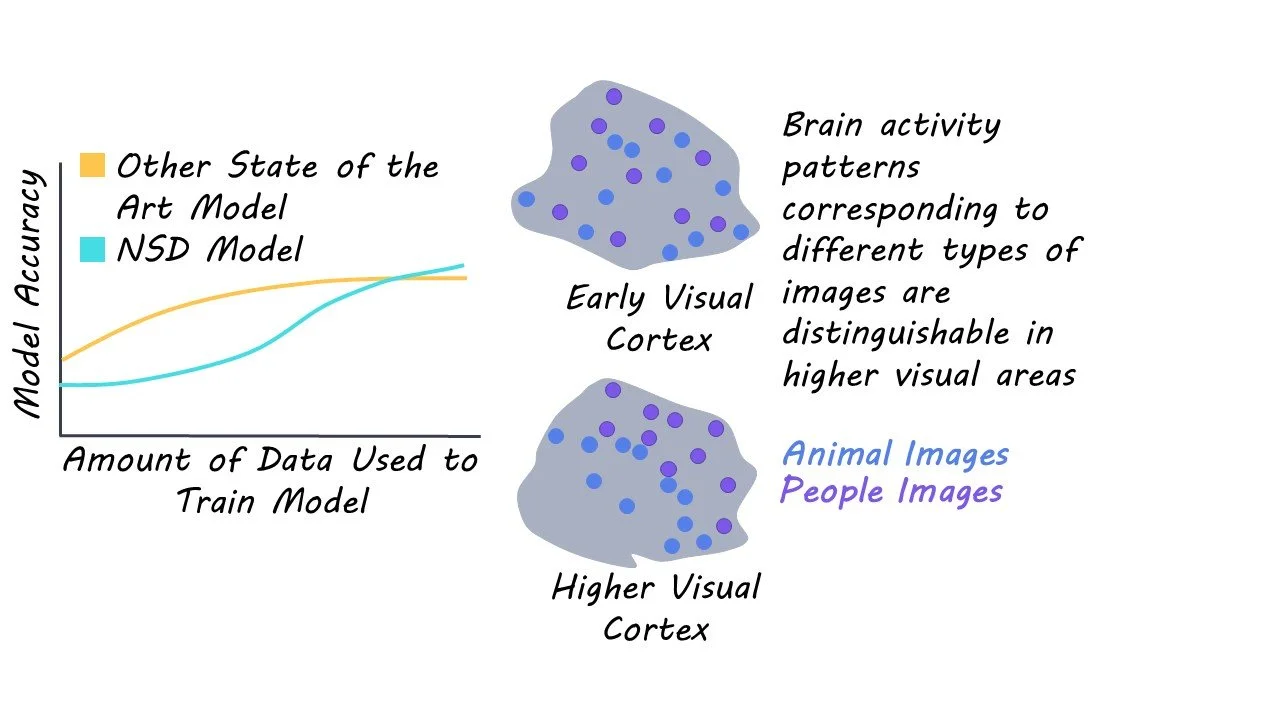
The authors demonstrated two initial applications of the NSD: First, they analyzed patterns of brain responses to the content of natural scenes and observed transformations of semantic representations along the ventral visual pathway. For example, brain patterns associated with people and animals were found in different parts of higher visual areas. Second, they applied machine learning techniques to build and train a deep convolutional neural network to predict brain activity in the brain’s visual areas. The large amount of data afforded by the NSD allowed their models to successfully predict brain activity more accurately than existing state-of-the-art models.

What's the impact?

This report introduces the NSD, a large-scale publicly available brain imaging dataset. The NSD is unique from other resources in terms of its massive scale (i.e., large amounts of data collected from individuals at ultra-high field strength), data quality, and novel analysis techniques. This sharable dataset has wide-ranging applications to the fields of cognitive science, neuroscience, artificial intelligence, and their intersection.