
Testing Domain Selectivity in the Human Brain Using Artificial Neural Networks

Post by Lina Teichmann

What's the science?

Several brain areas that are part of the human visual system have been shown to respond to some images more than others. For example, the fusiform face area (FFA) responds strongly to images of faces while the parahippocampal place area (PPA) responds more strongly to scenes. A prominent idea is that certain parts of the brain’s cortex are domain-selective, specializing in different types of visual content. One challenge of putting category-selectiveness in the brain to the test is deciding how to define what counts as an image of a given category. Additionally, we can only test a limited number of stimuli in each experiment, meaning that many potential images are untested. Thus, there is always a possibility that we have not tested the “right” images to put the idea of category-selectiveness to the test. This week in Nature Communications, Ratan Murty and colleagues address these challenges by showing that we can use artificial neural networks to predict the brain response in apparent category-selective areas. 

How did they do it?

Four healthy participants viewed a variety of natural images while their brain activity was recorded with functional magnetic resonance imaging (fMRI). Using the neural responses to a subset of the images, the authors then used artificial neural networks to predict the neural response of held-out images (not seen by participants) in areas FFA, PPA, and the extrastriate body areas (EBA). In addition, they used data recorded from a subset of participants to predict the neural response in other participants. To put the model’s ability to predict neural responses into perspective, the authors asked experts in the field to predict the neural responses they would expect for the given images. Additionally, they screened millions of images to identify images that would evoke a strong response in FFA, PPA, and EBA and also used a specific type of deep learning model to synthesize new images that were predicted to evoke strong neural responses in FFA, PPA, EBA. Finally, the model was used to identify features in the images that would drive the responses in each brain area.

What did they find?

First, the authors demonstrated that the artificial neural network could predict neural responses in FFA, PPA, and EBA, using only pixel-based information as input. The results even showed that the model outperformed the predictions of experts in the field. Based on these findings, the authors showed that the artificial neural network could be used to look at a huge number of images and make image-based predictions about the brain response in different brain areas. When assessing which images would evoke a strong response in FFA, PPA, and EBA, the authors found that images within the hypothesized preferred category (i.e., faces, scenes, and bodies, respectively) were predicted to have the strongest response. Thus, the findings support the hypothesis of category-selectively within areas of the cortex involved in vision.

Lina (3).jpg

What's the impact?

Overall, the authors have used artificial neural networks in an elegant way to enhance our understanding of human vision. The results lend further support to the domain-specificity hypothesis in the human brain, as several million images were predicted to align with category-selective responses in FFA, PPA, and EBA.

murty_sept28.png

Ratan Murty et al. Computational models of category-selective brain regions enable high-throughput tests of selectivity (2021). Access the original scientific publication here.
Medial Parietal Tau Deposition is Associated with Hippocampal-Retrosplenial Functional Connectivity

Post by Shireen Parimoo

What's the science?

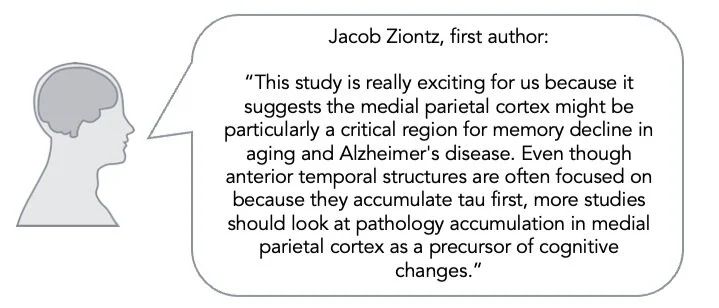
One of the hallmarks of Alzheimer’s disease pathology is the accumulation of misfolded tau protein, which begins in the transentorhinal region of the medial temporal lobe (MTL). Tau is thought to spread trans-synaptically between regions that are anatomically connected with the anterolateral entorhinal cortex (alERC), before spreading to the rest of the neocortex. Recent work suggests that tau might propagate from the MTL to functionally connected regions like the medial parietal cortex, which is part of the posteromedial memory network through its connectivity with the posteromedial entorhinal cortex (pmERC). It is important to better understand whether the functional connectivity between MTL regions and medial parietal cortex is associated with the spread of tau and episodic memory decline. This week in The Journal of Neuroscience, Ziontz and colleagues investigated the relationship between medial parietal tau accumulation and functional connectivity of MTL regions with the medial parietal lobe.

How did they do it?

Ninety-seven cognitively normal older adults (60–93 years old) were recruited from the Berkeley Aging Cohort Study and completed tests of verbal and visuospatial episodic memory. Participants also underwent a resting-state functional magnetic resonance imaging scan and a positron emission tomography scan, which allowed the authors to examine functional connectivity and amyloid/tau deposition in the brain, respectively. Functional connectivity was assessed between the hippocampus, alERC, and pmERC in the MTL and the retrosplenial cortex in the medial parietal lobe. The authors examined tau pathology in the entorhinal and inferior temporal cortices of the MTL, and in the medial parietal lobe, which included the retrosplenial cortex, posterior cingulate cortex, and precuneus regions. Specifically, they quantified tau deposition based on the signal magnitude of flortaucipir, a tracer that binds to tau protein in the brain. Lastly, they used the PiB tracer to examine amyloid-beta deposition in the medial parietal lobe and in the whole brain.

What did they find?

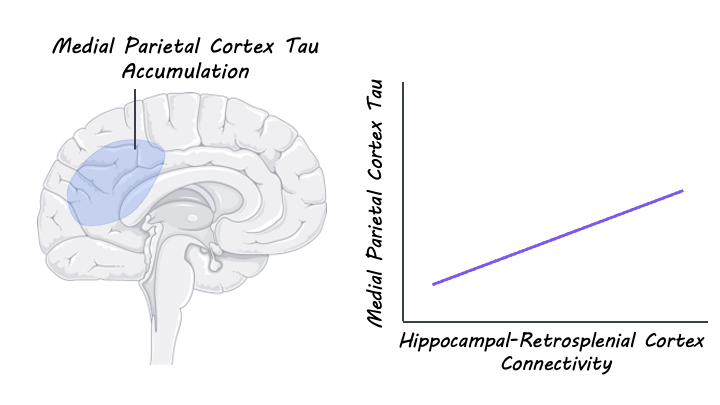
The retrosplenial cortex was functionally connected with the hippocampus and pmERC, but not with the alERC. Functional connectivity between these regions was not related to episodic memory. On the other hand, higher connectivity of the retrosplenial cortex with the hippocampus – but not with the alERC or pmERC – was associated with greater tau deposition in the medial parietal lobe. Medial parietal tau was not associated with functional connectivity between other regions, such as the hippocampus and the superior frontal gyrus. They also showed that the relationship between tau deposition in the medial parietal lobe and hippocampal-retrosplenial functional connectivity was unique to these regions.

tau_sept28.png

Higher medial parietal tau was related to greater tau deposition in the MTL as well as increased global amyloid-beta levels. Individuals with greater functional connectivity between the hippocampus and retrosplenial cortex showed stronger correlations between tau levels in the MTL and medial parietal lobe. Interestingly, these individuals were also likely to have worse visuospatial episodic memory, which is in line with the role of the medial parietal lobe in representing visuospatial information. Thus, visuospatial episodic memory suffered when tau levels and functional connectivity between the MTL and medial parietal lobe were both high.

What's the impact?

The results of this study suggest that tau might spread between regions that are functionally connected to each other. Tau pathology in cognitively healthy individuals might be a potential biomarker for the development of Alzheimer’s disease, a notion that is supported by the current finding that visuospatial memory was lower only in individuals who showed a stronger association between tau accumulation and functional connectivity. Overall, these findings provide an exciting avenue for future research to use tau and functional connectivity in conjunction to track and predict the trajectory of cognitive decline.

ziontz_sept28.png

Ziontz et al. Hippocampal connectivity with retrosplenial cortex is linked to neocortical tau accumulation and memory function. The Journal of Neuroscience (2021). Access the original scientific publication here.
An Optimal Period for Motor Recovery After Stroke

Post by Megan McCullough

What's the science?

Stroke recovery studies have used rat models to investigate the impact of motor training at different time periods after the brain injury. These studies have found that adult rats have critical periods of time after stroke where intensive motor retraining leads to the recovery of motor function. These post-injury critical periods are similar to periods of time in early development where there is increased neural plasticity and the brain is more sensitive to external stimuli. Previous research has not uncovered whether these critical periods also occur in human stroke patients. This week in PNAS, Dromerick and colleagues extended these rat model findings to investigate whether human stroke patients also had windows of time after the stroke that coincided with increased sensitivity to intensive motor training.

How did they do it?

Stroke participants received 20 hours of motor therapy in addition to their standardized therapy at either less than 30 days post-stroke (acute), 2-3 months post-stroke (subacute), or 6 months or more post-stroke (chronic). The control group received only standard rehabilitation. The authors conducted pre-tests and post-tests for each participant using the Action Research Arm Test (ARAT), which measures upper extremity movement. The treatment was administered in a controlled clinical setting to create a realistic set of conditions for human stroke patients.

What did they find?

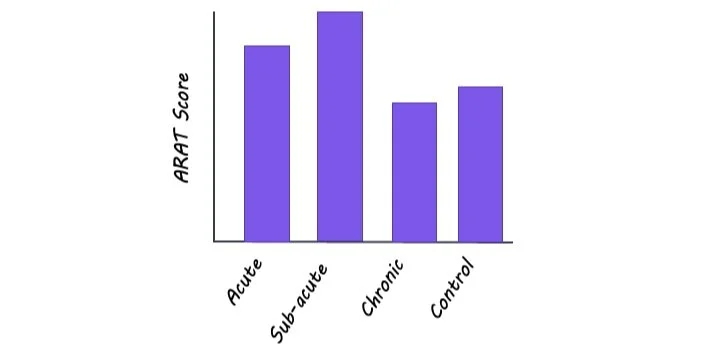
The researchers observed a relationship between the time after the stroke occurred and the rehabilitation therapy specific to this study. Patients in the subacute group showed a significant increase in motor function compared to controls. Patients in the acute group also showed a significant increase in motor function compared to controls; however, it was a smaller improvement than the subacute group. The patients in the chronic group did not show significant improvement in motor function compared to controls. This demonstrates that humans do have critical periods of time after brain injury where targeted treatment leads to increased improvement of motor abilities

stroke_sept28.png

What's the impact?

This study is the first to show that there are specific windows of time after brain injury where intensive motor therapy leads to an increased recovery of motor function in human stroke patients. Intensive motor therapy performed 2-3 months after stroke led to greater upper extremity motor recovery compared to patients who received this same therapy during different time windows after the stroke and compared to patients in the control group who received standard motor rehabilitation. This study has implications for the development of post-stroke treatments and further validates the translation of previous stroke research in animals to human brain recovery research.

Dromerick et al. Critical period after stroke study (CPASS): A phase II clinical trial testing an optimal time for motor recovery after stroke in humans. PNAS (2021). Access the original scientific publication here.