Updating our Ideas About Dopamine

Post by Anastasia Sares

What's the science?

Dopamine is known as the reward molecule: the chemical that we chase after for pleasure. A more precise theory popular among scientists is that dopamine encodes Reward Prediction Error: its release increases when we fail to accurately guess when the next reward will come, such as a pleasant surprise (ice cream, a hug, a paycheck), and decreases when we experience a lack of these things if we expected them to happen. This week in Current Biology, Kutlu and colleagues challenged this explanation of dopamine, arguing instead that it codes for saliency: responding to signals in our environment that need our attention, whether they are good, bad, or neutral.

How did they do it?

The authors combined a number of methods to measure dopamine activity in the Nucleus Accumbens, one of the major structures involved in motivation and reward. They trained mice using many different combinations of signals (tones or bursts of noise), rewards (sugar-water), or punishments (small foot-shocks or bitter-tasting water). In each experiment, the animals had to learn whether or not to respond to the signals by poking their nose into a small hole. This “nose-poke,” depending on the phase of the experiment, could result in a reward, delay a reward, bring a punishment, or help them avoid punishment. Sometimes the rewards and punishments came without warning, and sometimes the signals happened without any consequence.

The mice themselves were genetically altered (using optogenetics) so that dopamine release could be recorded using a certain wavelength of light. The cells in the Nucleus Accumbens could also be stimulated via another wavelength of light. Tiny fiber-optic cables implanted in the brain were able to deliver and record these light pulses.

What did they find?

The researchers observed dopamine activity for both rewards and punishments, and also when new signals were introduced without any relevance to reward or punishment. The profile of dopamine activity differed slightly between rewards and punishments. For rewards, dopamine activity after the signal could predict behavior on the current trial (whether the mouse poked its nose in the slot). For punishments, it was dopamine activity after the shock that predicted behavior on the next trial.

The researchers tried more things, like varying the intensity of a shock or the concentration of sweet and bitter substances. It turned out that dopamine was responding to intensity as well, and it didn’t matter if it was for a reward or a punishment—the more intense it was, the greater the dopamine response. Punishments without cues and cues without consequences also showed a dopamine response, which diminished with repetition. Adding an irrelevant cue enhanced the dopamine response, even though it had nothing to do with the reward.

anastasia2.png

Since this pattern of results doesn’t line up with the prevailing theory that dopamine only predicts reward or deviation from reward, the authors made an alternative suggestion: dopamine responds to saliency. In other words, anything that is new, important, and attention-grabbing will generate a dopamine response. Mathematical models using saliency predicted behavior better than the classical model, and stimulating the Nucleus Accumbens made mice act as they would if the signal were more salient, supporting this claim.

What's the impact?

This work calls into question the prevalent idea that dopamine has to do with reward and error prediction. Many neurodegenerative diseases and behavioral addictions involve an imbalance of dopamine, so it is important to accurately understand how dopamine impacts brain function. This will help us evaluate new treatments for these disorders, and also understand human behavior on a deeper level.
Calipari_Sept21.png

Kutlu et al. Dopamine release in the nucleus accumbens core signals perceived saliency. Current Biology (2021). Access the original scientific publication here.
The Impact of Collective Risk on Social Norms and Cooperation

Post by Leanna Kalinowski

What's the science?

Collective action problems exist where groups benefit from cooperating to achieve a shared outcome, but personal incentives drive individuals to instead rely on others’ efforts. Examples of this can be seen in reducing infectious disease spread and climate change action among many other societal challenges. Laws to foster cooperation to address these global issues are often unavailable, unenforceable, or insufficient, leading society to rely on social norms to encourage compliance. However, it is not fully understood how social norms shape cooperation among strangers and whether the level of threat faced by a society plays a role in the norms that evolve. This week in Nature Communications, Szekely and colleagues used a 30-day collective-risk social dilemma to measure how social norms change in response to varying levels of risk.

How did they do it?

Participants first completed personality trait tests and a demographic questionnaire to determine individual-level factors that may lead an individual to follow social norms. Then, they were separated into groups of six and interacted through 28 daily rounds of the collective-risk social dilemma, with the groups being shuffled daily. At the beginning of each round, each participant was allocated 100 points and asked to decide how many of those points to contribute to the group’s collective pool. If a threshold number of points (300) was met, the collective risk was averted, and all participants got to keep their unspent points. If the threshold was not met, participants risked losing their points determined by a pre-set probability (p).

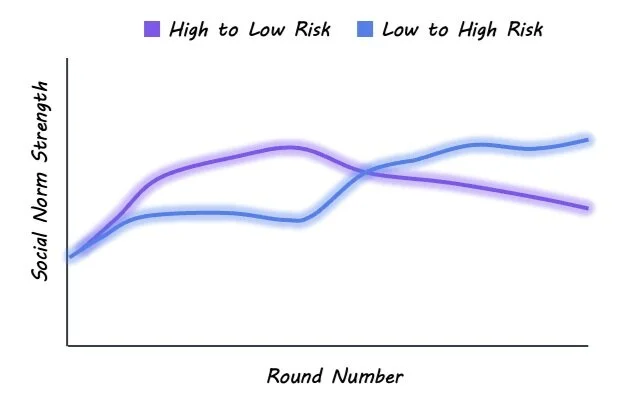
To determine whether higher risk environments led to stronger social norms, the probability of losing points was manipulated. Half of the participants experienced a low-risk environment for days 1-14 followed by a high-risk environment for days 15-28, while the other half of the participants experienced the risk environments in the opposite order. Following each round, participants’ personal normative beliefs and societal expectations were measured. Following the 28th round, participants were asked to determine their level of punishment for individuals who did not contribute at least 50 points.

What did they find?

First, the researchers found that societal expectations and personal normative beliefs have strong and positive associations with cooperative behaviors (i.e., number of points contributed). They then assessed whether cooperative behaviors are impacted by risk level, finding that there were stronger social norms in the high-risk environment compared to the low-risk environment. They also found that groups with stronger social norms are more likely to contribute more points and reach the collective threshold level compared to those with weaker social norms.

Social_Norms_Sept21.png

Next, they found that participants in the low-risk environment experienced a rapid strengthening of social norms upon entering the high-risk environment. Conversely, participants in the high-risk environment experienced a slow deterioration of social norms upon entering the low-risk environment. The presence of social norms was further indicated by punishment levels. Regardless of risk, low contributors (< 50 points) are punished with a higher intensity than high contributors (> 50 points).

What's the impact?

Taken together, these findings show that high risk of collective loss increases the strength of social norms, reduces tolerance of those who deviate from social norms, and increases cooperation. Understanding how social norms emerge during high-risk situations is imperative for developing policies to foster cooperation in the face of future global crises.

Szekely_Sept21.png

Szekely et al. Evidence from a long-term experiment that collective risks change social norms and promote cooperation. Nature Communications (2021). Access the original scientific publication here

Depleting Serotonin Impairs Reversal Learning

Post by Elisas Guma

What's the science?

Serotonin (5-hydroxytryptamine or 5-HT) is a key neurotransmitter in the brain, important for our ability to adapt previously learned responses to a changing environment — also known as reversal learning. Impairments in reversal learning and serotonergic dysfunction have both been reported in numerous neuropsychiatric disorders including obsessive-compulsive disorder (OCD), post-traumatic stress disorder, schizophrenia, and addictions. Despite its broad clinical relevance, few studies have investigated the impact of serotonin on behavioural adaptation in humans. This week in Molecular Psychiatry Kanen and colleagues sought to experimentally test the effect of serotonin depletion on reversal learning ability in healthy humans.

How did they do it?

Healthy volunteer participants were recruited to participate in one of two different experiments and randomly assigned to either acute tryptophan depletion (a serotonin precursor) or placebo in a randomized, double-blind, between-groups design. Tryptophan depletion was attained via consumption of a drink containing the essential amino acids but no tryptophan, while the placebo group’s drink included tryptophan. To ensure serotonin levels were depleted, blood plasma samples were collected.

In Experiment 1, 69 healthy participants were tested in an instrumental reversal learning task. Briefly, participants performed a series of trials in which they had to press a button with the correct finger based on the colour of the screen and the presence of a dot in one of five boxes (ex: red screen and dot in 4th box = right ring finger). In total, participants completed 4 rounds - 1 round of 20 trials of acquisition,  and three rounds of 20 trials of reversal learning where the rule was changed (ex: red screen and 4th dot = left index finger). Each of the 4 rounds was assigned a different level of reward salience (intensity). For the reward-punishment condition participants heard a cha-ching sound for correct answers (reward) and an aversive buzzer for incorrect answers (punishment). There were also reward-neutral (only the cha-ching sound), neutral-punishment (only the aversive buzzer), and neutral-neutral conditions.

Experiment 2 examined reversal learning in the Pavlovian domain. Participants were presented with two threatening faces, one of which was sometimes paired with electric shock (a level chosen by the participant to be uncomfortable but not painful), while the other was not. In the reversal learning phase the originally conditioned face became safe, and the initially safe face was paired with a shock.

What did they find?

For the instrumental learning task (Experiment 1), the authors found that participants who had received acute tryptophan depletion required more trials to criterion than the placebo group for the reversal in the most salient condition (reward-punishment condition). Further, in the reward-neutral condition, they also observed a deficit for the acute tryptophan depleted group, while no deficit was observed in the punishment-neutral or neutral-neutral conditions. Importantly, the magnitude of tryptophan depletion was related to the magnitude of reversal impairments in the reward-punishment and reward-neutral conditions.

elisa (3).png

In the Pavlovian acquisition (Experiment 2), the acute tryptophan depleted group also displayed reversal learning impairments, as they were not able to learn the association between face and shock had changed.

What's the impact?

This study provides evidence from two independent experiments that serotonin depletion impairs human reversal learning in both instrumental and Pavlovian domains. These deficits have not been well captured previously in humans, however, the findings are in line with observations made in other experimental animal studies, as well as in individuals with OCD. Understanding the role of serotonin in reversal learning, a fundamental learning process, may provide important insight into our understanding and development of treatment for conditions in which reversal learning is impaired.

Kanen JW et al. Serotonin depletion impairs both Pavlovian and instrumental reversal learning in healthy humans. Molecular Psychiatry (2021). Access the original scientific publication here.