Self-Determination Theory: Explaining Motivation to Exercise

Post by Shireen Parimoo

Why do people exercise?

Exercise is a physical stressor for our bodies that can be painful, sometimes resulting in injuries, yet people still dance, run, go to the gym, and play sports. Surely, they must derive some benefit from exercise that justifies the temporary pain. What keeps them motivated? Some exercise to improve or maintain their physical and/or mental health, others use exercise as a form of stress relief, while others focus on improving their appearance or on achieving a particular goal. These reasons are not mutually exclusive, as someone could have an achievement-focused mindset in their sport yet also feel like it helps them cope with the stresses of daily life.

Motivation refers to the factors that drive us to perform a behavior, like exercising or playing sports. Motivation not only influences our ability to initiate a behavior or change in lifestyle but also determines how successfully we can maintain that change over time. In general, motivation can be intrinsic and based on the inherent enjoyment that comes from doing something, or extrinsic and guided by factors outside of the activity itself such as competition or social factors.

Where does motivation come from?

According to the self-determination theory, motivation lies along a continuum of autonomy, ranging from fully autonomous to controlled sources of motivation. Autonomous motivation can be both intrinsic and extrinsic, such as exercising for fun (intrinsic), or because the outcome is consistent with an individual’s self-concept (extrinsic – integrated regulation) or their personal values (extrinsic – identified regulation). For example, identified regulation of behavior occurs when someone starts running because they want to be physically fit and value leading a healthy lifestyle, even if they do not enjoy the act of running. Controlled motivation is largely extrinsic, like exercising to lose weight, to win a medal, or to avoid feelings of guilt associated with leading a sedentary lifestyle. The last example illustrates introjected regulation, in which someone feels pressured or obligated to exercise because of the environment they are in, even if they do not enjoy it.

Successfully adopting and maintaining an exercise program are distinct stages of change that rely on different sources of motivation. For example, both autonomous and controlled motivation might be sufficient for someone to start exercising, but those who are autonomously motivated are more likely to continue exercising long-term. Identified and integrated regulation in particular are more predictive of long-term adherence to an exercise program because they are centered around an individual’s personal beliefs and values, which heavily influence their lifestyle. On the other hand, controlled motivation is less likely to lead to long-term maintenance of exercise behavior and may even be associated with a lower sense of psychological well-being.

How can motivation be improved?

It is not easy to go from forming an intention to exercise to implementing that change – motivation is crucial. A large body of research suggests that autonomous motivation can be fostered when three basic psychological needs are met:

Autonomy: how much control someone believes they have over their behavior.

Competence: how successfully someone feels in their achievements at their chosen sport or exercise program.

Relatedness: how much someone feels connected with and/or supported by their social environment.

Self_Determination.png

Each of these needs is met to varying degrees depending on the context and environment. Behavioral interventions that help address these psychological needs positively regulate autonomous motivation, which in turn leads to increased physical activity. Interventions focused on increasing the sense of autonomy and competence are most effective in facilitating behavior change. However, it is important to remember that interventions are typically not one-size-fits-all. For someone looking to start strength training, for instance, joining a local gym or fitness class might provide a consistent and supportive environment for exploration. Alternatively, others might benefit more in a one-on-one setting, like hiring a personal trainer.

On the contrary, not meeting these needs can be counterproductive. If a parent strongly pushes their teenager into joining the soccer team, for instance, the teenager may feel like they did not have any choice in the decision. If they also do not enjoy the sport, then they are less likely to continue playing. Similarly, setting unrealistic goals can lead to feelings of incompetence, which may lower someone’s motivation to continue exercising. Thus, although people might start to exercise for a wide variety of reasons, being mindful of their environmental and social context might help them effectively develop and maintain the habit.

Click to See References +

Conn et al. Interventions to increase physical activity among healthy adults: Meta-analysis of outcomes. American Journal of Public Health (2011).

Gillison et al. A meta-analysis of techniques to promote motivation for health behavior change from a self-determination theory perspective. Health Psychology Review (2019).

Knittle et al. How can interventions increase motivation for physical activity? A systematic review and meta-analysis. Health Psychology Review (2018).

Matsumoto & Takenaka. Relationship between basic psychological needs and exercise motivation in Japanese adults: An appraisal of self-determination theory. Japanese Psychological Research (2021).

Mehra et al. Aging and physical activity: A qualitative study of basic psychological needs and motivation in a blended home-based exercise program for older adults. In “Self-Determination Theory and Healthy Aging” (2020).

Ng et al. Self-determination theory applied to health contexts: A meta-analysis. Perspectives on Psychological Science (2012).

Ntoumanis et al. A meta-analysis of self-determination theory-informed intervention studies in the health domain: effects on motivation, health behavior, physical, and psychological health. Health Psychology Review (2021).

Olander et al. What are the most effective techniques in changing obese individuals’ physical activity self-efficacy and behavior: a systematic review and meta-analysis. International Journal of Behavioral Nutrition and Physical Activity (2013).

Ryan & Deci. Self-determination theory and the facilitation of intrinsic motivation, social development, and well-bring. American Psychologist (2000).

Teixeira et al. Exercise, physical activity, and self-determination theory: A systematic review. International Journal of Behavioral Nutrition and Physical Activity (2012).
The Role of Cocaine and Dopamine D2 Receptors in Conditioned Behaviors

Post by Andrew Vo

What's the science?

Addictive drugs are known to alter brain circuits — specifically the midbrain dopamine system that innervates the dorsal striatum (DSt) and nucleus accumbens (NAc). Dopamine signaling can have different effects in these distinct brain regions depending on the class of dopamine receptor the dopamine reaches: D1 receptors excite medium spiny neurons (MSNs), while D2 receptors have inhibitory effects on behaviour. Although the role of D2 receptors (D2Rs) in motivated behavior is understood and the impact of D2R dysregulation following long-term drug use in addiction is well-established, it remains unknown how initial cocaine exposure regulates D2R signaling in a region-specific manner to alter conditioned behaviors. This week in Neuron, Gong et al. investigated the cellular mechanisms underlying the effect of repeated cocaine exposure on drug-seeking behaviors in mice.

How did they do it?

The authors began by examining a) the effect of repeated cocaine exposure on D2R sensitivity in D2-MSNs and b) whether this effect differed between the DSt and NAc. To measure D2R signaling in D2-MSNs, electrophysiological activity from D2-MSNs was recorded during cocaine exposure while modulating the concentration of dopamine stimulation, generating a dose-response curve. Mice were repeatedly exposed to cocaine for 7 days, followed by a 14-day withdrawal period, before a single injection challenge of cocaine. Response curves were generated after each of these phases.

Next, the authors set out to determine the exact mechanism underlying changes in D2R sensitivity following cocaine exposure. To test whether these changes were caused by alterations in D2R levels, they sampled tissues from the DSt and NAc of mice treated with either cocaine or a saline control and measured the relative density of D2Rs using immunoblotting (a technique for analyzing proteins in a sample using antibody staining). They also generated mice in which D2R levels were either (1) knocked down or (2) overexpressed and observed any changes in the effects of cocaine exposure on D2R sensitivity. To test whether these changes were instead caused by regulation of G proteins, which tightly couple with D2Rs to facilitate dopamine signaling, they sampled tissues from the DSt and NAc of mice following acute, chronic, withdrawn, and cocaine-challenge compared to saline controls and measured G protein levels using western blotting (which detects the type and amount of a specific protein in a mixture). Further, they measured the effects of cocaine exposure on D2R sensitivity in G protein knockdown mice and again after G protein re-expression via a viral rescue procedure.

The authors were also interested in the behavioral effects of cocaine-mediated changes in D2R sensitivity. Using a conditioned place preference paradigm, in which mice learn to associate a previously neutral chamber with a drug, they compared behavior of G protein knockdown mice to controls, as well as following re-expression of G protein levels. In a self-administration task that assessed reinforcement learning, G protein knockdown and control mice were trained to self-administer cocaine in response to a cue, followed by an abstinence period, before a final relapse test.

Finally, the authors explored potential mechanisms that could capture the effect of cocaine exposure on D2R sensitivity changes. They tested the effects of increasing (i.e., administering a dopamine precursor or D2R-specific agonist) or decreasing (i.e., administering D2R or D1R antagonists) dopamine stimulation. They also examined the effects of chemogenetic inactivation of D1Rs in either D1-MSNs or the prefrontal cortex. Last, they tested the role of NMDA plasticity by administering an NMDA-receptor antagonist.

What did they find?

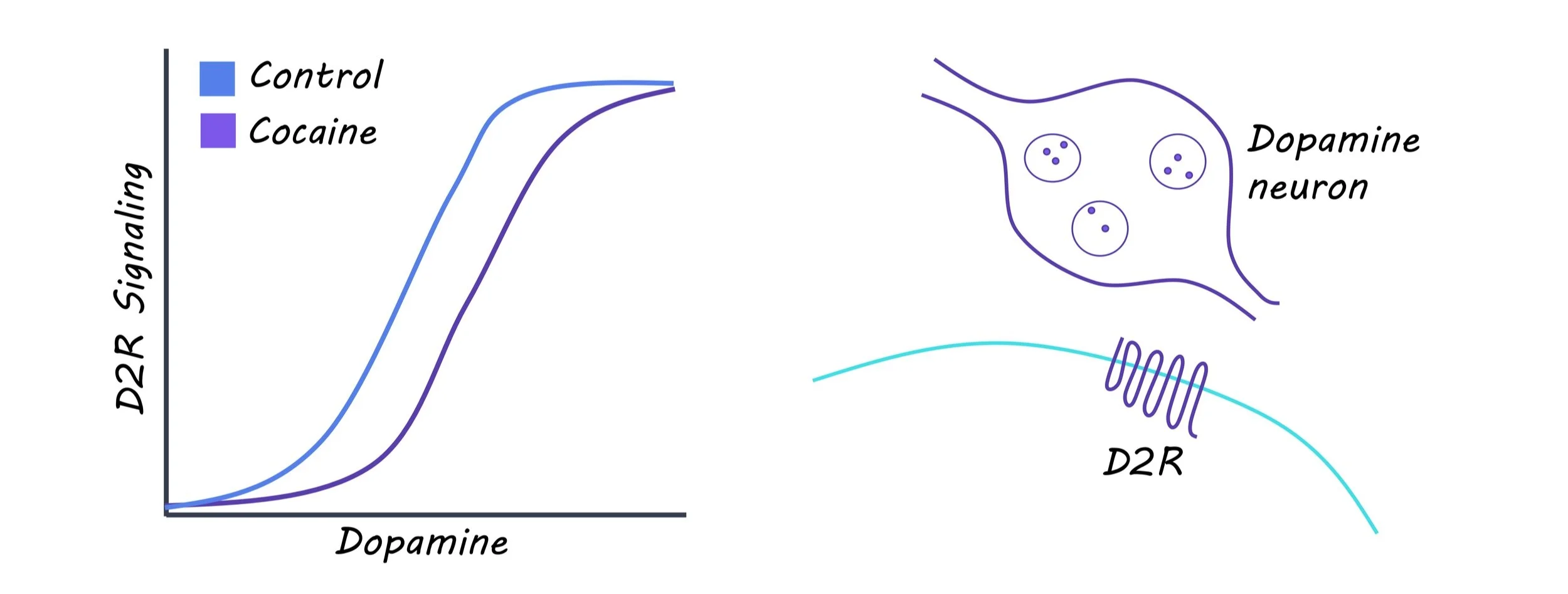
Repeated exposure to cocaine caused a rightward shift in the dose-response curve in the NAc but not DSt, indicating a region-specific reduction in D2R sensitivity. This reduced D2R sensitivity returned to baseline levels after a drug withdrawal period but was immediately reinstated following a single challenge injection of cocaine.

Immunoblotting revealed similar levels of D2R expression in both DSt and NAc in cocaine-treated mice compared to controls. Reducing or enhancing D2R levels, via knockdown or overexpression respectively, did not prevent cocaine-associated decreases in D2R sensitivity in the NAc. Western blotting showed that cocaine exposure reduced G protein levels in the NAc but not DSt. These altered levels returned to baseline after a withdrawal period but were reinstated following a single injection challenge of cocaine. Decreasing G protein levels via knockdown mice successfully reduced D2R sensitivity in the NAc and blocked the effect of chronic cocaine exposure. Viral rescue of G protein levels in these mice recovered the cocaine-associated reduction in D2R sensitivity in NAc. Collectively, these findings indicate that D2R sensitivity changes following cocaine exposure occur independently of changes in D2R levels and are instead related to the regulation of G proteins.

andrew.png

Cocaine conditioned place preference caused a reduction in G protein levels in the NAc. G protein knock-down mice were found to spend more time in the drug-associated chamber. This preference was eliminated after re-expression of G protein levels via viral rescue. In the self-administration task, knock-down mice were unaffected in their ability to self-administer cocaine in response to a cue. Following an abstinence period and subsequent relapse test, these knock-down mice were unaffected in the reinstatement of drug-seeking. Taken together, these results suggest that cocaine-induced changes in G protein expression leading to a reduction in D2R sensitivity in the NAc underlie conditioned drug-seeking behaviors.  

Increasing extracellular dopamine levels did not affect D2R sensitivity, unlike the result of cocaine exposure. D2R antagonism before cocaine exposure did not block reductions in D2R sensitivity in the NAc. In contrast, D1R antagonism could successfully block this cocaine-mediated effect. Further examining the role of D1R regulation of D2R-MSN sensitivity, inactivation of D1Rs in PFC but not D1-MSNs blocked the effect of cocaine on D2R sensitivity in NAc. A similar effect could be achieved by blocking NMDA receptors. These findings illustrate a regulatory role of D1R inputs from the PFC on D2R sensitivity.

What's the impact?

In summary, this study demonstrated that initial chronic exposure to cocaine reduced the sensitivity—but not the level—of D2Rs specifically in the NAc of mice. Reduced D2R sensitivity was caused by decreased expression of G protein in D2-MSNs following cocaine exposure. Together, these changes promoted conditioned drug-seeking behaviors. Uncovering the neural mechanisms through which initial drug exposure regulates drug-seeking behavior has important implications for the treatment of addiction and relapse.

Ford_Sept14.png

Gong et al. Cocaine shifts dopamine D2 receptor sensitivity to gate conditioned behaviors. Neuron (2021). Access the original scientific publication here.

The Impact of Social Learners on Collective Decision-Making

Post by Lani Cupo

What's the science?

In democratic societies, collective decisions, such as who should hold power, or what action should be taken to address climate change, can drastically impact society. But when people make decisions in groups, the most popular option is sometimes chosen even though it does not have the most merit. This phenomenon is due in part to the presence of those identified here as social learners who adopt the opinions of others instead of critically assessing options for themselves. This week in PNAS, Yang and colleagues developed a mathematical framework for investigating whether there is a critical threshold of social learners that can be present in a collective decision, after which one option may prevail because of popularity, rather than merit. 

How did they do it?

The authors created a dynamical system model which integrated two options (X and Y) with relative merit (m) associated with each option, where m was a number between zero and one. The model incorporated differing proportions of social and independent learners (s) in the population. Finally, it included one parameter as a function that is hypothesized to model two types of conformity, normative (engaging in a behavior because others do it), and informational (engaging in a behavior because it is the right thing to do). The authors derived transition rates between the options for the different types of learners, where social learners will transition between the options based on the popularity of the option, but independent learners transition based on the merit of the option. This allowed the authors to examine the fixed points of the equation, where the proportion of people favoring a given option stops changing. They also investigated how stable these fixed points are when the model is perturbed. Their conclusions remained the same when they changed the model to account for opinion on a spectrum from independent to social, when they only allowed individuals to be impacted only by their local environment, and when they introduced statistical noise to the model. Finally, the researchers simulated a model incorporating the strength of opinion weighting towards option X or Y. 

What did they find?

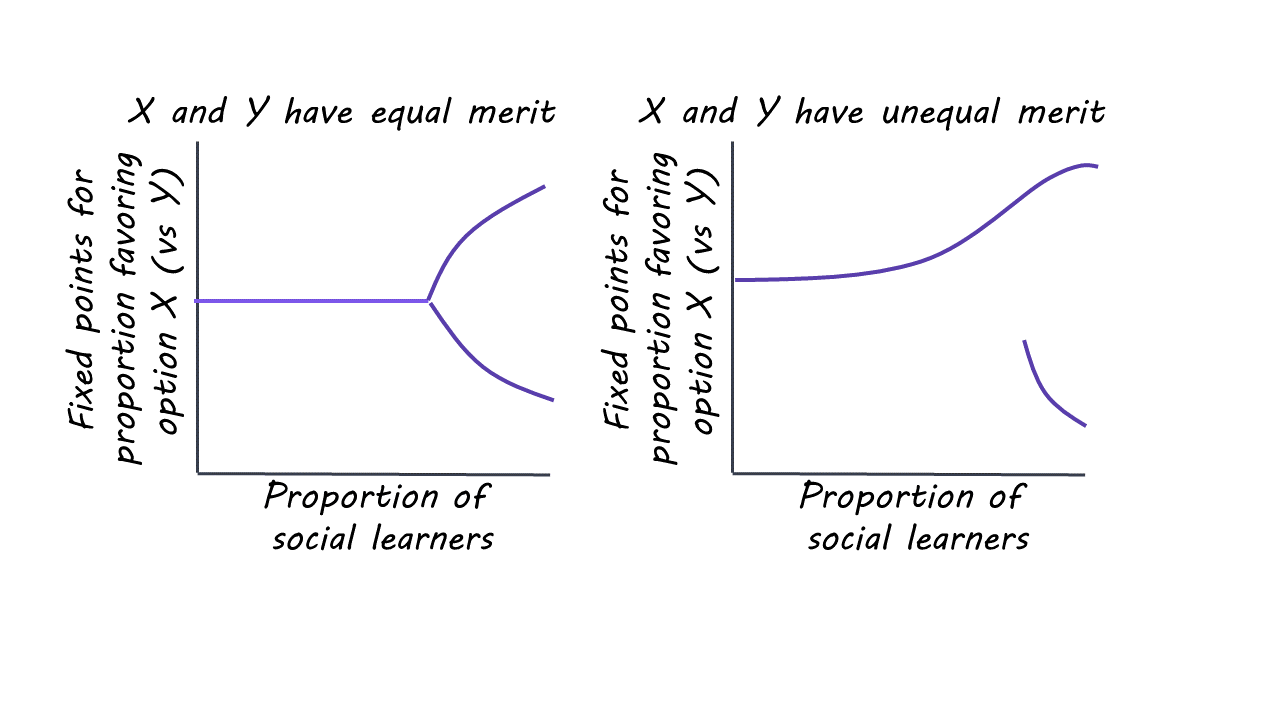
When X and Y are options with equal merit, there is a critical threshold for the proportion of social learners after which the model bifurcates into two branches, implying either option X or Y could be selected. In the case that the model is not equal between groups, the majority will favor the more meritorious option up to a critical point, but if the proportion of social learners is too high, instability is introduced into the model, meaning there can be cases in collective decision making where the less meritorious option is still chosen. The critical threshold is determined both by the discrepancy in merit between the two options and the conformity function. The threshold that these parameters identify predicts the threshold above which the proportion of social learners harms the decision. Notably, the model is flexible to adapt to different behaviors modelled through the conformity function or to allow parameters, such as the strength of opinions, meaning it represents a flexible tool that can be used to model different situations. 

lani (1).png

What's the impact?

This study investigated the impact of social learners on collective decision-making, demonstrating there is a threshold above which social learners may negatively impact the outcome of collective decisions. The outcome of collective decisions can drastically impact daily life—not only in small communities but on a national and global scale as well. The mathematical framework presented provides future studies with the ability to examine social learning in varied and complex scenarios. 

Yan et al. Dynamical system model predicts when social learners impair collective performance. PNAS (2021). Access the original scientific publication here