
Breath, Mindfulness and Mental State

Post by Elisa Guma

Our first breath

Our first breath at birth marks one of the most profound changes in our physiology. We transition from having fluid-filled lungs in the womb to suddenly filling them with oxygen. Hormonal changes occurring during labor stimulate the removal of fluid from the lungs. Once the baby enters the world, the sensation of air on the skin as well as rising carbon dioxide levels signal to the brain that it's time to initiate breathing. As the baby’s lungs begin to fill with air, increased oxygen in their system stimulates the closure of blood vessels in the heart called the ductus arteriosus, which are important in the womb for diverting blood away from the lungs. After birth, breath continues to influence our physiology throughout our lifespan.

Neural control of respiration

The neural control of involuntary breathing occurs mainly in the brainstem. This is necessary for sustaining life when voluntary respiration is not possible, such as during sleep. The medulla oblongata sends signals to respiratory muscles to induce breathing, with one portion signaling expiratory movements (exhaling), and another stimulating inspiratory movements (inhaling). This structure is also responsible for coughing, sneezing, swallowing, and vomiting reflexes. The pons, situated just below the medulla, is responsible for controlling the rate of involuntary respiration. In contrast, voluntary respiration occurs under conscious control and is important for higher functions such as voice control. This type of breathing is controlled by the motor cortex, which sends signals via the spinal cord to activate the diaphragm and accessory muscles of respiration. This can be overridden by various limbic structures of the brain, such as the hypothalamus. For example, in periods of perceived danger or intense emotional stress, signals from the hypothalamus cause an increase in respiratory rate in order to facilitate the fight or flight response.

Breath and mindfulness

The practice of ‘pranayama’ is a core component of many ancient practices such as yoga, meditation, and tai chi. This involves focusing one’s attention on the breath in order to reach a more calm and meditative state. The practitioner aims to slow the rate of breathing and often synchronizes breath with steady movement, increasing the link between the internal body and external world. This type of breathing increases oxygen uptake and activates the parasympathetic nervous system (‘rest and digest’) to allow us to enter a more relaxed state. Additionally, it activates brain regions beyond the brainstem involved in emotion, attention, and body awareness.

In addition to focused breathing, many of the contemplative traditions discussed above focus on mindfulness. Mindfulness is defined as the basic human ability to be fully present, aware of where one is in space and what one is doing, without interpretation or judgement. Breathing techniques are often employed in order to achieve this state, so it may be difficult to disentangle the benefits of intentional breathing from those of mindfulness.

Possible health benefits

In recent decades there has been increased scientific interest in these mind-body practices and the proposed benefits on physical and mental health. When attention is drawn to the breath, breathing is slowed, and as one elongates their exhale, decreased heart rate, blood pressure, and even inflammation have been observed. Improvement in symptoms of depression, as well as reduced anxiety, stress, and chronic pain have also been reported. Further, mindfulness practice has been shown to improve emotional regulation and reduce stress. Some of these effects may be mediated by activation of fronto-limbic brain networks involved in attention control, emotion regulation, and self-awareness during mindfulness meditation. However, many of the underlying mechanisms of these benefits are still unclear.

The link between breath and mental state

The link between involuntary breathing mechanisms and our ability to use breath to regulate our mental state from aroused or frantic to calm and contemplative are slowly becoming clearer.  Recently, a small cluster of neurons in the brainstem, referred to as “respiratory pacemaker”, linking respiration to relaxation, attention, excitement, and anxiety has been identified. Within this cluster of neurons, termed the pre-Bötzinger complex, there are more than 60 different neuronal subtypes responsible for different aspects of breathing.

Leveraging genetic knockout technology in rodent models, the roles of many of these neuronal subpopulations have been identified. The most exciting discovery pertained to two specific subpopulations (identified by the presence of Gdh9 and Dbx1 genes) that, when eliminated from the brain, produced mice that were exceptionally calm in experimentally induced stressful situations, producing fewer fast or sniffing breaths and more slow breaths. However, researchers realized that rather than regulating breathing, these neurons were relaying information back to the locus coeruleus, a brain region that projects to almost every part of the brain, driving arousal and alertness, as well as anxiety and distress. This seminal study demonstrates that information about stress states is normally relayed from breathing centers to the rest of the brain and provides evidence for the relationship between breath and mental states. Importantly, this region identified in the mouse also exists in the human brain.

Another possible pathway for the connection between breath and mental state could be the vagus nerve. This cranial nerve can slow down heart rate through its direct projections to the heart and may also suppress inflammation by exerting control on the sleep and anti-inflammatory pathways in the body. This interesting pathway has received some attention recently but remains largely unexplored.  

What’s next?

Interestingly, ancient practitioners were well aware of the connection between breath and mental states, despite not understanding the underlying physiology. Over the last few decades, our scientific understanding of these mechanisms has significantly improved. However, future work is needed to better understand how the central and peripheral nervous systems modulate the changes in our physiology and mental states associated with breath and mindfulness. In turn, understanding how to leverage this practice to help individuals suffering from mental health crises will be beneficial, as it is free, non-invasive and easy to disseminate.

References

Tang YY et al., The neuroscience of mindfulness meditation. Nature Reviews. 2015. Access to the publication can be found here.

Zaccaro A et al., How Breath-Control Can Change Your Life: A Systematic Review on Psycho-Physiological Correlates of Slow Breathing. Frontiers in Neuroscience. 2018. Access to the publication can be found here

Shi Y et al., A brainstem peptide system activated at birth protects postnatal breathing. Nature. 2021. Access to the publication can be found here

Gerritsen RJS & Band GPH. Breath of Life: The Respiratory Vagal Stimulation Model of Contemplative Activity. Frontiers in Human Neuroscience. Access to the publication can be found here.
The Role of Psychedelics in Treating Psychiatric Disorders

Post by Lani Cupo

What are psychedelics?

The term “psychedelics” can bring a lot of things to mind: The Beatles’ iconic song, “Lucy in the Sky with Diamonds,” notorious CIA-funded truth-serum experiments, tapestry-draped college dorm rooms filled with the mingled smoke from cannabis and incense. Less frequently in the 21st century, but still prominent, are horror stories centering on the dangers of psychedelics: violent outbursts or psychotic breaks. While psychedelics have been accepted as integral to spiritual and medicinal practices worldwide for millennia, more rigorous scientific exploration of the possible therapeutic potential of psychedelics has primarily emerged over the past 15 years. But before the effects of these substances can be discussed, they must be defined.

Psychedelics, also known as hallucinogens or entheogens, comprise substances with distinct and varied sources, compositions, and effects. Classic psychedelics that will be discussed here are partial agonists at 5-HT2A serotonin receptors and include various compounds such as tryptamines (e.g., psilocybin), N,N-dimethyltryptamine (e.g., DMT, naturally present in ayahuasca), phenethylamines (e.g., mescaline found in peyote cacti), and ergotamines (e.g., lysergic acid diethylamide, LSD). MDMA (3,4-methylenedioxy-methamphetamine) which is often classified as a psychedelic, has mechanisms of action on serotonin receptors, and has also emerged as a focus for research as a potential therapeutic. 

What do psychedelics do?

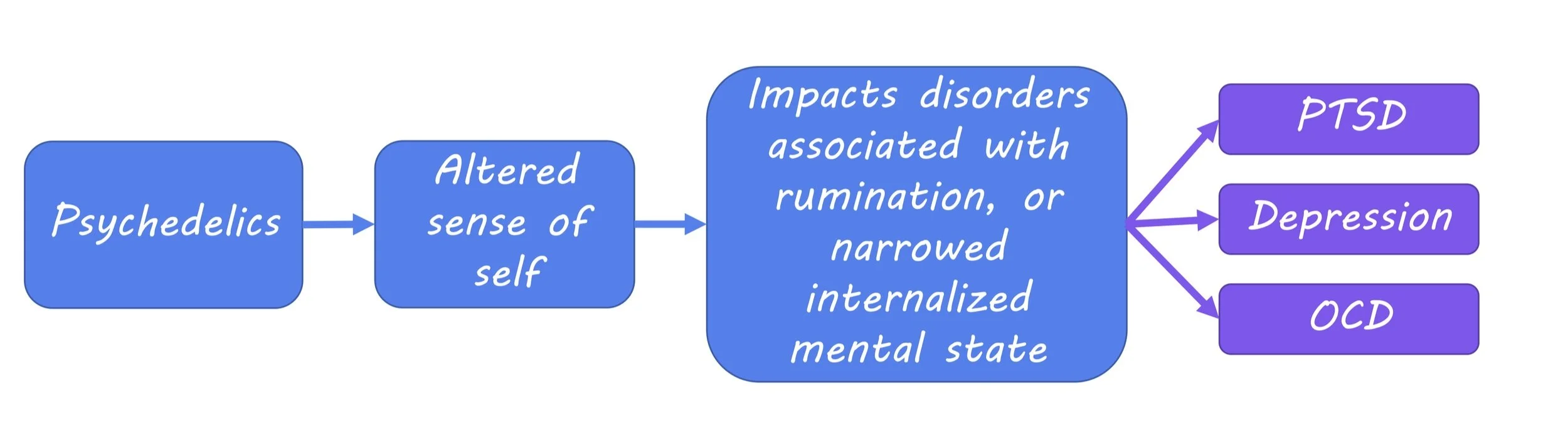
The subjective experiences associated with a psychedelic “trip” can be categorized into three main groups: altered emotional processing, self-processing, and social processing, all of which can be accompanied by perceptual alterations or hallucinations. Acute exposure to psychedelics not only enhances positive mood, sometimes inducing euphoria, but also reduces the processing of negative emotions and stimuli, particularly beneficial to those with a negative emotional bias like major depressive disorder. While difficult to assess in the clinical setting, altered perception of self is a hallmark of many experiences with psychedelics. Ego dissolution (or ego death) refers to a feeling of oneness with the environment and a loss of sense of self. Ego death can be accompanied by dread related to loss of control (which is rare in clinical settings), but altered perception of self is considered integral to psychedelics’ therapeutic potential, especially for those who struggle with rumination. In healthy participants, LSD and psilocybin can increase emotional empathy (feeling ‘with’ other people), with increased positive/altruistic social effects reported 4 to 12 months after administration. Since loneliness and social disconnect can often exacerbate or even contribute to the emergence of mental illness, increased social empathy could provide therapeutic benefits. The therapeutic potential of perceptual changes (most commonly altered visual perception) is not well understood, however such changes are one the most reliable features of psychedelic experiences and therefore cannot be excluded from a consideration of the impact of psychedelics.

One hypothesis for how psychedelics may contribute to altered consciousness focuses on the cortico-striato-thalamo-cortical loop that connects cortical and subcortical (e.g., striatum and thalamus) brain regions responsible for regulating internal and external sensory experiences. Preliminary neuroimaging evidence from humans suggests psychedelics can a) reduce thalamic filtering of information pertaining to both the internal state of the body (interoceptive) and the external world (exteroceptive) and b) increase synchronization between sensory cortical brain regions. This evidence is also consistent with a hypothetical model known as the “relaxed beliefs under psychedelics (REBUS)” model, which hypothesizes that psychedelics decrease the strength of expectations and assumptions about the world and enhance the amount of bottom-up sensory information. While early studies lend support for both of these hypothetical models, they remain far from definitive and more work in this area is necessary.

What psychiatric disorders can psychedelics treat?

Recently published studies investigate the potential for psychedelics to treat cancer- and illness-related anxiety and depression, major depressive disorder (MDD), obsessive compulsive disorder (OCD), substance use disorders (SUD), and post-traumatic stress disorder (PTSD).

In clinical trials, psychedelics are most commonly administered either at moderate-high doses once or twice or in a microdosing regimen, where extremely low doses are administered multiple times. Moderate dosages have been shown to reduce symptoms of anxiety and depression at 6 months following administration. Improvement has even been seen in participants whose depression resisted two or more first-line antidepressant treatments. Reductions in anxiety and depression are also widely documented in patients with terminal illnesses. Preliminary evidence also suggests a reduction in OCD symptoms, although studies with larger sample sizes are necessary to confirm these results. 

Psilocybin has been effective at reducing the use of alcohol and nicotine in patients with a substance use disorder, with up to 32-week follow-up. Psychedelics have also shown promise in the treatment of Post-Traumatic Stress Disorder (PTSD), and clinical trials are currently underway. PTSD is a complex, multifaceted disorder, and heightened arousal and sensitivity to sensory stimuli may present a challenge to this approach. Psychedelics appear particularly promising for treating conditions that include a narrowed, internalized mental state, seen in symptoms such as rumination and obsessive, or intrusive thoughts. Psychedelics show promise in treating other disorders such as anorexia or bulimia as well, but future research is required to confirm this.

lani.png

On the other hand, studies that have examined microdosing regimes show mixed effects. In one study examining the impact of low or high doses of LSD on anxiety symptoms, one study reported decreased anxiety after high doses, but increased anxiety after low doses, a symptom that was only reduced after the group was switched to the high dose in a crossover experimental design. Slight increases in anxiety were observed in healthy participants in the microdosing regime as well. Future studies are needed to investigate the effects of administration doses and regimens, especially as most microdosing research conducted thus far has been in healthy participants.

What are the current debates?

While much of the preliminary data suggests great therapeutic benefit from psychedelics in treating select psychiatric disorders, there is debate as to whether the subjective experience associated with psychedelic use is necessary for the beneficial effects. In fact, in a special issue of the Journal of ACS Pharmacology in 2020, two papers with opposing views on this debate were published side-by-side (see references Olson, Yaden). Olson posits that while some participants report breakthroughs with mystical experiences associated with their psychedelic treatment, other participants who do not report mystical experiences still exhibit improved symptomatology. Additionally, not all patients who do have a psychological breakthrough during treatment see a benefit to their symptoms. The author also points out that these experiences may be an indication of 5-HT2A receptor activation, perhaps representing a dose-response relationship. In other words, mystical psychedelic experiences could be due to more of the drug binding to receptors in the brain. In contrast, Yaden and Griffiths present evidence suggesting a major role for mystical experiences in the lasting beneficial outcomes of treatment with psychedelics. They suggest that in order to discern whether psychedelics can be effective treatments without the subjective psychedelic experiences, one could test psychedelic and placebo treatments while participants are fully unconscious, encoding no memories of the experiences themselves. Therefore, the question of what role the subjective experience of psychedelics plays in treatment response remains open.

What’s the hope for the future?

So, can psychedelics be used as an effective treatment for psychiatric disorders? Given the accumulating research evidence, psychedelics represent a promising tool for the treatment of psychiatric disorders—many of which have few pharmacological treatments (such as PTSD) or are characterized by high rates of treatment resistance (such as MDD). Given the mild, infrequent side-effects associated with psychedelics when administered in a safe, clinical setting, the potential benefit is high. It is important to note, however, that much of the research conducted thus far has been in relatively small sample sizes which often lacked a placebo control. Yet, clinical trials are already underway — such as MDMA-assisted therapy for PTSD — and based on this research, the coming decades may see Food and Drug Administration approval for psychedelics to be used as a treatment for a variety of psychiatric conditions.

References

Andersen et al. Therapeutic Effects of Classic Serotonergic Psychedelics: A Systematic Review of Modern-Era Clinical Studies. Acta Psychiatrica Scandinavica. (2021). Access the original scientific publication here.

Erritzoe et al. In Vivo Imaging of Cerebral Serotonin Transporter and serotonin2A Receptor Binding in 3, 4-Methylenedioxymethamphetamine (MDMA or ‘ecstasy’) and Hallucinogen Users. Archives of General Psychiatry (2011). Access the original scientific publication here.

Krediet et al. Reviewing the Potential of Psychedelics for the Treatment of PTSD. The International Journal of Neuropsychopharmacology. (2020). Access the original scientific publication .

Kuypers. The Therapeutic Potential of Microdosing Psychedelics in Depression. Therapeutic Advances in Psychopharmacology. (2020). Access the original scientific publication here.

Olson. The Subjective Effects of Psychedelics May Not Be Necessary for Their Enduring Therapeutic Effects. ACS Pharmacology & Translational Science (2021). Access the original scientific publication here.

Vollenweider. Psychedelic Drugs: Neurobiology and Potential for Treatment of Psychiatric Disorders. Nature Reviews. Neuroscience (2020). Access the original scientific publication here.

Yaden, David B., and Roland R. Griffiths. The Subjective Effects of Psychedelics Are Necessary for Their Enduring Therapeutic Effects. ACS Pharmacology & Translational Science (2021). Access the original scientific publication here.

Applying Deep Learning to Extract Meaningful Information from Raw Neural Recordings

Post by Lina Teichmann

What's the science?

Neural recordings contain a vast amount of information but require a lot of time and expertise to disentangle and interpret. Deep learning is a machine learning method that can be used to try and interpret and decode the content of large datasets, to better understand which elements of the data are informative. This week in eLife, Frey et al. show that a convolutional neural network (a type of deep learning model) requiring few assumptions can decode meaningful information from raw neural recordings. Training their network on neurophysiological data recorded from rodents and humans, the authors demonstrate that the network is able to decode a variety of stimuli from the raw, unsorted neural recordings.

How did they do it?

The neural network takes neural data that has been decomposed into a three-dimensional representation of time, recording channels, and frequency as inputs. The model contains convolutional layers and fully connected layers that share their weights across channels and time, respectively, to reduce computational load and improve the generalizability of the model. The model was trained in a supervised fashion on rodent and human neural data. Electrophysiological recordings, two-photon calcium imaging, and electrocorticography (EcoG) were used to test whether the model can decode stimuli across different recording modalities, different species, and different brain areas. The model was trained to decode position information, auditory stimuli, and finger movements.         

What did they find?

The model proved successful at decoding information from the raw neural recordings. First, the authors showed that the model could successfully decode position information from electrophysiological recording from mice hippocampus. The ability to decode different positional factors was driven by different features of the neural data. For example, self-location decoding was shown to be dependent on pyramidal cells in CA1 while motion speed was driven by theta oscillations and interneurons. Head direction decoding was driven by CA1 interneurons. To show that the model works beyond recordings from the hippocampus and can also be used for different types of datasets, the authors showed that the model could be used to successfully decode sounds from two-photon calcium imaging of the auditory cortex. Finally, the model also succeeded at decoding finger movements from ECoG recordings of human subjects.

lina (2).jpg

What's the impact?

Understanding how neural signals represent behavior is at the heart of neuroscience. Oftentimes, this is a challenging endeavor, as prior knowledge about the nature of these representations is required to process and analyze the data accordingly. The authors show here that deep learning can be used to read out meaningful information from raw neural recordings, allowing new and unbiased insights into how stimuli are represented in the neural code.

Frey et al. Interpreting wide-band neural activity using convolutional neural networks, eLife (2021). Use these links to access the original scientific publication and the code