Maternal Genetics, Early Life Exposures and Risk for Neurodevelopmental Disorders

Post by Stephanie Williams

What's the science?

Factors that occur before and during pregnancy, including maternal alcohol intake, poor nutrition, and stressful life events, have previously been linked with a higher risk for neurodevelopmental disorders in offspring. Most studies that assess the link between lifestyle factors and neurodevelopmental disorder risk do not properly account for maternal genotype, and could therefore be confounded by the genetics of the mother. This week in Jama JAMA Psychiatry, Leppert and colleagues assess the relationship between maternal lifestyle factors and maternal polygenic risk scores for neurodevelopmental conditions.

How did they do it?                                            

The authors analyzed data collected in an ongoing longitudinal study “Children of the 90s” of a large number (N=7921) of mothers in the United Kingdom. The dataset included genetic data and information on the health and lifestyles of the children and their mothers. Mothers were asked to report their drinking and smoking habits, use of antidepressants, and nutritional supplements. They were assigned a ‘stressful life score’ based on a self-report of whether they had experienced 18 different stressful life events.  Analysis of the mother’s blood was used to determine nutritional status and toxin exposure. Obstetric records were used to assess adverse birth events like low birth weight. The authors used previously identified risk alleles to calculate a polygenic risk score, which is a score calculated from the number of variants (single nucleotide polymorphisms) for a gene that indicates a certain amount of genetic risk for a disorder or disease. The authors were interested in investigating whether the polygenic risk scores for 3 different disorders, Attention Deficit Disorder (ADHD), Autism Spectrum Disorder, and Schizophrenia were associated with the lifestyle factors mentioned above. The authors calculated an association score for each of the lifestyle-related variables and the polygenic risk score for the 3 diseases.

What did they find?

The authors identified several associations between lifestyle factors and maternal risk alleles. Specifically, the authors identified associations between genetic risk for ADHD and SCZ and higher risk of smoking, and pregnancy BMI (higher BMI for ADHD, lower BMI for schizophrenia). Genetic risk for ADHD was associated with several additional factors, including infections, use of acetaminophen during late pregnancy, lower blood levels of mercury and higher blood levels of cadmium. The only factors found to be associated with polygenic risk score for all three disorders were maternal stressful life events during pregnancy and a higher risk for experiencing severe depression. Importantly, the authors point out that they found little evidence for associations between genetic risk for autism and schizophrenia and lifestyle factors (except for BMI with schizophrenia).

What's the impact?

This work emphasizes the importance of accounting for maternal genetics when drawing conclusions about lifestyle factors that affect risk for neurodevelopmental disorders. The authors identified for the first time associations between genetic risk for ADHD and several factors, including infections, acetaminophen, and blood levels of toxins. The results of the study could inform the care and treatment of pregnant women carrying risk alleles for neurodevelopmental disorders.

Leppert, B et al. (2019) Association of maternal neurodevelopmental risk alleles with early-life exposures. JAMA Psychiatry. Access the original scientific publication here

Thirst Controls Motivated Behavior by Modulating Neural Activity in Mice

Post by Lincoln Tracy

What's the science?

Motivation refers to an internal psychological state that explains how we can respond to the same stimulus or event in different ways depending on the context and our needs. For example, if you see a glass of water on a table, you are more likely to want to drink it after you have been exercising and are thirsty compared to when you had a glass of water ten minutes earlier. Traditionally, scientists have thought that motivational states control our behavior by altering the salience of a stimulus—that is, how noticeable or important we perceive something in our environment to be—depending on how much reward or pleasure we would get from the stimulus. Keeping in line with our example, we are more likely to notice the water when we are thirsty as drinking it then would be more rewarding. This week in Science, Allen and colleagues set out to uncover the neural mechanisms and activity that control these motivational states in the context of thirst.

How did they do it?

The authors first performed surgery on mice, so they could later use electrodes to record their brain activity. After the mice had recovered from the surgery they were deprived of water and trained in a modified version of a Go/No-Go task. In each trial of this task, mice were presented with one of two odors—ethyl acetate (the Go cue; a sweet-smelling liquid used in nail polish removers) or 2-pentatone (the No-Go cue; a colorless liquid found in apples). When ethyl acetate was presented in the trial, mice could lick a water spout and receive water as a reward. There was no reward associated with the 2-pentatone cue, meaning that the mice had no motivation to lick the water spout in these trials. The mice went through hundreds of trials of the task, learning to lick the water spout when they smelled ethyl acetate until eventually they had had enough to drink and stopped responding to the cue. Once the mice stopped drinking, another several dozen trials were undertaken where the mouse was presented with the same cues but did not drink because they were sated (i.e. satisfied). The authors used electrodes implanted throughout the brain to record brain activity while the mice completed the task to examine how neural activity changed throughout the brain at different stages of each trial, and throughout the whole task. Finally, the authors used optogenetics, a technique in which neural activity can be controlled by shining light on neurons that have been genetically modified to respond to light, to activate thirst neurons in the hypothalamus.

What did they find?

The authors found that neurons in different brain regions were active at different times during individual trials and throughout the task overall. Neurons could be grouped into one of three different clusters: state-related clusters that were active depending on whether the mouse was thirsty or not; cue-related clusters that were active or suppressed during the presentation of the odors; and behavior-related clusters that were only active in thirsty mice during Go trials when they drank the water. Each brain region where activity was recorded contained neurons belonging to each cluster, but specific regions had more of one type of neuron compared to other regions. In thirsty mice the presentation of the Go cue produced a rapid increase in neural activity, yet the same Go cue and the No-Go cue did not elicit the same activity increase in sated mice. These results suggest that the motivation to drink prior to the onset of drinking behavior is not driven by a broad change to all cue-responsive neurons, but rather a specific subset of neurons. When the authors optogenetically activated thirst neurons in the hypothalamus after mice were sated, they found that brain activity was temporarily restored to that of the ‘thirsty state’.

sciencepaper.png

What's the impact?

This study found that being thirsty places the brain in a particular motivational state. When we realize that water is available nearby—such as seeing a glass of water—there is a surge of activity in our brain that changes our motivation, resulting in us picking up the glass and drinking the water. Once we drink the water and are no longer thirsty, our brain state changes to prevent the same stimulus (a glass of water) from eliciting the same reaction (drinking the water). Further research is needed to determine whether these findings represent a more general form of arousal and motivational behavior in different states beyond thirst.

Deisseroth_quote_April30.jpg

Allen et al. Thirst regulates motivated behavior through modulation of brainwide neural population dynamics. Science (2019). Access the original scientific publication here.

Inflammation Triggers Somatic Bassoon Protein Accumulation in Multiple Sclerosis

Post by Shireen Parimoo

What's the science?

Multiple sclerosis (MS) is a neuroimmunological disease characterized by myelin (insulation for neuronal axons) damage due to inflammation in the central nervous system. This damage impairs neuron function and can cause neuronal death, resulting in symptoms like fatigue, loss of coordination, and cognitive impairment. The molecular mechanism by which inflammation results in neuronal loss is not clear because isolating damaged neurons from neuronal tissue has been a methodological challenge, making it difficult to determine the involvement of various proteins in this process. This week in Nature Neuroscience, Schattling and colleagues used neuron-specific profiling of messenger RNA to investigate the gene expression profiles of different cell types in inflamed tissue from MS patients and model organisms with MS.

How did they do it?

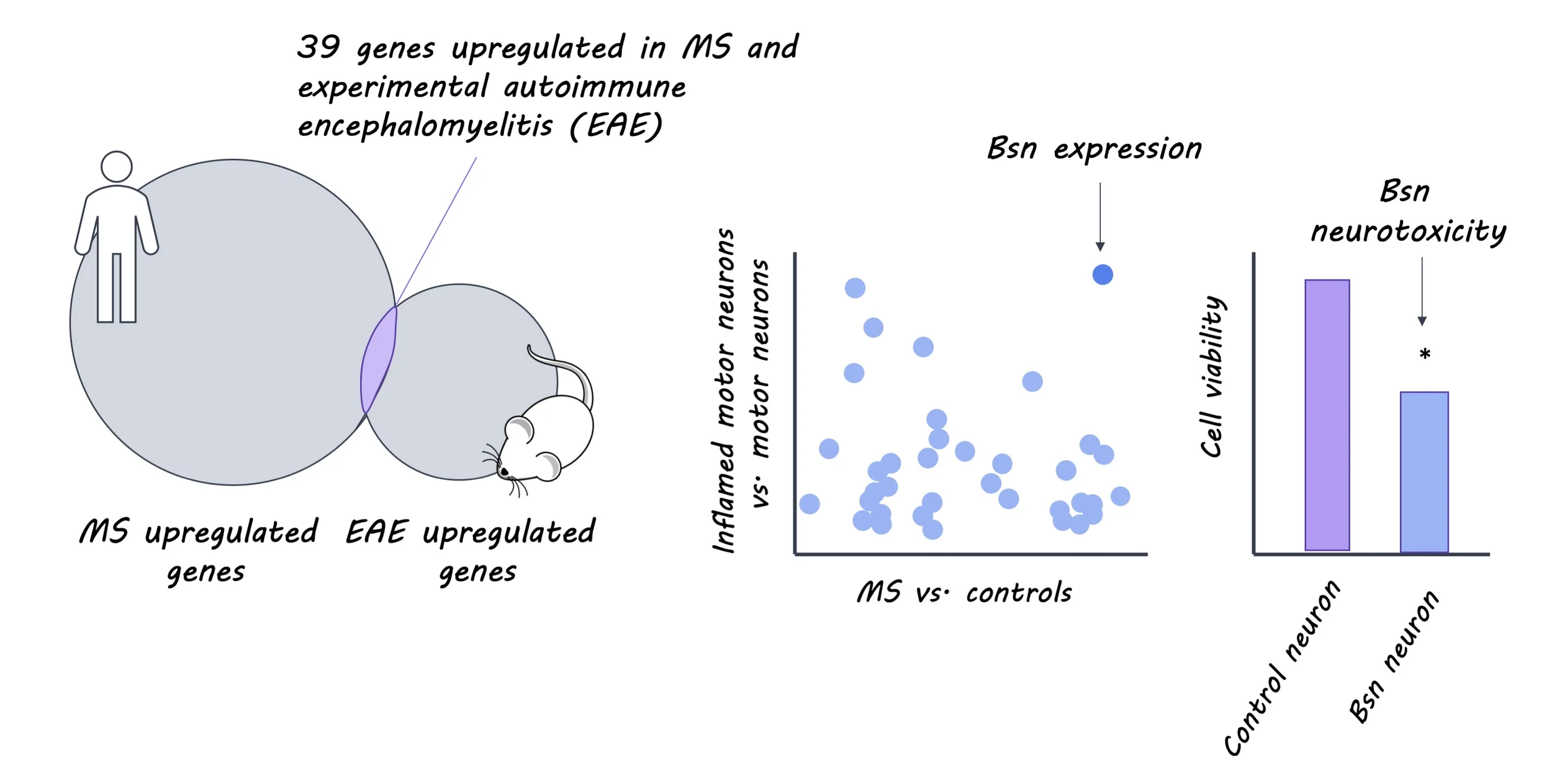
The authors first examined the genes expressed by neurons in inflamed spinal cord tissue. Mouse models of MS were created by inducing experimental autoimmune encephalomyelitis (EAE), which triggers inflammation and the demyelination of neurons, and results in partial or full paralysis. Translating ribosome affinity purification was used to isolate messenger RNA of different cell types in normal and inflamed cervical spinal tissue and gene set enrichment analysis was performed to determine whether certain genes were over- or under-expressed in those cell types. To identify which genes were up- and down-regulated in humans, they used a microarray dataset of MS patients to compare genes expressed in chronic MS plaques and in normal tissue. They then compared the overlap in genes expressed in both humans and mice using homology mapping, which is a method used to identify the genes shared by two different species. The Bassoon (Bsn) protein – a pre-synaptic scaffolding protein found in synaptic active zones – was highly expressed in inflamed motor neurons. The authors used immunohistochemistry to examine Bsn expression and localization in the mouse and human spinal cord. They further explored the cellular and behavioral effects of high and low Bsn expression and Bsn deletion (knockout) in mice and transgenic fruit flies. Cellular measures included energy metabolism, Bsn accumulation, and cellular survival and number. Behavioral measures included EAE symptomatic recovery in mice and climbing ability in flies. Finally, they investigated whether removing Bsn from neurons would rescue the adverse effects of inflammation and enhance neuronal survival by administering the ubiquitin carboxyl-terminal hydrolase 14 inhibitor (IU1), which allows proteins like Bsn to be degraded.

What did they find?

The authors identified 354 up-regulated and 448 down-regulated candidate genes in motor neurons found in inflamed mouse spinal cord tissue. The majority of the up-regulated genes were those involved in protein breakdown pathways, while the down-regulated genes were primarily those involved in energy metabolism, suggesting that the cellular energy metabolism process is impaired during inflammation. In humans, 11% of the up-regulated genes identified in chronic MS plaques overlapped with those observed in mice, including Bsn. There was a greater concentration of Bsn in spinal cord tissue obtained from EAE mice and MS patients than in wild-type mice and control participants. Interestingly, in these groups Bsn accumulated in the cell bodies of the inflamed motor neurons, even though it is typically located in the active zone of presynaptic neurons.

Increased Bsn expression in mouse cells was associated with Bsn accumulation in cell bodies, reduced energy metabolism, and reduced cellular survival. Similar to humans and mice, Bsn accumulation was observed in the neuronal cell bodies of transgenic flies, along with reduced climbing ability and increased mortality. On the other hand, mice with Bsn deletion (knockout mice) showed faster and better recovery from EAE symptoms compared to wild-type EAE mice. The knockout mice also had more axons and neurons in the spinal cord and fewer injured axons, but the same number of immune cells as wild-type mice. This suggests that the immune response to inflammation is not affected by knocking out the Bsn protein, and that Bsn likely plays a crucial role in determining neuronal fate. Consistent with this, administering IU1 facilitated Bsn degradation in neuronal cell bodies of mice and even restored pre-synaptic Bsn localization. Furthermore, mice that were administered IU1 had a larger number of axons and neurons, as well as a faster and better recovery trajectory than mice that were given a vehicle solution. These findings indicate that Bsn accumulation in the cell body might exacerbate the effects of inflammation by interfering with cellular energy metabolism and other intracellular processes.

Bsn_image_April30.jpg

What's the impact?

This study is the first to demonstrate that inflammation triggers Bassoon accumulation in neuronal cell bodies of both MS patients and model organisms. Importantly, both the cellular and symptomatic effects of inflammation can be partially reversed by promoting Bsn degradation. These findings have important implications for our understanding of the mechanisms underlying MS as well as potential targeted treatments for mitigating the symptoms of the disease.

Friese_quote_April30.jpg

Schattling et al. Bassoon proteinopathy drives neurodegeneration in multiple sclerosis. Nature Neuroscience (2019). Access the original scientific publication here.