
An Oscillator Model Predicts Activity in Auditory Cortex in Response to Music

Post by Amanda McFarlan

What's the science?

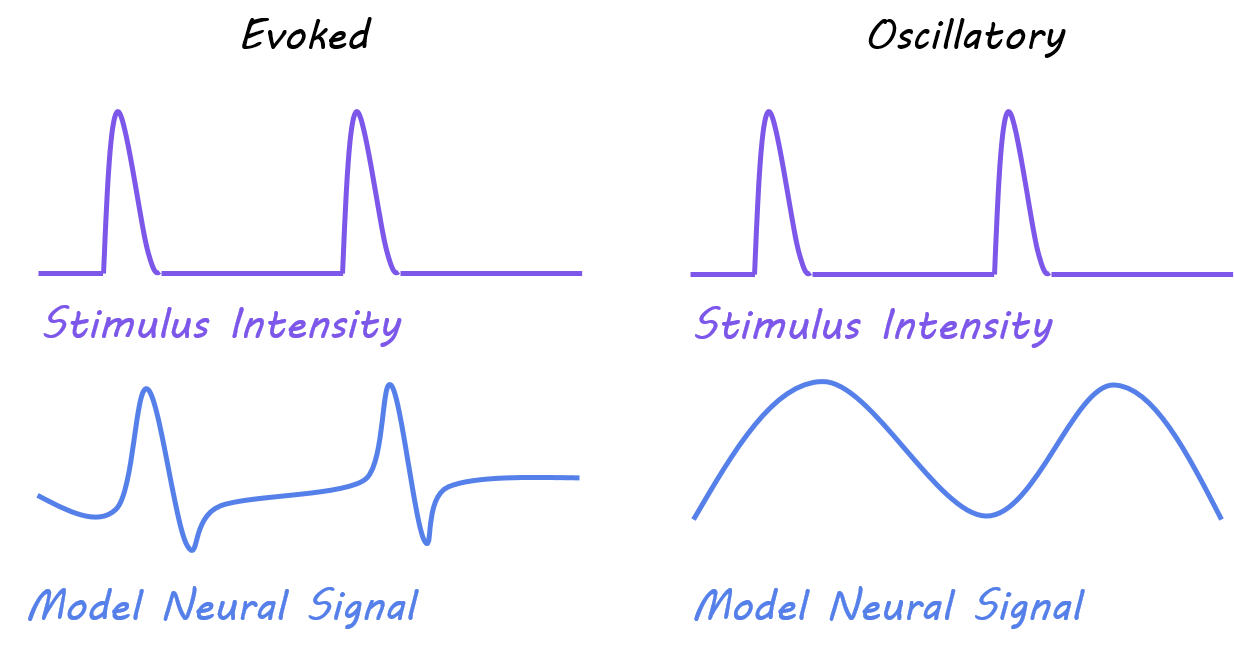
Research has shown that when presented with an auditory stimulus, neural activity in the auditory cortex tracks rhythmic patterns in the stimulus. There are two distinct hypotheses that explain this phenomenon: the oscillatory hypothesis and the evoked hypothesis. The oscillatory hypothesis suggests that the auditory cortex has an intrinsic neural oscillator that will synchronize to an acoustic stimulus, as long as the frequency of the stimulus is within a range close to the oscillator’s resting frequency. Conversely, the evoked hypothesis suggests that the auditory cortex responds to each individual acoustic stimulus and shows evidence of rhythmic firing because the inputs it receives (i.e. music, speech, etc.) are rhythmic themselves. This week in the PNAS, Doelling and colleagues used computational models to study these neural behaviors and to uncover whether human auditory processing follows the oscillatory hypothesis or evoked hypothesis.

How did they do it?

The authors created two distinct computational models, an evoked model and an oscillatory model, based on the evoked and oscillatory hypotheses that describe the mechanisms of auditory neural processing. The evoked model was convolution based, while the oscillatory model was based on the Wilson-Cowan model of excitatory and inhibitory neural populations. Musical stimuli of varying frequencies (0.5 to 8 notes per second) from piano pieces were used as inputs for both models. To compare the outputs from both models at the different frequencies, the authors developed a phase concentration metric that analyzed the phase lag between the stimulus input and the model output in both models across stimulus rates/frequencies. Next, the authors used their phase concentration metric to analyze data from a previous study in which 27 participants listened to musical stimuli (the same stimuli used in the computational models) while undergoing magnetoencephalography (MEG) recordings. They used confidence intervals and Gaussian fitting to compare the participants’ data with their computational models. In a subsequent experiment, the authors aimed to reduce the effect of evoked responses by altering the musical stimuli such that the musical notes were either smoothed in their onset (resulting in a reduced evoked response) or characterized by a sharp attack (evoked response present). They had 12 new participants undergo MEG recordings while listening to these altered musical stimuli, and compared data from the participants’ recordings with their computational models.

What did they find?

The authors found that in their evoked computational model, the phase lag between the musical note stimulus and the model output increased as the frequency of the musical note increased, suggesting the phase lag is frequency dependent. The oscillatory computational model, however, was better able to keep up with the change in musical note frequencies, and displayed a relatively consistent phase lag between the stimulus and model output. Next, they used their phase concentration metric to analyze MEG data that was collected while participants listened to musical stimuli (the same stimuli used for the computational models). They determined that the mean phase concentration metric from the analyzed MEG data was better matched to that of the oscillatory model compared to the evoked model, suggesting that there may be an oscillatory mechanism in the auditory cortex. The authors reasoned that, although the oscillatory model was found to be a better predictor of MEG activity compared to the evoked model, the well-documented evidence for evoked responses in the literature suggested that the auditory cortex may use a combination of both evoked and oscillatory mechanisms to process external stimuli. To investigate the role of evoked responses, they analyzed MEG recordings from participants who were presented with the ‘smoothed’ or ‘sharp attack’ musical stimuli. They found that, similar to the first experiment, the oscillatory model was better than the evoked model at predicting the MEG activity when participants were presented with a sharp attack stimulus. Notably, they determined that when the evoked response was not present (when the smoothed stimulus was presented), the oscillatory model was an even better predictor of the MEG activity compared to the evoked model. These data suggest that the relative weights of oscillatory vs. evoked responses are shifted based on various stimulus features, including sharpness of the stimulus note onset.
PNASpaper.png

What's the impact?

This is the first study to show strong evidence of an oscillatory mechanism for processing neural inputs in human auditory cortex using MEG recordings and computational modelling. These findings provide insight into the underlying mechanisms by which the human auditory cortex integrates information. The techniques used in this study may be useful for studying other sensory brain regions to further explore the role of oscillatory activity in the brain.  
Doelling_quote_April30.jpg

Doelling et al. An oscillator model better predicts cortical entrainment to music. PNAS (2019). Access the original scientific publication here.


Restoration of Brain Circulation and Cellular Function after Death

Post by Deborah Joye

What's the science?

Interruption of blood flow to the brain can result in lasting damage within seconds, and “brain death” can occur within minutes. Unless blood flow is restored quickly, a series of progressive and irreversible mechanisms are thought to ultimately led to cell death and decomposition of the brain. The growing consensus has been that brain decomposition happens within a singular, narrowly defined time period after blood flow to the brain has stopped. But death of brain cells may occur in a much more gradual way than previously thought. This week in Nature, Vrselja and colleagues use a newly-developed device to demonstrate that cellular function and circulation can be successfully restored to the mammalian brain up to four hours after death.

How did they do it?

The authors developed a device called BrainEx, which allows them to remove a brain 4 hours after death and flush it continuously (also called perfusion) for 6 hours with a blood-like fluid that promotes recovery from lack of oxygen, prevents excess liquid accumulation, and provides the brain with the energy it needs to function on a cellular level. The researchers tested this device on brains of 6-8-month-old pigs from USDA-regulated food processing facilities. The researchers developed four conditions to compare with the BrainEx and the blood-like fluid: 1) perfusion with a control fluid; 2) perfusion with the specially designed blood-like fluid; 3) no perfusion and kept at room temperature for a total of 10 hours (the total interval of all brains after death – 4 hours after death plus 6 hours of perfusion) and 4) processed 1 hour after death with no perfusion. The authors then quantified circulatory and cellular health of the brain by measuring flow dynamics throughout the brains, relative size of neural landmarks, and integrity and functional properties of different cell types throughout the brain, including excitatory, inhibitory, and glial cells. The authors also investigated whether brains could mount immune responses by injecting brains with lipopolysaccharide (an agent that induces an immune response) and measuring inflammatory responses. Finally, the authors measured energy metabolism and electrical activity to determine whether their device could restore metabolic and electrophysiological activity across the whole brain.

deb (1).png

What did they find?

Overall, the researchers found that perfusion with blood-like fluid through the BrainEx device can restore and maintain circulation and cellular life to brains that have been “dead” for four hours. Compared to control groups, the authors observed that brains perfused with the blood-like fluid showed decreases in cell death and preserved neuroanatomical and cellular integrity. Vasculature and glia were also responsive to an agent known to cause immune responses in the brain, indicating a restoration of cellular function. The authors also observed spontaneous synaptic activity and active metabolism. It should be noted that while cellular function was restored, it should not be interpreted that normal brain function was restored. Global electrical activity and integrated brain function associated with awareness, perception, and other higher-order function was not observed.

What's the impact?

This is the first study to demonstrate that degradation of the brain after death is a much larger grey area than previously thought. Instead of rapid degradation within a short time after death, this study reveals that the brain undergoes a prolonged period of degradation. Further, it demonstrates that BrainEx perfusion with blood-like fluid up to four hours after death can restore cellular and circulatory function. This technology presents the exciting possibility of investigating how the brain recovers from large insults like oxygen and blood-flow deprivation.

Vrselja et al., Restoration of brain circulation and cellular functions hours post-mortem, Nature (2019). Access the original scientific publication here.
Intrinsic Insular-Frontal Networks Predict Future Nicotine Dependence Severity

Post by Stephanie Williams

What's the science?

Some individuals are more susceptible to developing a dependence to nicotine than others. Identifying biomarkers that distinguish individuals at risk for developing addictions could inform treatment plans and preventative measures. This week in the Journal of Neuroscience, Hsu & Keeley and colleagues characterized a potential biomarker for risk of nicotine addiction.

How did they do it?

The authors administered nicotine to 10 rats for two weeks and used neuroimaging (functional magnetic resonance imaging; fMRI) to look for biomarkers that distinguished rats that became dependent on nicotine from rats that did not. To characterize dependence on nicotine, the authors looked for a cluster of common behaviors characteristic of nicotine withdrawal, including teeth chattering, gasping, body shakes, yawns, and escape attempts. They checked for the behavioral symptoms before administering nicotine, at one day and again at two weeks after stopping the administration of nicotine. Rats were observed for 50 minutes, and assigned a score depending on the number of behaviors they exhibited.

To assess whether brain activity could predict nicotine dependence and withdrawal, the authors analyzed the relationship between functional connectivity between different brain regions on day 1 (the “drug naïve” brain) and dependence behavioral scores. To measure functional connectivity the authors calculated correlations between the signal fluctuations in different brain regions while the rats were lightly anesthetized in the MRI scanner. Analysis resulted in a matrix defining the strength of the correlation between each brain region with every other brain region (“functional connectivity”). The authors then used a graph theory framework (modularity analysis) to define 5 brain modules (groups of brain regions that are similarly connected) as well as several sub-modules. After identifying modules in the brain, they assessed the strength of connections within modules and between modules, as well as the relationship between connectivity strength and drug dependence and reversal.

What did they find?

The authors found that functional connectivity between modules (inter-module connectivity) measured before rats were exposed to nicotine could predict the severity of nicotine dependence. Connectivity between a specific module, the insular-frontal module and the 4 other modules before nicotine exposure predicted dependence severity and abstinence-induced reversal. Specifically, stronger connections between the insular-frontal module and other modules was correlated with greater dependence severity. Weaker connections between the insular-frontal module and other modules was correlated with enhanced dependence reversal after abstinence from nicotine. Intra-module connectivity, in contrast, did not predict dependence severity.

stephanie_functional_connectivity.png

The authors further subdivided the insular-frontal module into three sub-modules and found that (1) the inter-module connectivity of all three submodules predicted dependence on nicotine and (2) the inter-module connectivity of two of the three submodules --the insula and frontal-motor submodules--predicted dependence reversal after two weeks of nicotine abstinence. These results suggest that intrinsic insular-frontal circuits could be used as biomarkers of nicotine dependence risk.

What's the impact?

This is the first study to identify patterns of connectivity that can predict future risk of nicotine dependence. The authors identified an insular-frontal cortical biomarker of nicotine dependence risk. The biomarker has the potential to identify individuals at risk for developing dependence, as well as individuals likely to recover after a period of abstinence.

Keeley_quote_April23.jpg

Hsu, L-M. Keeley, R.J., et al. Intrinsic Insular-Frontal Networks Predict Future Nicotine Dependence Severity. Journal of Neuroscience (2019). Access the original scientific publication here.