Different Profiles of Microglial Activation in Alzheimer's disease

What's the science?

Microglia, the immune cells of the brain, may contribute to Alzheimer’s disease by becoming activated in response to brain pathology (also known as neuroinflammation). Currently, whether neuroinflammation is associated with Alzheimer’s progression (harms the brain) or whether it may be protective (helps to “eat” plaques in the brain) is still a matter of debate. This week in BrainHamelin and colleagues used PET imaging to examine how microglial activation in the brain is related to Alzheimer’s disease progression.

How did they do it?

PET imaging was used to measure the uptake of a radiotracer (18F-DPA-714) in the brain binding to activated microglia. A large group of patients with Alzheimer’s disease were scanned twice for activated microglia, once at baseline and once two years later. They were then followed up annually and scanned with MRI to measure brain volume (measure of Alzheimer’s progression) and given annual cognitive tests to assess dementia severity and cognitive function. Based on this, patients were split into “fast and slow decliner” categories. The microglial activation levels over time were also analyzed compared to a control group of healthy participants.

What did they find?

Having a high level of microglial activation at baseline was predictive of being a slow decliner. In patients with a high baseline neuroinflammation, cognitive performance was better and brain volume was more preserved, suggesting that more microglial activation at baseline is protective. At two years follow-up, microglial activation was higher in Alzheimer’s participants but not controls as would be expected. Increased microglial activation over time was related to worsening cognitive scores and brain atrophy, suggesting that it is harmful. However, when they examined neuroinflammation over time at an individual level, they found that those with the highest baseline microglial activation had the lowest increase in microglial activation over time. They concluded that there is a dynamic relationship, whereby neuroinflammation may affect patients differently, depending on their original level of microglial activity. Microglial activation appears to be protective initially, but exacerbates Alzheimer’s disease over time; to a greater extent in those who had low levels of microglial activation to begin with.
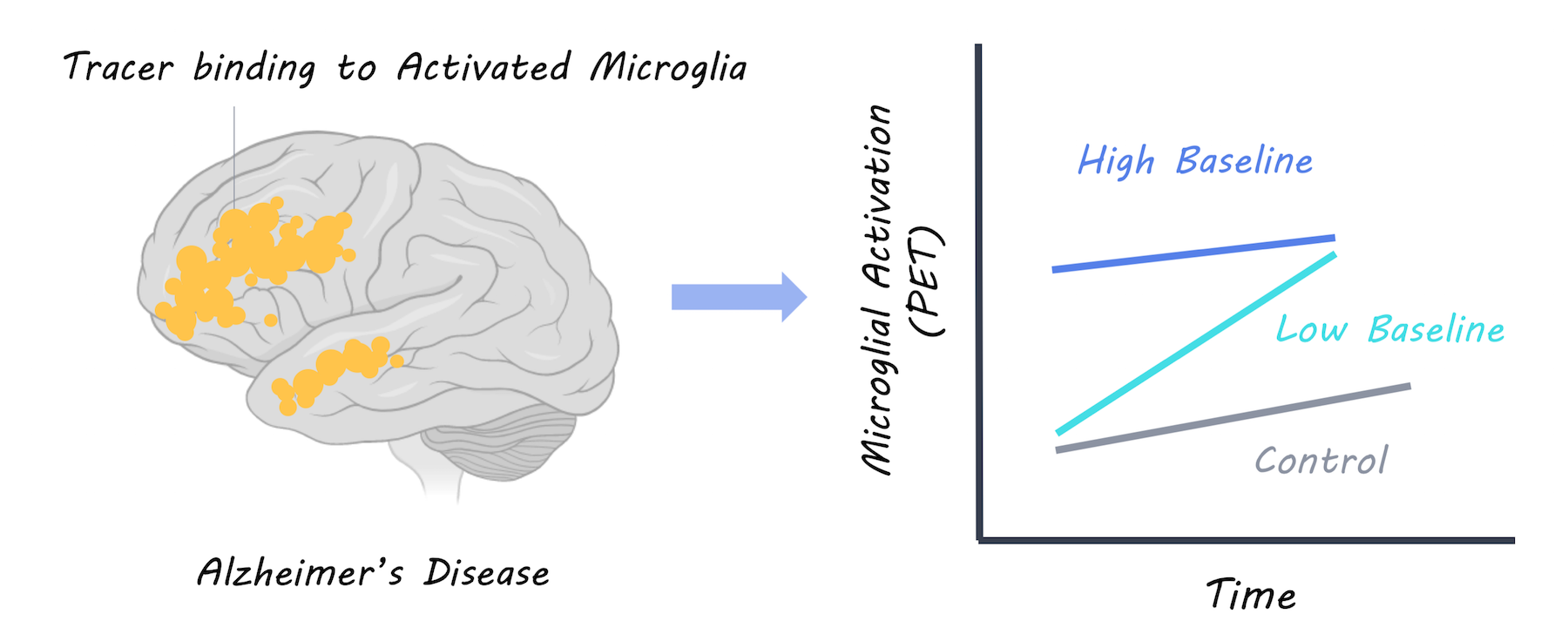
Microglial activation in Alzheimer’s disease

What's the impact?

This is the first study to show that neuroinflammation may affect individuals with Alzheimer’s disease differently depending on their baseline level of microglial activity. It shows us that microglial activation may be helpful or harmful depending on the individual and how far their disease has progressed. Understanding the role microglial activation play in Alzheimer’s disease is an essential part of understanding how the disease progresses.


L. Hamelin et al., Distinct dynamic profiles of microglial activation are associated with progression of Alzheimer's disease. Brain (2018). Access the original scientific publication here.

Functional Connections in the Brain are Stronger in Females Resilient to Depression

What's the science?

One third of females will be diagnosed with depression (major depressive disorder) during their adolescence. Resilience refers to the ability to adapt well in response to stress and bounce back from challenging life experiences. Currently, we don’t know the brain mechanisms that underlie resilience in adolescents who are at risk for depression. This week in JAMA Psychiatry, Fischer and colleagues test whether brain functional connectivity can be a biomarker for resilience in adolescent females at risk for depression (i.e. depression runs in their family).

How did they do it?

65 adolescent females were recruited: 25 low risk control participants who did not develop depression (control), 20 whose parents had a history of depression and developed depression themselves (i.e. converted) and 20 whose parents had a history of major depressive disorder but did not develop depression (i.e. resilient). The brains of all participants were scanned several times using  resting-state fMRI (which measures brain function at rest) over several years. They compared functional connectivity (synchronous brain activity) between resilient and converted females and between resilient and control females. They assessed the functional connectivity profiles of three brain regions known to be involved in depression: the amygdala (emotion), the anterior insula (attention/cognition) and the dorsolateral prefrontal cortex (planning). They measured the relationship between functional brain connections and life events.

What did they find?

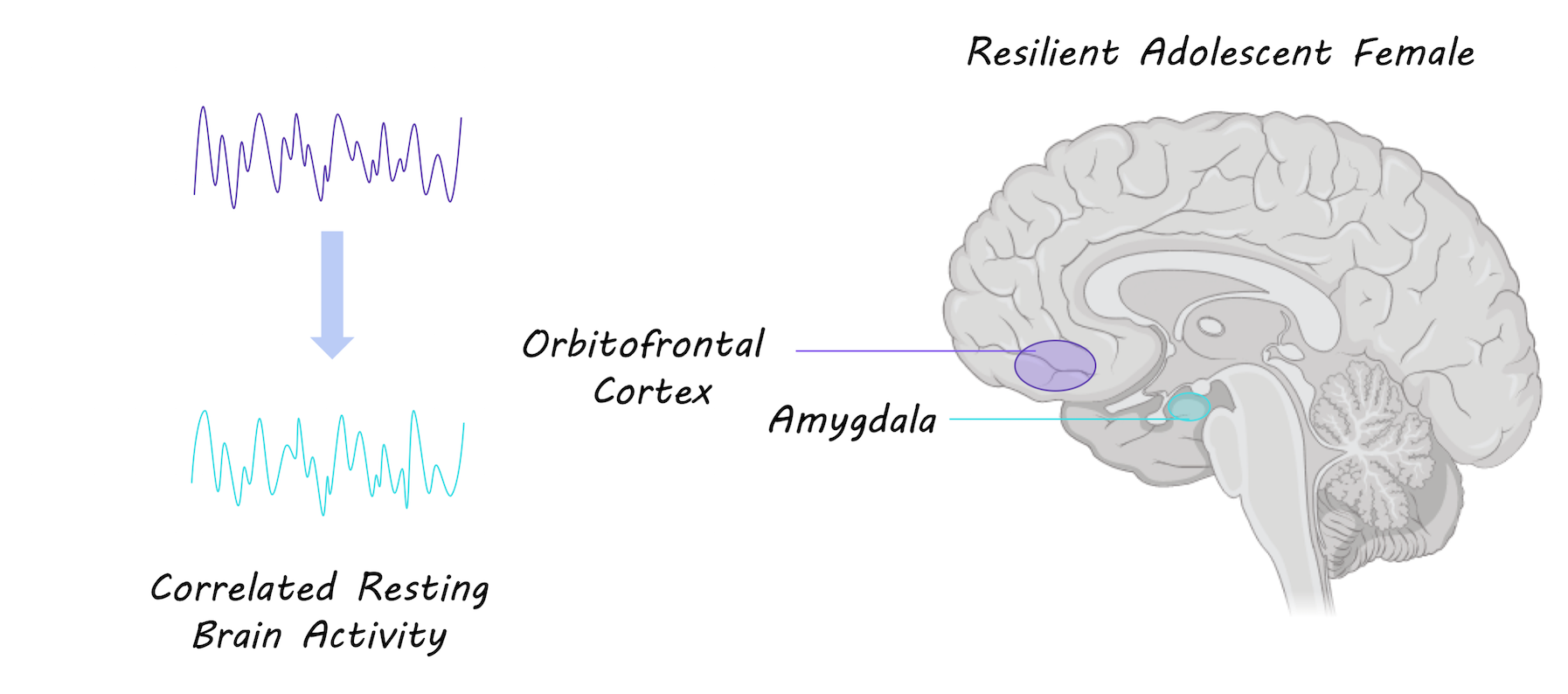
Females who were resilient to depression showed stronger functional connections in the brain between the amygdala (involved in fear and emotion) and the orbitofrontal cortex (involved in impulse control and modulating emotions). A stronger connection between these regions was associated with more positive life events. Resilient individuals also showed stronger connections between the dorsolateral prefrontal cortex (involved in planning and executive function) and the frontotemporal cortex (involved in cognitive control). Both resilient and converted groups had stronger functional connectivity within the salience network (a network of regions involved in attention and cognition) compared to the control group

Functional brain connectivity between orbitofrontal cortex and amygdala

What's the impact?

This is the first study to show that functional connections in the brain can be markers for resilience to depression in adolescent females at high risk for depression. Stronger functional connections could represent adaptation in the brain in response to positive life experience. It is crucial to understand how adolescents can develop resilience to depression in order to better prevent and treat depression.

inkquote4.png

A. Fischer et al., Neural Markers of Resilience in Adolescent Females at Familial Risk for Major Depressive Disorder. JAMA Psychiatry (2018). Access the original scientific publication here.

A Wearable Magnetoencephalography Scanner

What's the science?

Magnetoencephalography (MEG) uses superconducting sensors that are very sensitive in order to pick up miniscule magnetic fields generated by the brain. However, neural signals can easily be distorted by other signals in the environment (e.g. from electronics or muscle activity). The MEG system is also large and stationary, and sensors may be far from the brain depending on head size, which weakens the signals. This week in Nature, Boto and colleagues describe a new wearable MEG system that mitigates issues of weak signal and high noise. The authors aimed to move towards real world applications for MEG by building a system for which subjects are able to move around freely.

How did they do it?

The new MEG system works via ‘optically pumped magnetometers’; sensors containing rubidium vapour in a glass cell, and a laser beam which shines through the cell. With no magnetic field, lasers polarize rubidium atoms in a single direction, and light from the laser beam through the glass cell is maximized (detected by a photodiode (light sensor)). However, when a magnetic field perpendicular to the laser beam is present (e.g. during neuronal activity), light transmission drops, because rubidium atoms are no longer aligned with the laser beam. Sensors were attached to a 3D printed helmet, custom-fitted to the subject. To test whether signal quality was adequate with the new wearable MEG, data were recorded while the test subject moved their finger and 1) stayed still in the new system, 2) moved their body in the new system, and 3) stayed still in a traditional MEG system. The subject also played ping pong in the new system. To block magnetic interference in the environment, the system was placed in a magnetically shielded room. To reduce the effect of the earth’s magnetic field, large custom coils were placed on the walls in the room; this was key to enabling the subject to move around.   

Wearable Magnetoencephalography Scanner Design

What did they find?

When the subject moved their finger, typically found changes in activity were detected in a region of the motor cortex corresponding to the hand. The signal strength (signal-to-noise ratio) and localization of the brain activity was not different whether the subject was in the traditional MEG system, staying relatively still in the new system, or moving around (shaking and nodding head and drinking; approximately 10 cm head movement) in the new system. Turning on the custom coils they placed in the room to counteract the earth’s magnetic field reduced the earth’s magnetic field 15 fold. Finally, they were able to localize beta frequency activity to the arm and wrist areas of the motor cortex while the participant engaged in a ping pong game that required unexpected, natural head movements.

What's the impact?

This is the first wearable neuroimaging system to be developed, demonstrating that it is possible to conduct a MEG study while a subject is moving around. It is now possible to map the whole brain non-invasively at a high temporal and spatial resolution in natural experimental settings. For example, it is possible to study people while they move around or perform a spatial navigation task, or to study people with movement or neurodevelopmental disorders — clinical populations for whom staying still while being imaged is difficult.

inkquote3.png

E. Boto et al., Moving magnetoencephalography towards real-world applications with a wearable system. Nature (2018). Access the original scientific publication here.