
Plasticity in Neural Genomes During Early Life Experiences

What's the science?

The brain undergoes changes (i.e. plasticity) during early development, and these are thought to be due to gene-environment interactions. Retrotransposons are segments of DNA that are mobile and can essentially “jump” and insert themselves throughout the genome, and could be one way that DNA is modified by interactions with the environment. Currently, we don’t know whether retrotransposons play a role in changing DNA during early life. This week in Science, Bedrosian and colleagues observe the effects of early maternal care on retrotransposon levels in mouse DNA.

How did they do it?

Mice were divided into two groups: high and low maternal care (as evidenced by median natural levels of grooming and nursing over 2 weeks). They used droplet digital Polymerase Chain Reaction (ddPCR) to quantify the number of retrotransposons (‘L1’ retrotransposons, making up 17% of the mouse genome) in mice DNA from brain (hippocampus and frontal cortex) and heart tissue between the high and low care groups. They also manipulated the level of maternal care to test how this affected the number of retrotransposons over time.

What did they find?

There were more retrotransposons in the hippocampus in mice with low maternal care (but not in the heart or frontal cortex). When they manipulated the levels of maternal care by separating the mother and pup, retrotransposon levels also varied. They then tested what causes retrotransposon levels to change. They measured neurogenesis (the formation of new neurons) by staining hippocampal neurons, and found no differences (i.e. neurogenesis was not responsible for changes in retrotransposon levels). They also used bisulfite sequencing to measure the level of methylation of DNA (a DNA modification that affects gene expression). The retrotransposon regions in hippocampal DNA showed less methylation in mice with low maternal care (who have higher retrotransposon levels), suggesting that methylation is responsible for changes in retrotransposon levels with maternal care.

DNA structure associated with maternal care in mice

What's the impact?

This is the first study to show that maternal care alters retrotransposon (i.e. jumping gene) activity in early life. Before, we did not understand exactly how early life experience can change the structure of DNA. Now we know that retrotransposons are one of the ways that DNA plasticity (i.e. changes) occurs in response to early life experiences.

inkquote1.png

T. Bedrosian et al., Early life experience drives structural variation of neural genomes in mice. Science (2018). Access the original scientific publication here.

Gene Expression is Rhythmic in Brain and Other Tissues in the Body

What's the science?

Gene expression is critical for regulating every process in the human body, but how does gene expression change in real-time throughout the day? Previous studies of gene expression throughout the day have been in mice, who are nocturnal animals. Currently, we don’t understand how gene expression fluctuates in animals who are awake during the day, like humans. This week in ScienceMure and colleagues examine gene expression over 24 hours in baboons who share a similar sleep-wake cycle to humans.

How did they do it?

Gene expression was measured using RNA-sequencing, a technique for counting the number of transcripts (copy of DNA carrying information for protein production) produced by genes. The authors measured gene expression in the baboon every two hours in 64 different tissues over a 24-hour period. This 24-hour period contained 12 hours of light and 12 hours of dark and a fixed eating schedule. Sleep and behavior were monitored. Tissues examined for gene expression were several important brain regions and organs.

What did they find?

All tissues showed some level of rhythmic gene expression (i.e. transcripts that were produced cyclically throughout the day). The number of rhythmic transcripts varied a lot between tissues (for example 200 in the pineal gland to > 3000 in the prefrontal cortex) and there was little overlap between these rhythmic transcripts in different tissues. More than 10,000 transcripts detected were common to all tissues (i.e. “ubiquitously expressed genes”). These genes were involved in core processes such as protein regulation and DNA repair and the majority of rhythmic transcripts found across all tissues were from this set of genes. Gene expression was organized into bursts of expression that occurred in the early morning and again in the late afternoon, while expression was reduced in the evening before sleep when food intake was low.

Gene expression cycles throughout the day

What's the impact?

Understanding gene expression patterns is important for understanding human behavior. This is the first study to show that gene expression is rhythmic and cycles throughout the day in a species that shows a similar gene expression profile to humans. Understanding which genes are rhythmic will be important when targeting these genes for therapy in various diseases.

purplequote_afterink.png


L. Mure et al., Diurnal transcriptome atlas of a primate across major neural and peripheral tissues. Science (2018). Access the original scientific publication here.
No Change in Aggression After Adults Play Violent Video Games

What's the science?

Whether or not playing violent video games increases aggression and other negative behaviors is a topic of continued debate. Previous studies showing increases in aggression, tested behavior immediately after playing video games, so the effects could be due to ‘priming’ (i.e. aggressive thoughts are more accessible for a short period of time). This week in Molecular Psychiatry, Kühn and colleagues tested behavior after video games were played for a longer period of time.

How did they do it?

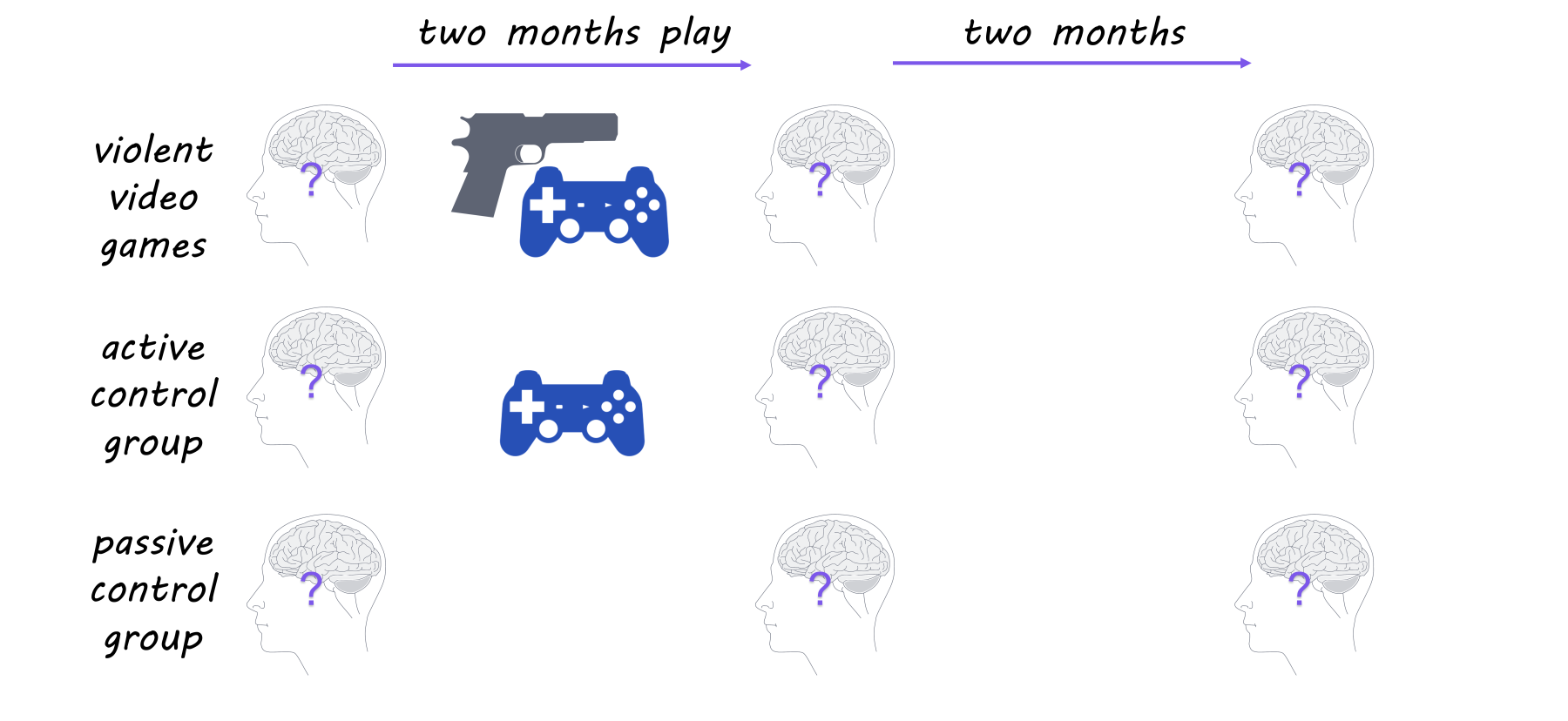
They recruited 90 healthy adults. Participants were randomly assigned to be in a passive control group (did not play video games), to play a violent video game (Grand Theft Auto V), or to play a non-violent video game (Sims 3) as part of an active control group. Each group completed 208 assessments (including the Boss-Perry Aggression Questionnaire) on aggression, worldview, hostility, frustration, mood, impulsivity, pro-social behaviour, and other measures, before playing, after 2 months of playing (30 min/day minimum), and 2 months after they finished playing. The authors statistically analysed the findings using two types of statistics (Bayesian and Frequentist).  

Study design: Effect of violent video games

What did they find?

They assessed whether the pre-play scores and the post-play scores were different across groups (an interaction effect), and found no negative effects in the group that played violent video games. Specifically, only 3/208 statistical tests found negative (interaction) effects in the group that played violent video games post-play, but 10/208 tests would be expected to be statistically significant simply by chance, therefore, they concluded there were no negative effects.

What's the impact?

This is the most robust study to comprehensively assess the longitudinal effects of violent video games after long-term (two months) play. This study suggests that there is no evidence for long-term changes in behavior or aggression following violent video game play in adults, however, further research in children is needed.

S Kühn et al., Does playing violent video games cause aggression? A longitudinal intervention study. Molecular Psychiatry (2018). Access the original scientific publication here.